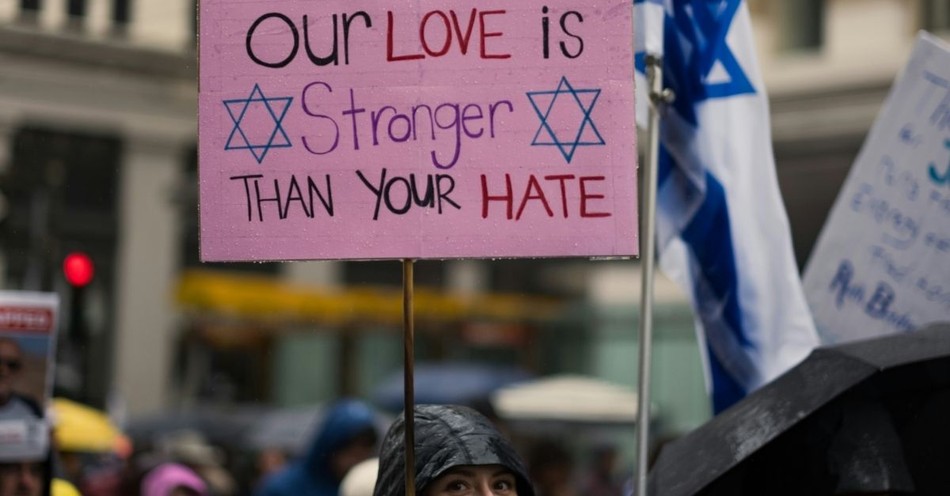
Had I stepped into that synagogue in January, hours after a masked teenager drenched the sanctuary in gasoline and sparked a blaze over its "Jewish ties," my heart would have shattered. Smoke still suffocated the altar, forcing the building into immediate lockdown. Silence paralyzed the worshippers as they stood outside the police tape. Ancient Torah scrolls, borne through generations of exile and persecution, collapsed into ash. The flames did not merely ravage property; they gutted identity, incinerated memory, and exiled a community from its sacred home. And it has not stopped.
On March 12, 2026, a terrorist rammed his truck into Michigan’s Temple Israel, igniting a fierce blaze. Months earlier, in Boulder, an attacker weaponized Molotov cocktails against a Jewish solidarity walk, killing one and wounding over a dozen. In May 2025, a gunman ambushed and slaughtered two Israeli embassy employees in Washington. This month, a drunken tirade ambushed Representative Mike Lawler at a D.C. restaurant, unleashing vile antisemitic tropes under the false assumption that he was Jewish. These are not isolated eruptions. They are warning flares—revealing how swiftly hatred moves from slogans to firebombs, from rhetoric to shattered lives.
Antisemitism is no longer lurking in history books. The Anti-Defamation League 2024 audit cites that antisemitism attacks have risen to more than twenty-five incidents every day. It is marching openly through streets, campuses, and neighborhoods once thought immune to such darkness. And Christians cannot look away. Christians must confront antisemitism because hatred toward Jewish people attacks human dignity, distorts biblical truth, and ignores the Jewish roots of the Christian faith. Scripture declares that the Jewish people are not strangers to the story of redemption but are deeply woven into it. Jesus Himself was born a Jew. The apostles were Jewish. The roots of the Christian faith draw life from the promises God gave to Israel. Rising antisemitism is not merely a cultural issue—it is a moral and spiritual one that summons believers to respond with courage, truth, and Christlike love. The question is no longer whether antisemitism exists. The question is whether Christians will plant their feet clearly against hatred while reflecting the compassion and virtuous clarity of Christ in a progressively hostile age.
Why Antisemitism Has Such a Long and Dangerous History
Antisemitism did not begin in modern politics. It cuts across history—from Pharaoh's oppression in Egypt to present-day hostility on university campuses and city streets. From the beginning, God chose Abraham and his descendants as His covenant plan for the world: "The Lord your God has chosen you… to be His treasured possession" (Deut. 7:6). Through Abraham came the Hebrew people, the prophets, the Scriptures, and ultimately Jesus Christ Himself—the promised Messiah from the tribe of Judah. Scripture lays bare Israel's failures amidst God's faithfulness. The prophets repeatedly confronted Israel over rebellion, idolatry, and broken covenant. Isaiah cried out, "Woe to the sinful nation…" (Isaiah 1:4). Jeremiah thundered judgment. Ezekiel summoned the people to repentance. God disciplined Israel through exile exactly as He had warned in Deuteronomy 28. But discipline never meant abandonment.
The Old Testament also chronicles repeated attempts to destroy the Jewish people altogether. In the book of Esther, Haman engineered genocide against the Jews throughout the Persian Empire. God rescued His people through Queen Esther and Mordecai, sealing again the truth that His covenant purposes would not fail. Hatred pursued the Jewish people into the New Testament era. Although the gospel broke beyond Jewish borders after Pentecost, Jewish communities still weathered hostility and persecution. Throughout the Middle Ages, Jews were stripped of property rights, barred from professions, and branded as outsiders. The Crusades unleashed horrific, violent atrocities by vilifying Jews as enemies of Christ. This extremism culminated in the Rhineland Massacres of 1096, where radicalized mobs ravaged entire Jewish communities. Attackers torched homes and synagogues, dragged families into the streets, and extorted, tortured, or executed thousands who refused baptism.
Most tragic was the institutional church's impotence to arrest the slaughter. While sporadic clergy courageously sheltered Jewish families and denounced the atrocities, many others largely acquiesced through silence. Some leaders cowered before radicalized mobs. For others, generations of theological anti-Semitism have already poisoned societal minds, effectively stifling any Christian empathy for Jewish suffering. The contrast with Jesus could not be sharper. The same Savior who commanded, "Love your neighbor as yourself," was being invoked by men carrying swords while they slaughtered innocent people made in the image of God. The church, called to be a light to the nations, too often stood dim and compromised—failing to defend the persecuted when courage was required most. This painful history matters. Antisemitism does not erupt overnight. It grows where lies go unchallenged, where prejudice is tolerated, where people remain silent because the cost of speaking feels too high. History warns us what can happen when hatred is baptized in religious language and moral conviction is replaced by tribal rage.
Christians today should not respond to these failures with defensiveness, but with humility and honesty. The Church must never repeat the sin of standing quietly while Jewish people are threatened or attacked. Genuine Christianity does not fuel hatred toward Jews. The gospel is from the Jews, and the message of Christ calls believers to defend human dignity, not destroy it.
What Does the Bible Say about Israel and the Church?
While cultural voices recast Israel as merely symbolic and redefine covenant to fit the spirit of the age, the Church must choose its authority. Scripture answers plainly: "Has God rejected His people? By no means!" (Romans 11:1). From the beginning, God's covenant with Israel was never meant to end with one nation, but to bless all nations through it. The prophets anticipated this expansion: "I will also make you a light for the Gentiles, that my salvation may reach to the ends of the earth" (Isaiah 49:6). Gentile inclusion was never intended to erase Israel—only to widen the reach of God's kingdom. Gentile believers are "grafted in" by grace through faith (Romans 11:17–18). They are joined to the covenant promises, not substituted for Israel. Paul speaks directly to Gentile believers: "Do not be arrogant toward the branches." That warning echoes across every generation, including our own.
A growing movement today claims that the Church has replaced Israel—that covenant promises once given to the Jewish people now belong exclusively to the Church. This view, known as replacement theology, stands in direct tension with Romans 9–11. Israel's unbelief is acknowledged in Scripture, but her future is not erased. The Church stands by grace, not by displacement.
How Modern Antisemitism Repeats Ancient Hatred
Modern antisemitism mutated from primarily religious hostility into racial and political ideology. Under Adolf Hitler and Nazi Germany, Jews were branded an inferior race. Six million Jews had their homes, livelihoods, dignity, and lives ripped away in one of history's darkest demonstrations of unchecked evil. Families were torn apart. Millions were starved, tortured, gassed, and exterminated in concentration camps while much of the world watched in silence. The Holocaust exposed how quickly hatred becomes normalized when truth collapses, and propaganda devours morality. Yet even after the horrors of World War II, hatred refused to die.
Why Israel’s Modern History Matters for Christians
Understanding the modern conflict demands a reckoning with history—not slogans. Jerusalem has been the capital of only one nation: Israel. King David planted Jerusalem as Israel's capital around 1000 BC—more than 1,500 years before the birth of Muhammad. The words Jerusalem and Zion appear nearly 1,000 times in the Hebrew Bible and the New Testament. Jerusalem is never mentioned in the Quran.
Following World War I, the Ottoman Empire collapsed, and Great Britain governed the region under the British Mandate. In November 1947, the United Nations proposed a partition plan creating two states west of the Jordan River—one Jewish and one Arab. The Jewish leadership accepted the proposal. Arab leaders rejected it. In May 1948, the modern State of Israel was officially declared. The following day, five Arab nations declared war against the newborn Jewish state. Instead, Israel held. When the ceasefire ended, Israel retained the territory assigned under the UN plan. Jordan held the West Bank. Egypt held Gaza. Years later, the Palestine Liberation Organization was formed while Jordan still controlled the West Bank—its stated purpose not to liberate territory from Jordan or Egypt, but from Israel itself. This history rarely surfaces in modern discussions.
October 7, 2023, marked a turning point. Hamas launched a coordinated terrorist assault on Israeli communities—murdering over 1,200 people, taking hostages, and committing atrocities documented by witnesses worldwide. The subsequent war in Gaza inflamed tensions and triggered a surge in antisemitic incidents unlike anything seen in decades. When Hamas fires thousands of rockets into Israeli cities, deliberately targeting civilians, international attention consistently focuses on Israel's defensive response rather than the initiating violence. Violence against Jewish civilians is routinely rationalized as "resistance," while Jewish self-defense is treated as morally suspect.
Israel is only about 8,000 square miles—roughly the size of New Jersey—while surrounding nations, including Egypt, Jordan, Syria, Iraq, and Iran, are roughly 150 times the physical size of Israel. Yet international pressure continues to demand that Israel cede land. Today, antisemitism erupts openly on college campuses and in public demonstrations. Many students have been molded by selective history, ideological activism, and social media propaganda rather than careful historical understanding. Criticizing government policies is legitimate in any democracy. Directing hatred toward Jewish people as an ethnicity or faith is something entirely different—and Christians must refuse to be swept into it.
Why Christians Should See Antisemitism as a Spiritual Battle
Scripture insists that history carries more than human politics. A spiritual battle is unfolding behind the scenes of earthly events. The book of Daniel pulls back the curtain on this unseen conflict, exposing spiritual powers operating behind earthly kingdoms: "The prince of the kingdom of Persia withstood me twenty-one days, but Michael… came to help me" (Daniel 10:13). Later: "The prince of Persia… the prince of Greece will come" (Daniel 10:20).
Earthly kingdoms in Daniel appear as beasts empowered in rebellion against God. This mirrors Revelation, where the final rebellion includes what many describe as an "unholy trinity":
- The dragon — Satan
- The beast — corrupt world power
- The false prophet — deceptive religious influence
These counterfeit powers wage war against God the Father, Jesus Christ the Son, and the Holy Spirit—but their defeat is sealed. Paul anchors believers:
"For we wrestle not against flesh and blood, but against principalities, against powers…" - Ephesians 6:12
The conflict surrounding Israel is not merely a geopolitical issue. It is spiritual. Scripture warns that nations will rage against Jerusalem in the last days (Zechariah 12–14; Ezekiel 38–39; Matthew 24). Revelation 16:16 describes a final global conflict erupting at Armageddon—a real place in Israel where armies have gathered throughout history. Yet Scripture never abandons believers to fear. Christ has already sealed the victory:
"The kingdom of the world has become the kingdom of our Lord and of His Christ." - Revelation 11:15
How Should Christians Respond to Rising Antisemitism?
1. Become Strategic, Regular Students of Scripture
Christians cannot dismantle deception without knowing God's Word. Barna finds that even as Bible reading increases, fewer Americans strongly affirm its authority—and propaganda rushes into that gap. Know the covenant. Know the prophets. Know Israel's history. Believers who do not cannot be easily swept into hatred.
2. Guard Against Propaganda and Misinformation
Not every loud voice speaks truth. Much modern media and academic rhetoric runs on ideology rather than historical honesty. Pursue reliable historical sources, weigh claims carefully, and filter cultural narratives through a biblical worldview rather than emotional outrage.
3. Speak Against Falsehood with Wisdom and Grace
Christians must not stand silent while false history and antisemitic rhetoric spread unchecked. We are called to speak truth—with gentleness, humility, and integrity. "Always be prepared to give an answer… with gentleness and respect" (1 Peter 3:15).
4. Pray for Jerusalem and the Jewish People
"Pray for the peace of Jerusalem" (Psalm 122:6). Pray not only for Israel's safety, but for Jewish people to encounter Jesus as Messiah. Christians can stand with the Jewish people without endorsing every political decision of the Israeli government. Our support is anchored in God's covenant faithfulness and His love for all people.
5. Learn to Distinguish Disagreement from Hatred
There is a difference between criticizing a government and hating a people. A person may disagree with Israel’s policies or military decisions without being antisemitic. But when Jewish people everywhere are blamed, harassed, threatened, or attacked simply for being Jewish, the line has been crossed. When synagogues are burned, Jewish students are intimidated, and crowds chant for the death of Jews, the issue is no longer politics—it is hatred. Christians must have the courage and clarity to call it what it is: antisemitism.
6. Take Concrete Action
Scripture promises that Christ will triumph over evil, death, Satan, and every rebellious kingdom. That confidence should move us. Push back when a family member forwards antisemitic content. Write to a university president. Support organizations like the International Fellowship of Christians and Jews. Give towards your church’s mission efforts to Israel. If you travel, visit Israel. Affirm the covenantal understanding of their place in history and God’s redemption plan. Christian courage is not passive sympathy; it is truth spoken with humility, love shown at personal cost, and faithfulness when silence would be easier. The story of history does not end in chaos—but in the return of the King.
Christians Cannot Stay Silent about Antisemitism
Antisemitism is not simply another cultural trend. It is an ancient hatred that claws its way back generation after generation. Christians cannot afford to ignore it, excuse it, or stand silent in the face of it. Believers are called to respond differently than the world, anchored in Scripture, in compassion, and in confidence in God's sovereign plan. In an age of confusion, propaganda, and spiritual darkness, the Church must rise as both a witness to truth and a light of love. Because the same God who made promises to Abraham is still faithful, and His kingdom will ultimately prevail.
Frequently Asked Questions about Christians and Antisemitism
- Why should Christians care about antisemitism?
Christians should care because Jewish people are made in the image of God, Jesus was Jewish, the apostles were Jewish, and the Christian faith is deeply rooted in God’s promises to Israel. - What is antisemitism?
Antisemitism is hostility, prejudice, hatred, or discrimination directed against Jewish people because they are Jewish. - Is criticizing Israel the same as antisemitism?
No. Criticizing a government policy is not automatically antisemitic. But blaming, threatening, harassing, or attacking Jewish people as a group crosses into hatred. - What does the Bible say about Israel and the Church?
Romans 11 teaches that Gentile believers are grafted in by grace and warns them not to become arrogant toward Israel. - How can Christians respond to rising antisemitism?
Christians can study Scripture, reject propaganda, speak truth with gentleness, pray for Jerusalem, defend Jewish neighbors, and take concrete action when hatred appears.
For Further Reading
- When Antisemitism Targets the Church
- Dangerous Trends in Jewish–Christian Relations
- The Biblical Foundation for Christian Support for Israel and the Jewish People
- What Does Romans 11 Mean by Gentiles Grafted In?
- 6 Ways to Pray for Peace in Jerusalem
Photo Credit: ©Unsplash/Levi Meir Clancy