
OCD UK states that Obsessive-Compulsive Disorder is “the sixth largest contributor to non-fatal health loss globally.” Why is it non-fatal? Well, there are no formal, scientific publications to produce evidence of OCD-based deaths to say otherwise.
However, just because it isn’t on paper doesn’t mean it’s not real. I know of someone who committed suicide after being unable to work though/live with this mental condition. The intrusive, debilitating thoughts that looped through her mind, over and over, stealing her ability to function, were simply too much. If you are experiencing suicidal thoughts or feel unsafe, reach out for immediate help. In the U.S., call or text 988 to connect with the Suicide & Crisis Lifeline.
What OCD Really Feels Like
This is my story. I was diagnosed with OCD in 2019 and have since been an advocate for others with the same mental condition. I’m well aware of the depressive thoughts and debilitating weight OCD places on the heart and mind.
Truth be told, I was unable to keep a full-time job in my early twenties because of OCD. I’ve been in a car wreck because of a compulsive thought that I “needed” to give in to. I’ve been in therapy for years. If that isn’t enough, I’ve been labeled “depressed,” “anxious,” and suffering from a mental disorder that “has no cure.”
Meanwhile, dishearteningly enough, in today’s society, even as mental health awareness is on the rise, people still casually throw around the (false) idea that they are “so OCD.” Whether they are trying to explain their need for order or desire to keep things clean, it’s a misconstrued, damaging idea.
As a result, those who truly struggle with the disorder can easily assume they don’t have OCD since their struggles are so much deeper than the casual symptoms of desiring to color-coordinate one’s clothes. They don’t get the proper treatment and are only debilitated even further. OCD is not a preference for order or cleanliness; it is a serious mental health disorder marked by intrusive thoughts, compulsive responses, distress, and daily-life impairment.
Why OCD Stereotypes Are Finally Being Challenged
Noah Kahan, an American singer-songwriter, has recently spoken about his fight against OCD, which has many people discussing the true nature of the disorder. Kahan told Rolling Stones, “I was under the influence of the idea that OCD was like, ‘I need to wash my hands a hundred times.’ But I didn’t realize how much more there was to it. I started putting all these pieces together from my childhood, and these different rituals I’ve had my whole life. It wasn’t just anxiety or being stressed. It was this real insidious disorder that I was struggling with.”
He even opened up about his intrusive thoughts: “I was convinced something was happening that was not happening, or that I had said something that I just didn’t say… I could convince myself that I ran somebody over, knowing for a fact that I didn’t see another person on the road.”
Thus, it only makes sense that we discuss how vital it is to dismantle OCD’s most common stereotypes so its true victims can find help and, most desirable, freedom:
Photo Credit: Unsplash/Alexandra Gorn


1. Myth 1: There Is Only One Type of OCD
OCD is as complex as the intrusive thoughts it causes. This means there is more than one type of OCD, and each type has many subtypes.
What Is Symmetry OCD?
While many people, those who often loosely use the “so OCD” self-descriptor, think the only type of OCD is the one based on the need for organization and order, that’s only one type: Symmetry OCD. And it’s far more than a need for organization and order. It requires compulsive responses that can make it hard for one to function, let alone enjoy living. The other primary types include Harm OCD, Religious Thoughts/Taboo Rituals OCD, and Contamination OCD.
What Is Contamination OCD?
Some have heard of Contamination OCD, a debilitating fear of germs, laden with contact-tracing, obsessive hand washing, and a general fear of being around others. But few have heard of or understand Harm OCD and Religious Thoughts/Taboo Rituals OCD.
What Is Harm OCD?
Harm OCD is a fear of hurting someone else, no matter the method. It might look like fearing that you’ve caused a car wreck and need to turn around to ensure no one was injured (hence my wreck), or sexually harming someone (which makes those with the disorder afraid of things like changing their own child’s diaper).
What Is Religious Thoughts/Taboo Rituals OCD?
Religious Thoughts/Taboo Rituals OCD includes intrusive thoughts often associated with the fear that you have blasphemed God. It’s panicking when someone discusses eschatological concepts or evil. People with this type of OCD are often unable to watch horror films or even discuss the idea of Halloween. The images these conversations provoke, paired with terrifying thoughts, leave them afraid of constant damnation.
Photo Credit: ©Pexels/Juan Pablo Serrano Arenas

2. Myth 2: OCD Is Something People Can Control
You don’t have possession of OCD. OCD has possession of you. That’s what makes it miserable. That’s why people seek therapy. That’s why some people, sadly, commit suicide.
When my mind pictures OCD in a physical body, it’s always a looming monster. It’s always hanging over me, always in control. I certainly lay no claim to the monster. I never have and never will long to have possession of any such creature. I simply want to be free from it in the name of Jesus.
Consider this: OCD wouldn’t be a disorder, certainly not a casual, boastful adjective that so many people misuse, if those with the disorder truly had control over it. We would choose to defeat it, bury it, and leave it behind for all eternity. Thus, OCD wouldn’t exist. It’s so awful that none of us would ever choose to keep it, no matter how many ways we’d like to think we could twist and change it into some useful part of us.
Photo Credit: ©Unsplash/Ian Espinosa

3. Myth 3: OCD Is Helpful or Productive
I’ve heard many people contextualize OCD in such a way that it’s like a helpmate. It’s that nagging but well-meaning part of your brain that nudges you to finish cleaning the kitchen or reorganizing your work desk. It’s a cheerleader with a megaphone that only wants what’s best for you. After all, if you follow its prodding, good things come about. The kitchen is clean. You now know where all your important paperwork is in your desk. Life is smoother and easier; you even feel a sense of relief.
Except OCD never makes its victims feel relief. Instead, they feel instant dread, anger, frustration, depression, fear, moodiness, and/or hopelessness. The thoughts that true OCD nudges your way aren’t encouraging. They are fear-laced, convincing you that if you don’t do x, y, or z (aka, following through with a compulsive response), the intrusive thought might become real or true. The thoughts are never fun. They are never good. And giving in to the compulsive response they beg for only leaves you stuck in a frenzied loop, where no matter how many times you follow through and obey its relentless “nudges,” you are miserable. Often, you’re even unable to function in normal society. You are anything but aided.
Photo Credit: ©iStock/Getty Images Plus/jacoblund
4. Myth 4: OCD Is Only about Cleanliness or Organization
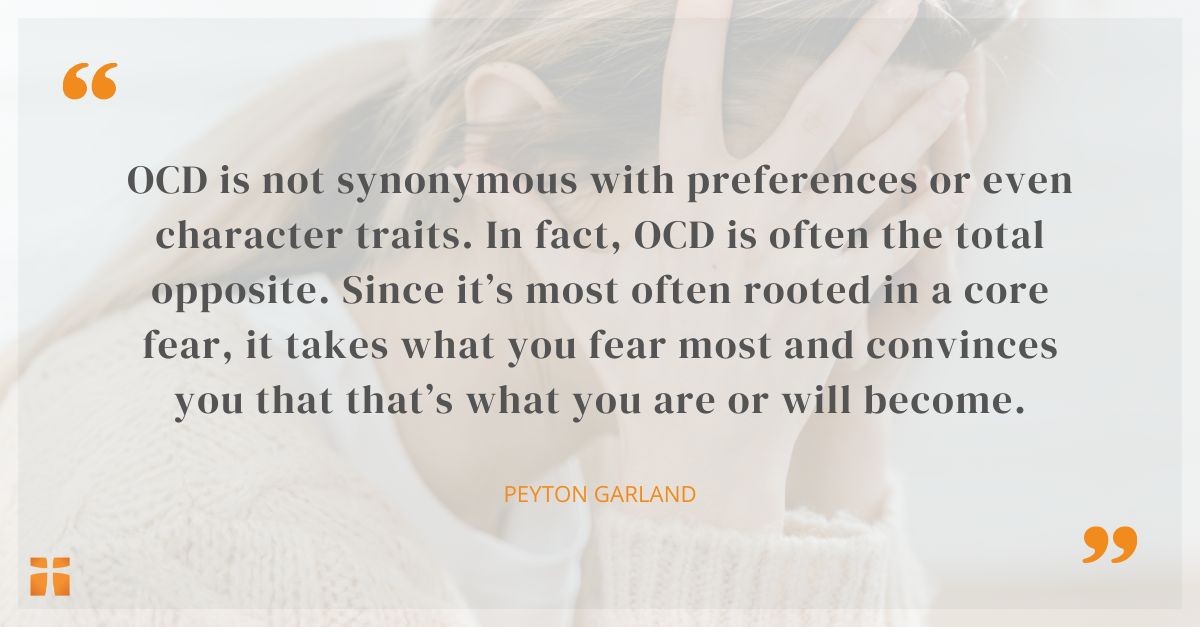
As we discussed earlier, no matter how many times I share with others that there are many branches/types of OCD, these same people still want to chat about “their” OCD regarding tidiness or timeliness. Remember, OCD is not synonymous with preferences or even character traits. In fact, OCD is often the total opposite. Since it’s most often rooted in a core fear, it takes what you fear most and convinces you that that’s what you are or will become.
Are you afraid you’ll run another car off the road by accident, becoming a homicidal criminal? Well, the best move is to simply never drive again. So if you drive again, you will undoubtedly run someone off the road since you’re ignoring the intrusive thought that you should never drive again. And if you’re willing to take such a wild risk, are you truly any better than a homicidal criminal? Or worse, what if you actually want to be a homicidal criminal, and that’s why you drive your car?
See? It’s a loop. A constant, miserable loop that’s only organization skills are those that keep you walking a tightrope, enslaved to thoughts that you never wanted.
Photo Credit: SWN Design

5. Myth 5: OCD Is Just an Obsession
I’ve had so many people ask how they can know if they have OCD versus a sole obsession. For example, I’m obsessed with color-coordinating my closet. I follow the scientific ROYGBIV order, and though I love when others help with my laundry and put away my clothes, it greatly irks me when I flip on my closet light and see that someone has stuck a green shirt in my blue clothes area. I’m obsessed with this organization—but it’s not OCD because it doesn’t trigger a compulsive response. In other words, you must have the “C” to have OCD.
I can walk away from my disorganized closet without it causing mental anguish. There are no mental loops where my thoughts spiral. I don’t think, “If I don’t color coordinate my clothes [insert wild or tragic thing] might happen.” I don’t feel sweaty or have my heart racing if I don’t reorganize my closet. My desire for this organization is a deeply rooted preference, but it doesn’t pause my day and cause debilitating anxiety and relentless, pestering thoughts. It doesn’t demand a compulsive response that silences the intrusive thought, but only for a second, until it comes back again.
OCD thoughts are destructive because they force a response. Over and over, the thoughts control a person’s sense of worth, even their purpose. Their life is consumed by responding to the very thoughts they wish never entered their mind.
Photo Credit: ©Unsplash/Joice Kelly

A Word of Hope for Those Living with OCD
To those with OCD, the one lie I wish you wouldn’t give in to is the idea that you are your disorder, that you are the very things the intrusive thoughts want you to believe. I pray fear doesn’t dictate your story, that you seek Christian therapy, and that you don’t let this disorder have the last say. Hope will always win. Scripture makes it clear that fear will never have the final say.
Hope does not mean pretending OCD is small; it means believing that Christ is near, help is worth seeking, and this disorder does not get to define who you are. Remember this as you push on, dear friend:
“Not only so, but we also glory in our sufferings, because we know that suffering produces perseverance; perseverance, character; and character, hope. And hope does not put us to shame, because God’s love has been poured out into our hearts through the Holy Spirit, who has been given to us.” - Romans 5:3-5 (NIV)
If OCD is interfering with your daily life, tell a trusted person, contact a qualified mental health professional, and seek treatment from someone trained to understand intrusive thoughts and compulsions.
Photo Credit: ©GettyImages/Janina Steinmetz

Frequently Asked Questions about OCD, Intrusive Thoughts, and Faith
- What is OCD?
OCD is a mental health disorder involving intrusive, unwanted thoughts and/or compulsive behaviors that cause distress and can interfere with everyday life. - Is OCD just wanting things clean or organized?
No. Cleanliness or organization can be part of some people’s OCD, but OCD can also involve harm fears, religious fears, taboo thoughts, contamination fears, checking, repeating, reassurance-seeking, and other compulsions. - What are intrusive thoughts?
Intrusive thoughts are unwanted thoughts, urges, or mental images that can feel disturbing, frightening, or inconsistent with a person’s values. - Can Christians struggle with OCD?
Yes. Christians can struggle with OCD just as they can struggle with anxiety, depression, or other mental health conditions. Having intrusive thoughts does not mean a person has chosen or approved of those thoughts. - Should Christians with OCD seek therapy?
Yes. Seeking qualified mental health care can be a wise and faithful step. Christian support, prayer, and Scripture can work alongside evidence-based treatment.
For Further Reading
- 3 Powerful Ways to Stop Your Thoughts from Spiraling Out of Control
- How to Deal with Anxiety as a Christian
- How to Stop Anxious Thoughts and Reclaim Peace
- 8 Important Ways for Christians to Care for Their Mental Health
- What the Church Should Know about Mental Illness
Photo Credit: ©GettyImages/max-kegfire

Originally published Monday, 18 May 2026.

Was this resource helpful? Add Christianity.com as a trusted source for Biblical content.