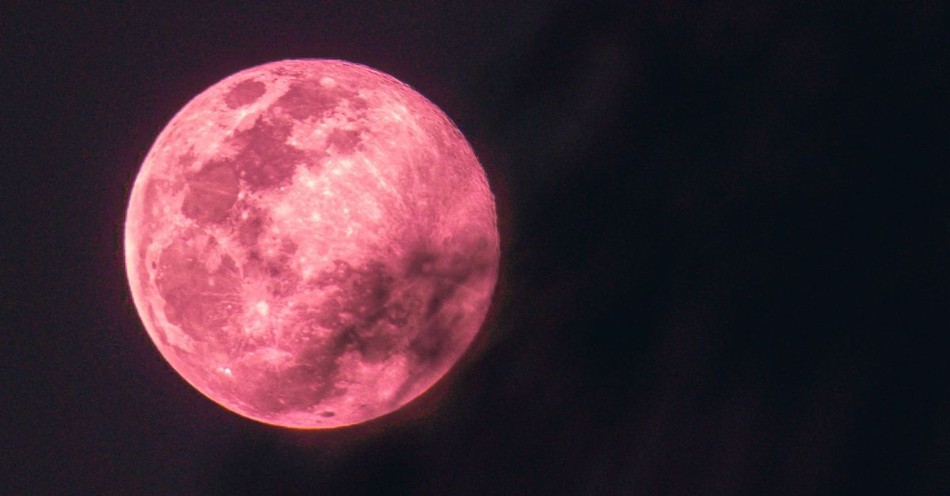
What Is the Easter Pink Moon?
Jesus died on Passover—an observation that always takes place in connection with a full moon. The entire Jewish calendar is lunar instead of solar, meaning it is tied to the cycle of the moon, not the sun like the Gregorian calendar is. Each year, Easter falls on the first Sunday after the full Moon that occurs on or after the spring equinox. This is known as the Pink Moon phenomenon or Paschal Moon (Paschal meaning “related to Easter”). And while the Pink Moon isn’t actually pink, it is named for a colorful type of moss phlox that blooms during this time.
This year, the Pink Moon appeared as NASA sent astronauts on Artemis 2 on an historic launch to the moon. We haven’t been back to the moon since 1972, so it’s a pretty big deal that we are returning 50-plus years later. What’s more amazing—this historical event is happening during Holy Week.
When you think about the biblical timeline of events leading up to Christ’s crucifixion, Jesus walked through the Kidron Valley after the Last Supper and prayed in the garden of Gethsemane under the light of a full moon. Jesus died on Passover— the holiday connected to the full moon, the same day that the nation was all bringing their Passover lambs to be slaughtered. Josephus says that between the ninth and the eleventh hour (three to five in the afternoon), lambs were brought to the temple to be sacrificed.
On top of that same moon, in 1969, Buzz Aldrin would eat bread and drink wine almost two thousand years later and nearly two hundred and fifty thousand miles away. The world was stunned when Aldrin, Neil Armstrong, and Michael Collins flew a quarter of a million miles to the moon in their Apollo spacecraft. Six hundred and fifty million people tuned in live for the landing, making it one of the most viewed events in history.
We tend to take the moon for granted. It was there yesterday, and it will be there tomorrow, so we can become blind to it. Just like we do to God. It is so easy to become high-functioning atheists, professing spiritual beliefs we haven’t set foot on in years.
Why Does the Easter Moon Point Us to Peace and Hope?
When I look at the moon, I marvel. I marvel because it is so far away, and yet it shines so bright. I marvel because its brightness is not its own but belongs to another. I feel the pull of the moon. It speaks to me. Calls to me. Dares me to dream. Invites me to live fully.
When I look at the sky at night and see the moonlit wonder, the explosions of stars, I ask God, How is it that you even notice me? Are its movements not somewhat hypnotic as it shrinks to a sliver and then grows full- size? When I see it, I find myself calming down. I take a breath. You sent us a companion to always be with us, reflecting the light of our sun in the darkness of night. When I am afraid, I will trust in you and take great comfort from the night- light you left on for me.
When we lift our eyes and see the moon, we are connected to every human who has ever lived. Our lives look different than those who were before us. Yet when we look up to the moon in the night sky, we see exactly what they’ve seen. Not just similar. The same. There has only ever been one moon above our Earth. When I am stressed or scared, I like to look at the moon and remember those who have gone before me, and the fact that on many nights, they probably looked up at the moon while they worried. David’s nauseous guilt over what he did to Uriah (2 Sam. 12:13). Peter’s bitter sorrow over his denial of Christ (Matt. 26:75). The fear Esther felt as she prepared to step into the chamber of the king (Est. 4:15–16). Daniel’s agony as he defied the order and chose to pray anyway (Dan. 6:10).
The problems they faced have come and gone, and the moon shines on. This is now your time to shine.
What Can the Easter Moon Remind Christians of Today?
Long after you and I leave this world, the moon will rise in the sky and shine. David called the moon God’s eternal, faithful witness in the sky (Ps. 89:37). Its predictable orbit and nightly glowing point to the one who spoke it, hung it, and calls it out by name. He has a plan for you to shine in the midst of your struggles. Not someday when you sort out all your issues, or when you have a better job, or are out of school. Right now, in the middle of the suffocating smallness of your situation, he wants you to shine.
I fear we think of the cross and resurrection too little and too lightly. It comes up in the days leading up to Easter. At our best, we take a Lent journey or Passion Week trip in our minds in the same way we count down to Christmas. Five golden rings. Easter is the end of Holy Week. The payoff of Passion Week, the final seven days of Christ’s earthly life. Then we pack it all up and put it into the boxes in the garage, between Halloween scarecrows and Christmas lights, until next year.
We do this not only with decorations, but also in a deeper way within our hearts. When Jesus died on the cross and rose from the dead, it wasn’t the last chapter but the start of a whole new story. The beginning. Artemis. It wasn’t the termination of something but the genesis of everything. Through it, he triggered the start of the reconciliation of all things.
Theologically, this is articulated as the already but not yet. The first domino fell when Christ rose from the dead. The last domino will fall when all things are made new. The moon and the cross cannot be separated. The moon calls to lovers. Dreamers. Painters. Fiends. The cross whispers to the broken, the needy, the dying. Through them God calls to sinners and to saints. May all the godly flourish during his reign. May there be abundant prosperity until the moon is no more.
Going back to the moon landing of 1969, when President Nixon called the astronauts from the White House, his voice relayed into the radios in their space suits. One thing in particular he told them explodes in my heart every time I read it, because, in a profound and eternal way, it is true of Jesus’ accomplishment. With excitement palpable in his voice, he told Neil and Buzz, “Because of what you have done, the heavens have become a part of man’s world.”
The heavens, dear friend, are a part of your world! I hope you never take that for granted— not heaven, which is where your Savior and citizenship are, or the heavens that are the home of the moon, God’s eternal night- light reminding you of his goodness and presence in your life. Every time you see it, I hope you’ll do what I do— reach out and try to grab it between your thumb and pointer finger and know that the one who hung it is holding you. The moon is your invitation to wonder, a reminder of your inner space left to be conquered, and a symbol of God’s love for you.
Adapted from “Last Supper on the Moon” by Levi Lusko. Copyright 2021 by Levi Lusko. Used with permission from Thomas Nelson.
Frequently Asked Questions About the Easter Pink Moon
- What is the Easter Pink Moon?
The Easter Pink Moon is the full moon that falls around the time of Passover and Easter. In Christian tradition, it is often called the Paschal Moon because it helps determine the date of Easter. - Why does Easter depend on the moon?
Easter is celebrated on the first Sunday after the first full moon that occurs on or after the spring equinox. That is why the date of Easter changes every year. - Is the Pink Moon mentioned in the Bible?
The term “Pink Moon” is not a biblical phrase. It is a traditional seasonal name for an April full moon. However, the moon does connect meaningfully to the timing of Passover, Holy Week, and Easter. - What does the Paschal Moon mean for Christians?
For Christians, the Paschal Moon can serve as a reminder of God’s faithfulness, the historical setting of Christ’s final days, and the hope of the resurrection.
(FAQ's added by Christianity.com Editorial Staff)
For further reading on related topics:
- When Is Easter Sunday
- Holy Week Timeline
- What Happened on Maundy Thursday
- What Happened on Good Friday
- Easter Sunday Meaning
Photo Credit: ©Unsplash/Dylan Sauerwein

Learn More and Stay Connected: https://levilusko.com/christianity