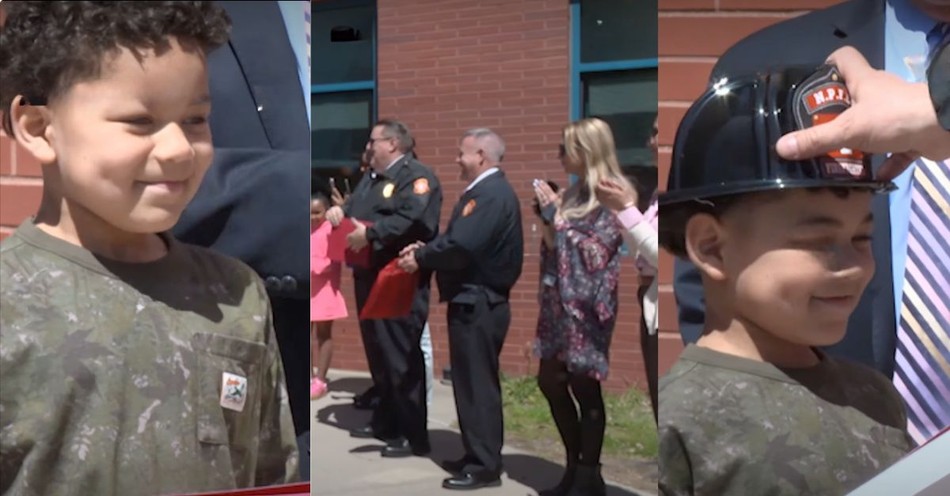
What was the day like? Perhaps Sameer Santana was eating cheesy goldfish like half the other kids, enjoying snack time. Maybe he was mid-sentence explaining about the fun thing he and his family did this past weekend. Did he gaze out the window, observing the changing buds on the tree outside in his Rhode Island town? We can’t be sure, but Sameer Santana is now a hero. He saw an emergency in motion and took action. While complacency might have urged him to sit silently or to stay still, He did the opposite. He acted. He got up. He moved. He did what many would not do. He put into action the Heimlich maneuver, as a kid was choking on an apple, even though he had only learned the maneuver within the last year. What should we learn from Sameer Santana? Sameer Santana’s courage reminds Christians that compassion is not passive; it moves us to act when someone is in need, even when everyone else stays still.
What Can Christians Learn from a 7-Year-Old Hero?
First, herd instinct is a real thing. People will do what others are doing. If everyone else is sitting, most others will stay seated. If people aren’t helping, studies prove, others won’t help either. Have you ever noticed in churches how people seem to wear the same types of clothes or use a similar vernacular? Maybe a church is known for one thing or another. In some ways, this is a herd mentality. Even in churches, people conform to a mold of acceptability to belong. However, God made us different as individuals, so that we will not all be the same.
What Does the Bible Say about Herd Mentality?
Scripture readily addresses the herd mentality. In fact, a herd mentality is what crucified Jesus. As they yelled, “Crucify Him!” (Mt. 27:20-22) The herd joined in the common cause or the common view, agreeing to Jesus’ death. As Christians, we are not called to fit in; we are called to stand out. We are not called to stay still, but to act for those in need. We are called to be a city set on a hill. We are to be transformers and not conformers.
“And be not conformed to this world: but be ye transformed by the renewing of your mind, that ye may prove what is that good, and acceptable, and perfect, will of God.” - Ro. 12:2 KJV
In this moment, when Sameer Santana faced, we do not know whether he discerned God’s will, but we do know he must have discerned what was good and right – by taking action. If he let a herd mentality overpower his desire to move, undoubtedly, he would not have gotten up and out of his seat. However, He moved. He acted, and he acted fast. We are to take note of this. To conform is not to transform. And to transform is not to conform. Rather than noting what others are doing, or what everyone is thinking, we can get about doing the right thing swiftly. In doing so, we will do what is right. Even if, like Sameer, we aren’t sure if we will do the move well enough to get the job done, we do it anyway. Because we can do all things through Christ, who gives us strength. (Phil. 4:13)
By God’s grace and power, nothing is impossible. God can absolutely do it, even if no one else is. The key is not to delay. To delay is often to disobey. Sameer Santana teaches us that a fast move can be a life-saving one. He teaches us that being sure about what we’re doing is not a prerequisite to God’s saving power. The child was only 7 years old. If he can move, we certainly can.
God Can Use Anyone Who Is Willing to Move
God can use anyone. If there’s an unaddressed emergency on the side of the road, with various cars driving by, do you know what the majority of people think? They think, “Someone else will help that person.” Then, they keep driving. When everyone does the same, how does that leave the stranded, helpless, in-need person? Why do they discount themselves? Why do you discount yourself? But, what if the someone God had picked to help was them, or you? What if you, with all your weaknesses, with your imperfect knowledge, with your inability to have an answer, were precisely the one in whom God was going to allow His miraculous power to flow through? And, what if we miss it – by not showing up?
God has great plans to use inadequate people – all we need to do is to show up. Despite any perceived Samaritan-like status – still, God can use us.

The Good Samaritan Shows Us What Compassion Looks Like
But to ignore the problem, to join the herd that’s moving a thousand miles a minute, is often to miss the heart of what matters most to God….
“A man was going down from Jerusalem to Jericho, when he was attacked by robbers. They stripped him of his clothes, beat him and went away, leaving him half dead. A priest happened to be going down the same road, and when he saw the man, he passed by on the other side. So too, a Levite, when he came to the place and saw him, passed by on the other side. But a Samaritan, as he traveled, came where the man was; and when he saw him, he took pity on him. He went to him and bandaged his wounds, pouring on oil and wine. Then he put the man on his own donkey, brought him to an inn and took care of him.” - Luke 10:30-34
It was the impure, the ostracized, the one who many looked down upon – that actually made the move. WE don’t have to be perfect to move; we only need to move.
What Does It Mean to Be Moved with Compassion?
- Notice what the Samaritan moved in? First, they moved in “pity.” This means they felt something. Rather than laughing about another’s misfortune as the world does, or being callous to another’s need, they felt something. Pity in this verse is also translated to “compassion.” It means to “be moved”. Jesus was often moved before he performed a miracle. Many times, as Christians, we are not moved because we are removed from the problem. We think, “That’s someone else’s issue” or “I’m too busy.” If we notice the feeling in our heart or body and feel compassion, that will help us take action.
“And Jesus went forth, and saw a great multitude, and was moved with compassion toward them, and he healed their sick.” - Matthew 14:14 - “So Jesus had compassion on them, and touched their eyes: and immediately their eyes received sight, and they followed him.” - Matthew 20:34
Compassion preceded the miraculous. Are we hard of heart or soft of heart? Do we notice those in need or overlook them while we're head-down on our phones?
Christian Courage Begins with Availability
Bottom line? Being a hero is as much about being available as it is about courage. When compassion moves us faster than fear or conformity, we become available for God to use us in moments that may matter more than we realize.
Frequently Asked Questions about Christian Compassion and Taking Action
- What can Christians learn from Sameer Santana’s story?
Christians can learn that compassion should move us to action. Even a child’s quick response can remind believers not to wait for someone else to help. - What is herd mentality?
Herd mentality is the tendency to follow others rather than think or act with conviction. In moments of need, it can keep people passive. - What does Romans 12:2 teach about conforming?
Romans 12:2 teaches believers not to conform to the world but to be transformed by the renewing of the mind, so they can discern and do God’s will. - How does the Good Samaritan show compassion?
The Good Samaritan noticed a wounded man, felt compassion, and took practical action to care for him. His example shows that compassion is active, not merely emotional. - Can God use ordinary people to help others?
Yes. God often works through willing people who may feel inadequate but choose to show up, act in love, and trust Him with the outcome.
For Further Reading
- The Parable of the Good Samaritan: Meaning and Lessons
- What Is the Role of Conformity in Our Everyday Lives?
- What Does It Mean “By the Renewing of Your Mind”?
- Why Does the Bible Have to Tell Us to Be Kind to One Another?
- What Is Christian Empathy?
Photo Credit: ©Instagram/nbc10wjar