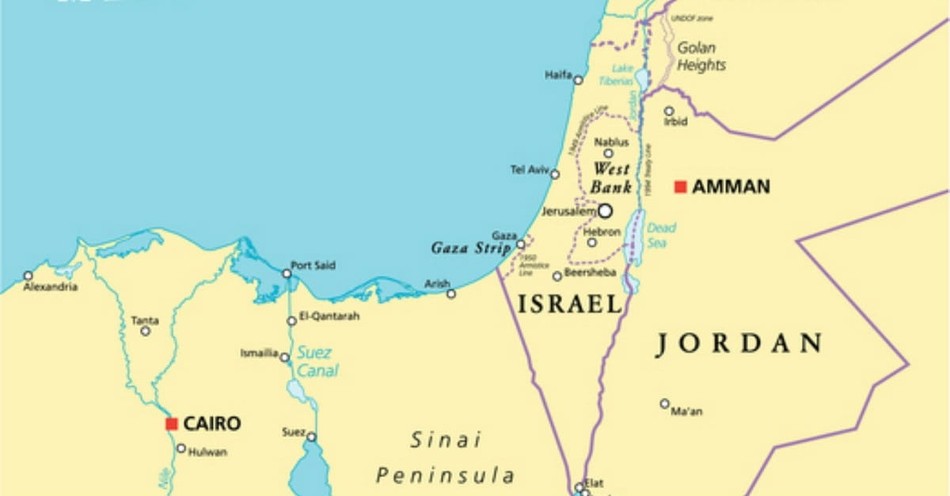
In my last article, I defined Christian Zionism as the belief that God bequeathed the land of Israel to the Jewish people as an everlasting possession for the purpose of world redemption. This is the biblical foundation for Christian support for Israel and the Jewish people. This principle of land is not just in the Old Testament but continues in the New Testament.
Let’s first consider the legitimacy of God’s promises in the Old Testament.
Validity of Old Testament Promises
Replacement theologians often emphasize that the Old Testament and Judaism have been brought to an end and were replaced with something totally and completely new: Christianity. But this is precisely the approach Paul warned against in Romans 11, when he refers to the root of Christianity as being Jewish and warns against an arrogant position that does not honor the root.
According to Anglican priest, theologian, and author Gerald McDermott in his book Israel Matters, “For Paul, then, the believing church will never be separated from its root, Jewish Israel. If the church thinks it can be separate and in fact replace Jewish Israel, it has become ‘proud’ and ‘arrogant.’”[1]
A popular type of Replacement Theology is Fulfillment Theology, which teaches that Jesus fulfilled the Law, so it is no longer relevant. However, Jesus said: “Do not think that I came to destroy the Law or the Prophets. I did not come to destroy but to fulfill” (Matthew 5:17). Some say even the Ten Commandments do not apply to Christians because Jesus brought a new set of ethics, when, in fact, in His Sermon on the Mount, Jesus expounded upon the basic principles found of the Ten Commandments—He did not replace them with something new. Clearly, the New Testament confirms the validity of the promises of God found in the Old Testament and does seek to redefine or redirect them to another people.
The Promised Land in the New Testament
The God of the Bible is the God of the whole earth. Yet His promise of this piece of land to one family—the descendants of Abraham, through Isaac and then Jacob—is confirmed and repeated in Scripture more than one thousand times. Clearly, this attention affirms the importance of the land in God’s purposes.
Land is a necessary element for forming a nation. The land also provided a stage on which the Almighty God carried out His plan of redemption. As long as God’s covenant with Abraham was in play (everlasting), the land belonged to his descendants (everlasting). The land is an integral part of the covenant because it is the place where God would work through His people and fulfill His promise to bless the world. But does the New Testament even mention the land?
Indeed, it does! However, one problem Christian Bible readers face is the English translation of a Greek word that can mean “land” or “earth.” For example, Matthew 5:5 states, “Blessed are the meek, for they shall inherit the earth” (emphasis added). Many scholars are beginning to recognize that a better translation is “Blessed are the meek, for they shall inherit the land.” This is more in keeping with the Jewish context of inheriting the land of Israel as reflected in Psalm 37, where David says he would have “lost heart, unless I had believed that I would see the goodness of the Lord in the land of the living”—imagery that echoes God’s covenant promise of dwelling securely in the land God has given His people Israel.
As discussed in Part 2 of this series, Jesus did not deny that there would be a future Israel [in the land] when asked in Acts 1:6 7. Paul predicted that one day “all Israel will be saved” because Israel’s deliverer would “come out of Zion” (Romans 11:26), and Peter referred to the “restoration of all things” in Acts 3:21, which was a Greek term based on the Old Testament concept of the future return of the Jews to the land and reestablishment of a Jewish nation.[2]
The Return of the Jews to the Land
Though some argue the prophecies of Israel’s return were fulfilled when Jews returned to rebuild Jerusalem after the Babylonian captivity, this does not align with Jesus’ very teachings, and what His disciples believed, about a future for Israel.
Jesus prophesied a coming exile of the Jewish people and Gentile control of Jerusalem, but only for a time. Gentile rule would come to an end one day, and Jerusalem would come under Jewish control: “And they will fall by the edge of the sword and be led away captive into all nations. And Jerusalem will be trampled by Gentiles until the times of the Gentiles are fulfilled” (Luke 21:24, emphasis added). It is important to note that Gentiles indeed controlled Jerusalem for the next 1,900 years until it came under Israeli sovereignty in 1967.
The Return of Jesus to Jerusalem
In His Olivet Discourse, Jesus looked over the city of Jerusalem and prophesied the coming destruction of the city and the temple. But he also prophesied in Luke 13:35 that one day, the Jewish people would welcome Him back to the city with the Hebrew greeting Baruch Haba BaShem Adonai (“Blessed is He who comes in the name of the Lord”). Jesus would return to a Jewish Jerusalem.
In Matthew 19 Jesus speaks of reigning from His throne in the New Jerusalem, judging the 12 tribes of Israel (v. 28). McDermott, citing Markus Bockmuehl in The New Christian Zionism: Fresh Perspectives
on Israel and the Land, says indications in the Gospels seem to affirm “the early Jesus movement . . . continued to focus upon the restoration of Israel’s 12 tribes in a new, messianic kingdom.”[3]
And in Mark 11:17, Jesus quoted Isaiah’s prophecy concerning a restored Jerusalem. Each of these prophecies speaks of a literal, physical place from where Jesus will one day rule and reign.
The New Jerusalem
The book of Revelation also affirms that Israel, as a particular land, has a place in God’s plan for the future. McDermott observes:
Christians are right to say that the Bible speaks of the whole earth being renewed. But not all Christians have seen that the center of the renewed earth will be Israel.[4]
The Bible depicts the Lamb standing on Mount Zion (Revelation 14:1), the new earth that is to come centered in Jerusalem, and the New Jerusalem adorned with 12 gates inscribed with the “twelve tribes of the sons of Israel” (Revelation 21:2, 12).
Conclusion
Clearly, the New Testament carries on the Old Testament principle of the importance of the land and reaffirms the covenants, the law, and the prophetic writings, all of which point to a future return of the Jews to the land and a coming glorious day when the kingdom of God is on earth. In my next article in this series, I’ll explore the historical origins of Christian Zionism.
[1] Gerald R. McDermott, Israel Matters (Grand Rapids, MI: Brazos Press, 2017), 29.
[2] McDermott, Israel Matters, 30.
[3] Gerald McDermott, Ed., The New Christian Zionism: Fresh Perspectives on Israel and the Land (IVP Academic, 2016), citing Markus Bockmuehl, Jewish Law in Gentile Churches: Halakhah and the Beginning of Christian Public Ethics, Baker Academic, 2000, p. xi.
[4] McDermott, Israel Matters, 30–31.
Photo Credit: ©GettyImages/PeterHermesFurian