
Why Conviction Once Had Room to Mature
I grew up in Uganda in a very different world. News traveled slowly. In our village, you might hear a major story days after it happened. Sometimes longer. We did not carry the world's crises in our pockets. We knew our neighbors. We knew our responsibilities. Most of life was lived within a relatively small circle of relationships and obligations.
I remember a culture in which a man's word carried enormous weight. If two men shook hands and made an agreement, that agreement was expected to stand. A promise was more than a legal arrangement; it was a matter of honor. Your word was your bond.
Of course, there were disputes and failures. Human nature has not changed. But there was a stability to life that I increasingly find myself missing. People could not easily reverse every decision because they had encountered a new opinion, a new headline, or a new emotional trigger an hour earlier. Commitments had room to mature because emotions had time to settle. That was then. Today, constant stimulation is training us to mistake emotional reaction for lasting conviction.
How Constant Stimulation Reshapes What We Feel and Believe
Now we live in the most connected age in human history. Every hour, a device in my pocket delivers news, tragedies, scandals, conflicts, and crises from every corner of the globe. A teenager in rural Botswana is expected to process political unrest in Argentina. A trader in Cambodia is emotionally drawn into debates about cryptocurrency regulation in Europe. A mother in Texas feels the weight of wildfires in Australia, a bridge collapse in Thailand, and an earthquake in Chile—all before breakfast.
Much of this information has little or no direct bearing on our immediate responsibilities, our families, our neighbors, or our communities. Yet it occupies our minds, stirs our emotions, and competes for our attention. We have become emotionally invested in events thousands of miles away while often neglecting the people sitting across the dinner table from us.
The issue is not merely that we have more information than previous generations. The issue is that we have more emotional triggers than any generation in history. Every headline, notification, video clip, social media post, breaking news alert, market fluctuation, political controversy, and cultural debate has the power to alter our emotional state.
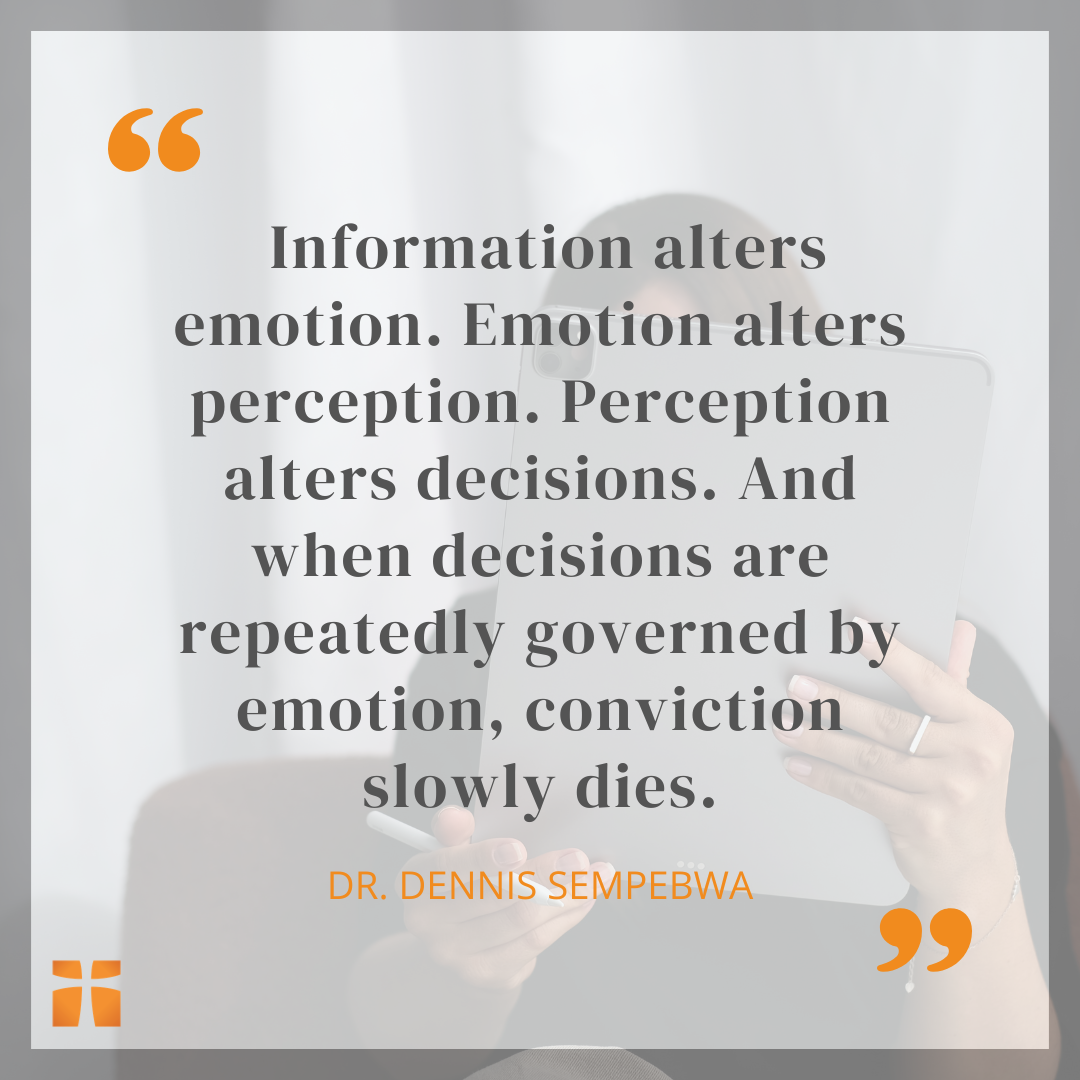
Now read this carefully: Information alters emotion. Emotion alters perception. Perception alters decisions. And when decisions are repeatedly governed by emotion, conviction slowly dies. People feel one way today and differently tomorrow. The facts may not have changed. The commitments may not have changed. Only the emotions have changed.
This helps explain much of modern instability. Increasingly, agreements require contracts, signatures, witnesses, legal reviews, and enforcement mechanisms. Handshakes are no longer enough. A person's word is often considered insufficient because everyone understands how quickly feelings can change. The implications extend far beyond business. Marriages struggle when commitment is tethered to emotion. Friendships suffer when loyalty depends upon feelings. Citizens disengage when they no longer feel connected to a cause. Employees leave when enthusiasm fades.
Why Emotion Cannot Carry Commitment
A culture governed by emotion will inevitably struggle to find stability because emotions were never designed to provide it. They respond, they fluctuate, they change. Consider two friends who have suffered a painful falling out. After a long conversation, they decide to reconcile. They embrace, apologize, and agree to move forward. But the next morning, the warmth of the moment has faded. Old feelings return. New irritations emerge. Suddenly, the reconciliation no longer feels right. What changed? Not the facts. Not the agreement. Only the emotions.
Or consider a CEO who, in a moment of frustration, decides to sell an entire division of his company. Negotiations begin. Contracts are drafted. The transaction moves forward. Weeks later, after the anger subsides and clarity returns, he realizes he never truly wanted to sell. The emotion that drove the decision has disappeared, but the consequences remain.
We see this everywhere. Relationships begin because people feel something. Relationships end because they no longer do. Partnerships are formed impulsively and dissolved just as quickly. Commitments that once seemed immovable are abandoned at the first change of mood. Entire lives are being built on emotional weather patterns.
How Emotional Overload Weakens Spiritual Conviction
The implications reach even into the church. Pastors increasingly minister to congregations whose emotional landscapes are being reshaped hourly. A sermon preached on Sunday may genuinely move a congregation. Conviction rises. Tears flow. Commitments are made. Altars fill. Decisions are taken.
Yet before the week is over, that same believer may have consumed twenty podcasts, fifty social media clips, several news cycles, dozens of YouTube videos, and countless opinions from voices the pastor has never met. Each one carries the power to reinforce, dilute, redirect, or even contradict what was received on Sunday morning.
The challenge is not that the sermon lacked sincerity. Nor is it necessarily that the congregation lacked sincerity. The challenge is that emotional momentum has become increasingly difficult to sustain in a world saturated with competing stimuli.
The same technology that allows truth to travel also allows distraction to travel. The same device that delivers a stirring sermon can, moments later, deliver a competing narrative, an opposing worldview, a political outrage, or an entirely different set of emotional triggers. The result is that many believers live in a state of perpetual emotional recalibration. What seemed unquestionably true on Sunday can feel uncertain by Wednesday and irrelevant by Friday.
Why Churches Need Formation More Than Stimulation
This creates a subtle temptation for churches. If people are increasingly driven by emotion, the pressure naturally arises to create increasingly emotional experiences. More stimulation. More intensity. More spectacle. More atmosphere. More urgency. But emotional intensity is not the same thing as spiritual formation. A firework can light up the sky for a moment. A furnace changes the temperature of a house. One produces amazement. The other produces transformation.
The Christian faith has historically been built not upon emotional moments but upon enduring convictions. The saints who preserved the faith through persecution, imprisonment, famine, war, and suffering were not sustained solely by feelings. They were sustained by truths that remained true even when they felt nothing at all.
When Feelings Masquerade as Changed Beliefs
The same pattern appears in politics. Citizens passionately support a candidate, a movement, or a policy. They campaign, donate, advocate, and defend. Yet months later, after a relentless stream of headlines, commentary, controversies, and counterarguments, many find themselves questioning convictions they once held with certainty. Sometimes the change is justified. New facts should influence honest people. But often, what has changed is not the evidence but the emotional environment surrounding it. Hope becomes frustration. Confidence becomes anxiety. Patience becomes anger. And because modern culture increasingly confuses feelings with facts, emotional change is often mistaken for intellectual change. The individual concludes, "I no longer believe this." What they often mean is, "I no longer feel the way I felt when I believed this."
The distinction is enormous.
How Christians Can Anchor the Mind in God’s Truth
Centuries ago, the prophet Isaiah offered a remedy that feels remarkably suited to our age of endless notifications, breaking news, and emotional overload: "Thou wilt keep him in perfect peace, whose mind is stayed on thee: because he trusteth in thee." (Isaiah 26:3)
Notice where peace is found. Not in controlling circumstances, information, or emotions, but in anchoring the mind. The modern world trains us to react, but the Word of God trains us to remain. The modern world rewards immediacy, but God's Word cultivates steadfastness. The modern world asks, "How do you feel today?" The Christian faith asks, "What is true today?" One question changes every hour. The other remains unchanged through generations.
Perhaps our age does not suffer from a lack of information. Perhaps it suffers from a lack of anchors. And perhaps the church's greatest contribution in an emotionally overheated age is not more stimulation, but more stability. Not more excitement, but more rootedness. Not merely moving hearts, but anchoring minds. For a mind stayed upon God is far harder to manipulate than a heart chasing the emotion of the moment.
May we return to covenant again. May we return to stability again. May we return to the quiet strength of decisions rooted not merely in emotion, but in truth. And may we once again discover the perfect peace that comes from a mind stayed upon God.
Frequently Asked Questions about Christian Conviction in an Emotion-Driven Age
- What is Christian conviction?
Christian conviction is a deeply rooted belief shaped by Scripture, the Holy Spirit, and obedience to Christ rather than by mood, pressure, or personal preference. - How does constant stimulation weaken conviction?
Constant stimulation weakens conviction by repeatedly triggering emotions and shifting attention before truth has time to take root. - Are emotions bad for Christians?
No. Emotions are part of being human, but they were never meant to rule our beliefs, commitments, or obedience to God. - What is the difference between conviction and emotion?
Emotion responds to the moment, while conviction remains anchored in what is true even when feelings change. - How can Christians stay rooted in truth today?
Christians can stay rooted through Scripture, prayer, worship, silence, wise community, spiritual disciplines, and a renewed mind fixed on God.
For Further Reading
- What Does the Bible Say about Conviction?
- How Can We Know if Our Personal Convictions Are Biblical?
- How to Guard Your Mind in the Digital Age
- 8 Ways to Renew Your Mind
- Wading through a World of Overwhelm with God’s Word as a Steady Anchor
Photo Credit: ©Unsplash/Marvin Meyer