
This is a reflection, some tools, and a prayer for anyone waiting for someone to come home. By now, you have likely seen the footage — Savannah Guthrie, sitting across from her dear friend Hoda Kotb, tears streaming, voice breaking as she describes the unthinkable. Her 84-year-old mother, Nancy, has been missing since February 1st, 2025. Evidence points to abduction. Ransom notes appeared in the press. And now, more than eight weeks later, there are still no answers.
“We are in agony,” Savannah said. “We are in agony. It is unbearable.”
She described waking up in the middle of the night, every night, in the darkness — imagining her mother’s terror.
“I will not hide my face,” she said through her tears.
I don’t know about you, but when I heard those words, something in me went very still. Because that kind of grief — the grief of not knowing, of waiting, of imagining — is one of the most excruciating forms of human suffering there is. Savannah Guthrie is living it in front of the whole world.
This article offers biblical encouragement, practical tools, and a prayer for anyone living in the agony of not knowing. Whether you are waiting for a missing loved one, carrying ambiguous loss, or struggling with anxious thoughts in the dark, these reflections are meant to help you bring your grief honestly to God and remain anchored in His presence.
What Is Ambiguous Loss and Why Is it So Hard?
There is a specific kind of grief that comes with clear, final loss. It is devastating and real, and it demands its own kind of mourning. But there is another kind of grief — the grief of the threshold, the grief of waiting, the grief of liminality, the grief of a door left open that no one walks back through. This is the grief of the family with a missing loved one. The grief of the spouse with an unreturned call that stretches into days. The grief of the parent whose child has vanished into addiction, or distance, or silence. Grief without a resolution.
This is sometimes known as ambiguous loss — loss without closure, grief without a grave. And for many of us, this is the hardest kind to endure. Because it gives the mind nowhere to land. Our imaginations fill every quiet moment with worst-case scenarios. With countless what-ifs. Every ring of the phone is both terror and hope. Every text message is both agony and expectation. Ambiguous loss is grief without closure. It happens when someone is gone, missing, emotionally absent, or unreachable, yet there is no clear ending or final resolution. This kind of grief is especially painful because the mind has nowhere to land. Instead, it lives in the tension between hope and fear, love and uncertainty, prayer and silence.
How do any of us survive ambiguous loss? How do we actually lean on God when the grief we are holding feels too heavy to even say aloud, too brutal to pray about?
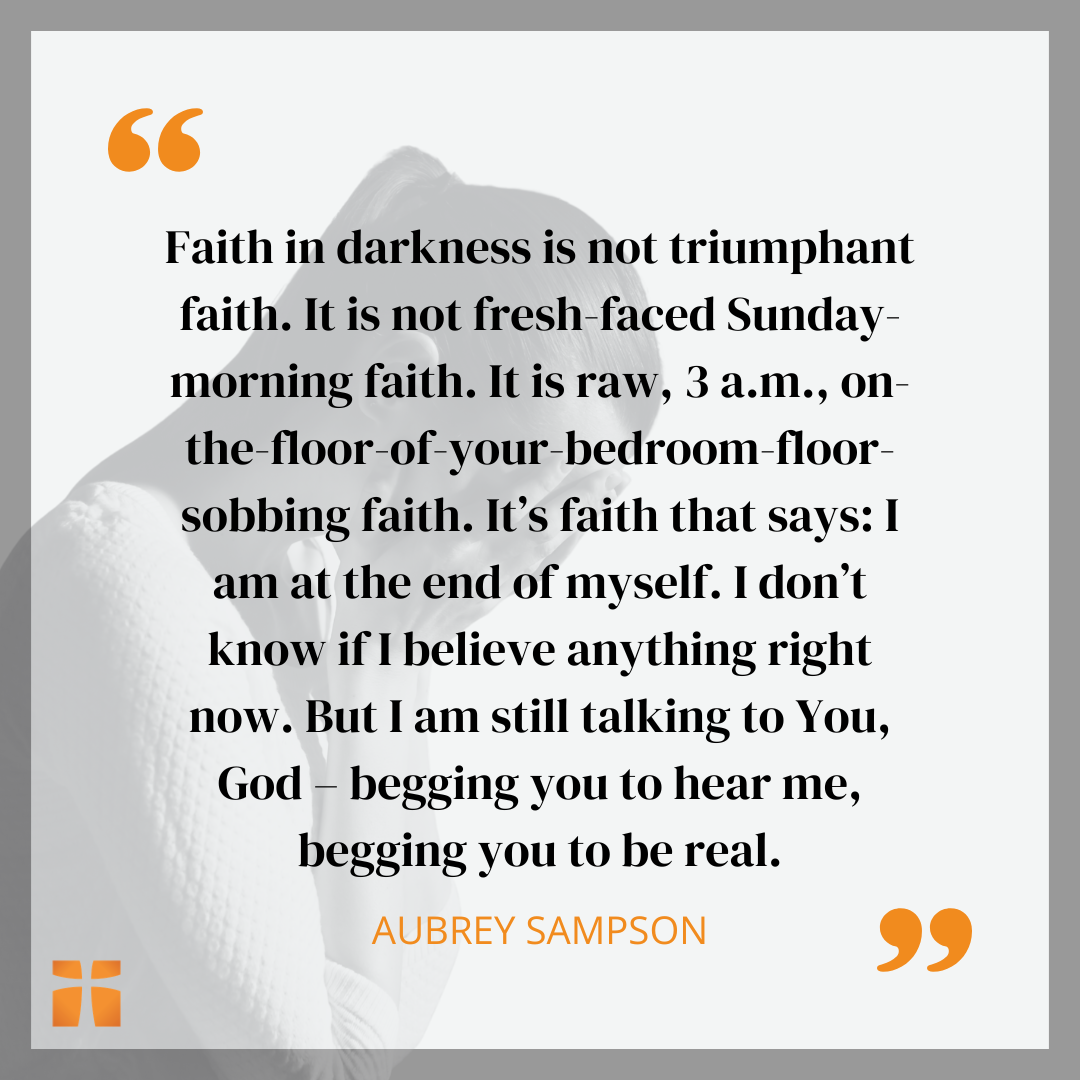
I have written about faith in the darkness in my book What We Find in the Dark: Loss, Hope, and God’s Presence in Grief. Faith in darkness is not triumphant faith. It is not fresh-faced Sunday-morning faith. It is raw, 3 a.m., on-the-floor-of-your-bedroom-floor-sobbing faith. It’s faith that says: I am at the end of myself. I don’t know if I believe anything right now. But I am still talking to You, God – begging you to hear me, begging you to be real.
The Psalms are full of this kind of raw faith. How long, O Lord? Will you forget me forever? How long will you hide your face from me? (Psalm 13:1) The writers of Scripture did not sanitize their anguish. They brought it, unfiltered, to the throne of God. They wept. They accused. They begged. And somehow, in the bringing — in the act of turning toward God, even in rage and confusion, something shifted.
Faith in the dark is not about manufacturing peace you don’t have. It is about choosing to remain in a relationship with God even when you have no peace to offer. It is choosing to say You are here, God, even when you cannot feel God’s presence, or declaring I trust you, God, even when you doubt the answer He will provide.
How to Trust God When You Are Waiting and Imagining the Worst
Here is what I know about grief and faith after years of walking with people through both: the muscles we use in lighter seasons are the ones we need in dark ones. But even when we haven’t built them, these muscles—these tools of faith—are available to us. Here is how to use them when you are in the thick of ambiguous loss:
Five Tools for Faith in the Dark of Not Knowing
- Pray aloud, even if it feels like nothing. When everything is internal, when the spiral of anxious thought won’t stop, speaking out loud — even just a few words — interrupts the constant loop. You don’t even have to know what you’re saying; it doesn’t have to be eloquent. God, I can’t. God, why? God, help. That is a complete prayer. Silence is okay, too; screaming is okay, too. But in moments of acute panic, speaking aloud can anchor the soul in a way the mind and the emotions alone cannot.
- Bring your body along. Grief and terror live in the body. When anxiety hits — when those 3 a.m. thoughts demand to be thought — place your hands somewhere firm. On the floor. On your chest. On a wall. Let something physical remind you that you are still here, that your body is present, that God is present in the physical world, too. Breathe in. Breathe out. These are not tricks; they are how we are made - embodied.
- Let others pray when you can’t. There are seasons when you cannot carry your own prayer life or faith. The people of God are made to carry it for you. Let them. Receive that. It is not a sign of failed faith to say I need you to pray, I need to borrow your faith, because I have nothing left. It is actually a sign of deep faithfulness.
- Resist the tyranny of the resolved ending. We want this to end. We want a clear answer, a clear road home, a clear something. But sometimes the task of faith is to live faithfully in the not-yet—not because we must accept whatever happens, but because God is present and at work even in the unresolved middle of our stories. This is not toxic positivity. This is not “everything happens for a reason.” This is the hard, slow, honest work of trusting that the God who sees the sparrow fall (Matthew 10:29-31) has not looked away from your loss.
- Lament is worship. Grief brought to God is not faithlessness or spiritual immaturity — it is intimacy. When we express our agony to God, we are practicing something biblical and deeply spiritual – lament. Tell God the truth. Tell God what it feels like. Tell God you are furious and terrified and exhausted, and you need something to break in your favor. That is not faithlessness. That is the prayer of the faithful. The prayer of the Psalmists. The prayer of the prophets. The prayer of Jesus in Gethsemane. You are in good company.
What to Do When Anxiety Spirals in the Dark
When fear begins to spiral, start small. Say one honest prayer out loud. Put both feet on the floor. Take one slow breath in and one slow breath out. Reach out to one safe person and ask them to pray. Open to one Psalm and let borrowed words carry you when your own words fail. You do not need to solve tomorrow in the middle of the night. You only need to bring this moment, as it is, into the presence of God.
If you aren’t sure what to pray, I’d like to offer this prayer for you:
A Prayer for Those Who Are Missing — and for Those Who Wait By the Door
God of the searching shepherd,
God of the woman sweeping the whole house to find the one lost coin — We come to You with empty hands and broken hearts.
We bring you the names we cannot stop saying. The faces we see when we close our eyes. The last ordinary conversations we had were the last. We bring you the nights that won’t end. The phones that won’t ring with the right news. The silence that fills every room.
We ask You to be with the one who is missing. Wherever they are — in fear, in confusion, in pain — Let them know they are not alone. Let some flicker of Your presence reach them in the dark. Let them know they are loved, sought out, and prayed over.
We ask You to be with those of us who wait. Hold us when the anxious night-thoughts come. Meet us in the middle of the night when terror rises. When imagination runs to the worst, when love refuses to look away — be there in that place. Breathe into that place.
Give strength to weary bodies. Give focus to investigators and search teams. Give wisdom to those asking the hard questions. Move in the hearts of anyone who holds information that could bring someone home.
We do not know how this ends. We do not know what tomorrow holds. But we know that You are the Holder of all tomorrows. We know that you see what we cannot see. You work in ways we cannot trace. Your presence does not depend on our peace or our performance of faith. Even in this thing that is not good at all, you are good.
So we choose, in this dark and difficult moment, to remain in Your presence. To keep talking. To keep hoping. To keep asking.
Bring them home. Bring them home. Bring them home.
Amen.
A final word: If you have a missing person in your life — a parent, a child, a friend — please know this: your grief is real, and it is holy. You do not have to pretend faith. You do not have to be okay. You are allowed to say this is unbearable because sometimes things are unbearable, and God is large enough to hold that truth. And if you don’t know what to pray, start there. Start with what’s true. Start with the ache. God has never needed us to clean ourselves up before we come to Him — He meets us at the door, and more often than not, He is already running toward us long before we get there.
Frequently Asked Questions About Faith in the Dark
What is ambiguous loss?
Ambiguous loss is grief without closure. It happens when someone is missing, emotionally absent, or gone in a way that leaves no clear ending, making it difficult for the mind and heart to process what has happened.
How do you trust God when you do not know what happened?
Trusting God in uncertainty does not mean having perfect peace or answers. It often means bringing your fear, grief, and unanswered questions honestly to Him and choosing to remain in relationship with Him in the dark.
What does the Bible say about waiting in grief?
Scripture is full of people who cried out to God while waiting in pain and uncertainty. The Psalms especially show that lament, questions, and honest anguish are not signs of weak faith but part of faithful prayer.
How do you pray when you are imagining the worst?
Start with simple, honest words. Pray aloud if you can. Even a prayer as short as “God, help me” is enough. When your own prayers feel impossible, ask others to pray for you and let Scripture give words to your grief.
For Further Reading:
- Bible Verses About Grief
- What the Bible Says About Anxiety
- Prayers for Hard Times
- Psalms for Waiting on God
- How to Trust God in Difficult Times