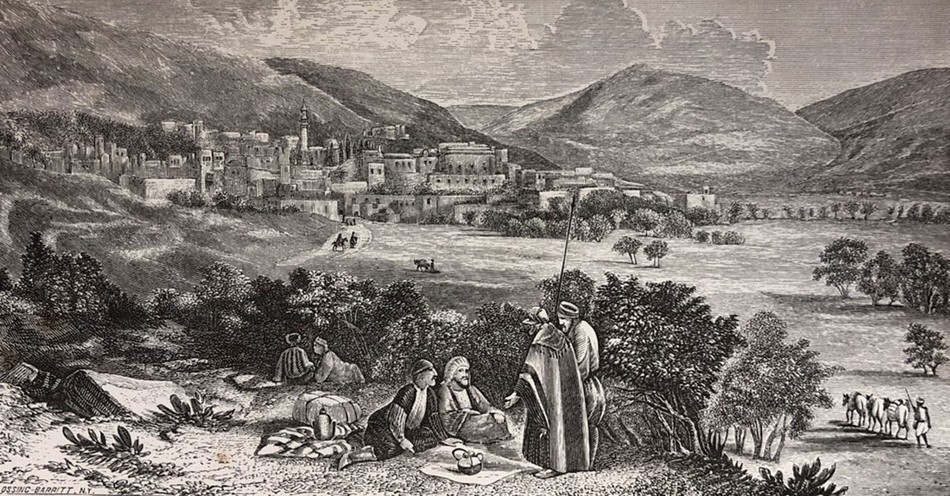
Depending on where you live, when someone asks you where you’re from, you’ll either tell them where you were born or where you live now. When we think of Jesus, we may also wonder, “Where did Jesus grow up?” Jesus was born in Bethlehem, just as the prophets foretold—but He grew up in Nazareth, a town of humble reputation. This article walks through the biblical timeline of Jesus’ early life, why His birthplace and hometown both fulfill prophecy, and what Scripture reveals about His childhood in Galilee.
Jesus’ Birthplace vs. Hometown: What’s the Difference?
A person’s birthplace is not always one’s hometown, like when a family stays in the town where their child is born for only a short time. A hometown in where a person and/or their family sets roots and raises the family.
Jesus’s birthplace was Bethlehem. The prophet Micah foretold Jesus’s place of birth:
“But you, Bethlehem Ephrathah,
Though you are little among the thousands of Judah,
Yet out of you shall come forth to Me
The One to be Ruler in Israel,
Whose goings forth are from of old,
From everlasting” (Micah 5:2, c.f. Matthew 2:6).
Why Bethlehem?
We learn the answer in the book of Luke. “And it came to pass in those days that a decree went out from Caesar Augustus that all the world should be registered. This census first took place while Quirinius was governing Syria. So all went to be registered, everyone to his own city” (Luke 2:1-3).
Verses 4-5 tell us, “Joseph also went up from Galilee, out of the city of Nazareth, into Judea, to the city of David, which is called Bethlehem, because he was of the house and lineage of David, to be registered with Mary, his betrothed wife, who was with child."
Bethlehem was the first town to be called the City of David because it was David’s birthplace, and it served as his early home (a key place in the life of David and now in the life of Jesus). David’s father, Jesse, was a Bethlehemite, and it was in Bethlehem that Samuel anointed David to be King over Israel (1 Samuel 16:1-13).
Joseph, Jesus’s earthly father, traced his lineage to King David, thus making Jesus the lawful heir to David’s throne. And since Jesus fulfilled the law and the prophets (Matthew 5:17; Luke 24:44; John 1:45), His birth in Bethlehem corresponds to both. An interesting fact about Bethlehem is “in those shepherds' fields outside Bethlehem, a very special breed of sacrificial lamb was raised and nurtured to be brought to Jerusalem at Passover to be slaughtered to cover the people's sins." How fitting that the Messiah—the final Passover Lamb—was born there.
The young family may have stayed in Bethlehem for a few years, because in the Scriptures, Jesus is called a young child rather than a baby in the narrative about the wise men from the East, as recorded in Matthew 2:1-12 (c.f. Matthew 2:11-16; Luke 2:16).
Jesus’s earthly parents, Joseph and Mary, were warned in a dream to flee Bethlehem and go to Egypt (Matthew 2:13). They fled to Egypt (and therefore fulfilled the prophecy from Hosea 11:1, which reads, “Out of Egypt I called My Son”).
Herod was the Roman ruler who sought Jesus’s life as One he feared would usurp his power (Matthew 2:1-3, 16-18). When Herod died, Joseph was directed by an angel of the Lord to return to Israel. When Joseph heard Herod’s son ruled, he took his family to Nazareth in Galilee (Matthew 2:19-23).
Nazareth then became Jesus’s hometown.
We learn from Scripture that Nazareth was Joseph’s and Mary’s hometown. “Now in the sixth month the angel Gabriel was sent by God to a city of Galilee named Nazareth, to a virgin betrothed to a man whose name was Joseph, of the house of David. The virgin’s name was Mary” (Luke 1:26-27). After Jesus’s birth and the family’s journey to Egypt, God directed Joseph to Nazareth via a dream (Matthew 2:22). “And he came and dwelt in a city called Nazareth, that it might be fulfilled which was spoken by the prophets, 'He shall be called a Nazarene'” (Matthew 2:23).
Therefore, God ordained by prophecy that Jesus would grow up in Nazareth.
What Does the Bible Say about Jesus’s Childhood?
Scripture doesn’t give us many details about Jesus’s childhood, but some events can be inferred based on the recorded events in His life.
Bethlehem:
- Luke 2:21 records that Jesus was circumcised according to Jewish law on the eighth day after his birth.
Jerusalem
- After waiting thirty-three days according to the law of purification after childbirth (Leviticus 12:1-8), Joseph and Mary took Jesus to Jerusalem to present Him to the Lord and offer a sacrifice (Luke 2:22). While there, Jesus was revealed to Simeon, a man filled with the Holy Spirit who had awaited the Consolation of Israel that he knew to be Jesus Christ the Messiah. Simeon held Jesus and praised God for allowing him to see His salvation (Luke 2:29-32).
- Anna the prophetess (Luke 2:36-38) served in the temple for eighty-four years with fastings and prayer. “And coming in that instant she gave thanks to the Lord, and spoke of Him to all those who looked for redemption in Jerusalem.”
- King David later deemed the fortress of Mt. Zion (on the southwestern side of Jerusalem) as City of David (2 Samuel 5:7-10; 1 Kings 3:1; 8:11 Chronicles 11:4-9). Mt. Zion is steeped in historical events and prophetic symbolism surrounding the Lord Jesus Christ. From His childhood on, Jesus made multiple visits to Jerusalem before His crucifixion, death, burial, and resurrection. And Scripture says Mt. Zion is the spot to which He will return in His second advent (Revelation 14:1).
Nazareth
- After His parents had performed all the things according to God’s law, they returned to Nazareth. The Bible tells us, “And the Child grew and became strong in spirit, filled with wisdom; and the grace of God was upon Him” (Luke 2:40).
- We know that Jesus lived a sinless, perfect earthly life (2 Corinthians 5:21; 1 Peter 2;22; 1 John 3:5). As He grew, however, being 100 percent God and 100 percent man, he underwent physical and intellectual growth just as any normal human would. But as God’s Son, He experienced God’s grace in a way no other human could because He is God’s Son and God’s favor rested upon Him (Luke 2:52).
- As the “son” of a carpenter, we can assume that Jesus spent time with His earthly father, perhaps just watching or learning some of the methods of carpentry. For sure Jesus knew of the staples of the land—agriculture and shepherding. He used many analogies related to both during His ministry years.
- One event the Bible narrates for us is in Luke 2:41-52. His parents went to Jerusalem for the Feast of the Passover every year. When Jesus was twelve years old, he accompanied his parents to Jerusalem from Nazareth. After they finished the days of the feast, they headed back to Nazareth, but unbeknownst to them, Jesus stayed behind. When they discovered his absence, they returned to Jerusalem and, after three days, found Him in the temple, “sitting in the midst of the teachers, both listening to them and asking them questions. And all who heard Him were astounded at His understanding and His answers” (Luke 2:46-47). As Jesus’s parents expressed their anxiety at His absence, He said, “Why is it that you were searching for Me? Did you not know that I had to be in My Father’s house? (Luke 2:49).” This passage makes it clear that Jesus knew Who He was and He knew His priorities. Yet He humbled Himself in subjection to them, and He returned to Nazareth with them. Jesus most likely attended the local synagogue for His childhood education.
- The next account we have of Jesus is His baptism (at about age thirty) as recorded in Matthew 3:13-17, Mark 1:9-11, Luke 2:21-22, and John 1:29-34. It’s obvious He knew the law and the prophecies about Himself, for Jesus told John the Baptist at His baptism, “it is fitting to fulfill all righteousness” (Matthew 3:15).
What Was Nazareth Like in the First Century?
Nazareth in Jesus’s day was an unimportant agricultural town. Author Joel Ryan tells us, “In the eyes of most Jews in Judea, including some in Galilee, Nazareth was also a town of low regard and disrepute…In any case, the gospel writers were the first writers in the Bible to mention Nazareth, because of its connection to Jesus.”
It’s hard to find anything more than bits and pieces about Nazareth, for outside its mention in the New Testament, Nazareth is rarely referred to in ancient writings. A town of probably only a few hundred, Nazareth wasn’t known for anything except its insignificance.
According to archaeologist Yardenna Alexandre, “Jewish settlers came to the Galilee during a northward expansion of un-landed Hasmonean soldiers and others from the late Hellenistic to Early Roman periods (late second century BCE to early or mid-second century CE). Among these residents who arrived during the Judeans’ manifest destiny movement were presumably the family of Jesus’s mother Mary.”
Archaeological digs continue to unearth new facts and spark speculation about life in first-century Nazareth. Professor Ken Dark surmises that Nazareth may have been a quarrying town, and much limestone in the area supports this belief. Evidence of glass working and cloth making expounds the idea that other crafts were an industry in Nazareth, possibly supplying nearby towns. A town with these industries would most likely have a synagogue.
Where Jesus Grew Up—A Fulfillment of Prophecy
Matthew’s gospel says, “And He went and lived in a city called Nazareth, so that what was spoken by the prophets might be fulfilled, that He would be called a Nazarene” (Matthew 2:23). Matthew doesn’t identify from where this prophecy comes, but scholars have deduced the following as explained by Pastor Erik Raymond: “Matthew may have been alluding to not to one but several diffident themes found in the prophets (note Matthew refers to multiple prophets). The Nazarene is someone who will be called a regal prince, suffering servant, and Spirit-anointed Holy Man (Craig Blomberg). R.T. France writes, “This suggests that it is not meant to be a quotation of a specific passage, but a summary of a theme of prophetic expectation.” (See Isaiah 11:1, where we see the words “branch” and Nazarene” have the same root word; Psalm 22:6; Isaiah 49:7; 53:3; John 1:46; Judges 13:7).
Other Scripture that speaks of or alludes to Nazareth in Jesus’s life include John 18:5-7; 19:19, Acts 2:22, Matthew 26:71, Numbers 6:13, Judges 13:5, 1 Samuel 1:11, Psalm 69:9-10, Amos 2:10-12, John 1:45-46, and Acts 24:5.
During His ministry years, Scripture reminds us of where Jesus grew up, “And He came to Nazareth, where He had been brought up. And as was His custom, He went to the synagogue on the Sabbath day, and He stood up to read” (Luke 4:16). This wasn’t new to Him, as the verse attests. In that same passage, we learn of the unbelief of the people of Nazareth after He read from Isaiah 61 in the synagogue and said, “Today this Scripture has been fulfilled in your hearing” (Luke 4:21).
The people fixed their eyes on Him and questioned His authority. Jesus said, “Truly, I say to you, no prophet is acceptable in his hometown” (Luke 4:24).
The prophecy recorded by Isaiah comes to mind, “Who has believed what he has heard from us? And to whom has the arm of the LORD been revealed? For He grew up before Him like a young plant, and like a root out of dry ground; He had no form or majesty that we should look at Him, and no beauty that we should desire Him.”
No matter what we know about Jesus’s birthplace or His hometown as a young man, we know, “But when the fullness of time had come, God sent forth his Son, born of woman, born under the law, to redeem those who were under the law, so that we might receive adoption as sons” (Galatians 4:4-5).
We praise the Lord for what He has done (putting on flesh to save us—John 1), for what He is doing (building His church and interceding for us—Matthew 16:18b; Romans 8:34), and for what He will do (return in glory—Revelation 19:11-16).
Photo credit: ©Getty Images/Campwillowlake

This article is part of our catalog of resources about Jesus Christ and His life, teachings, and salvation of mankind! Discover more of our most popular articles about the central figure of Christianity:
When was Jesus Born? Biblical & Historical Facts
What Language Did Jesus Speak?
Why Is Christ Referred to as Jesus of Nazareth?
How Old Was Jesus When He Died?
What Did Jesus Look Like?
What was the Transfiguration of Jesus?
Jesus Walks on Water - Meaning & Significance
Why Is it Important That Jesus Was Jewish?