
Key Points
- Americans’ rising retirement fears reveal more than a savings problem; they expose a deeper anxiety about the future.
- Jesus does not condemn wise planning, but He warns against letting tomorrow’s uncertainty steal today’s peace.
- The prayer for daily bread teaches believers to depend on God one day at a time.
- Scripture calls Christians to prepare responsibly while holding money, plans, and retirement goals with open hands.
- Our hope for the future rests not in reaching a certain number, but in God’s faithful provision and care.
The number keeps climbing, and so does the unease behind it. According to Northwestern Mutual's 2026 Planning & Progress Study, the amount Americans believe they need to retire comfortably — the so-called "magic number" — has jumped to $1.46 million, up $200,000 in a single year. Nearly half of Americans, 46 percent, say they don't expect to be financially prepared when retirement arrives. Almost as many, 48 percent, fear they will outlive their savings altogether.
Behind the statistics are real people lying awake doing math that never quite adds up: the average 401(k) balance sits at $167,970, but the median — the number that describes the typical saver, not the wealthy outliers — is only $44,115. Fewer than one in four workers have even written down a retirement plan. It's no wonder 41 percent of Americans say they expect to keep working past retirement age, and interestingly, the top reason isn't the money. It's the desire to still feel useful, still needed, still part of something.
That detail matters more than it might seem. This isn't merely a savings problem. It's a soul problem — a very old, very human ache about whether we'll be provided for, cared for, and kept safe in the years we can't yet see.
For Christians, retirement anxiety invites us to practice both wise stewardship and deeper trust in the God who provides daily bread and already holds every tomorrow.
And it is exactly the kind of ache Jesus spoke to directly.
What Did Jesus Say About Anxiety and Tomorrow?
In Matthew 6:25–34, Jesus tells His disciples plainly: "Do not worry about tomorrow, for tomorrow will worry about itself. Each day has enough trouble of its own." He points them to the birds of the air, who neither sow nor reap nor store away in barns, yet are fed by their heavenly Father — and asks, "Are you not much more valuable than they?"
Notice what Jesus doesn't say. He doesn't say don't plan. He doesn't say don't work. He says don't let tomorrow's uncertainty rob today of its peace. There is already enough to carry today without also carrying the weight of a future only God can see clearly. If we belong to Him, we are covered — not only for our daily bread, but for the fuller measure of what we actually need.
Why Did Jesus Teach Us to Pray for Daily Bread?
Jesus taught His disciples to pray for daily bread, not a lifetime's supply (Matthew 6:11; Luke 11:3). That's a strikingly short horizon for the God who owns the cattle on a thousand hills. But it's deliberate. Asking for today's bread builds a habit of daily dependence — not hoarding out of fear, not drifting into fatalism, but returning to Him again tomorrow, and the day after that.
We've seen this pattern before. In the wilderness, God sent manna each morning — enough for that day, with a double portion before the Sabbath so no one went without (Exodus 16). Centuries later, Jesus fed five thousand people from five loaves and two fish, a miracle so significant it appears in all four Gospels. In both cases, provision came in the moment of need, and it was sufficient.
I think of the widow in 2 Kings 4, left with nothing after her prophet husband died — no pension, no safety net, only a creditor coming to take her sons as slaves for the debt. All she had left was a small jar of olive oil. Elisha told her to borrow empty jars from her neighbors, as many as she could gather, and pour her oil into them. She kept pouring, jar after jar, and the oil didn't run out until every single jar was full. God's provision often isn't given before the need. Yet when we seek Him first, He is always faithful when the need arises.
How Can Christians Plan Responsibly Without Worrying?
None of these excuses passivity. Scripture is just as clear about diligence: "The plans of the diligent lead to profit" (Proverbs 21:5). The ant stores up in summer without anyone telling it to (Proverbs 6:6–8). Paul instructed believers to work with their own hands and provide for their households, warning that those unwilling to work shouldn't expect to eat (2 Thessalonians 3:10–12; 1 Timothy 5:8).
So the tension isn't really planning versus trusting God. It's planning versus worrying.
You can hold a retirement account and an open hand at the same time.
Saving isn't a lack of faith — Joseph stored grain for seven years before the famine ever came (Genesis 41). What Scripture warns against is anxious hoarding as a substitute for trust — like the rich fool who tore down his barns to build bigger ones, congratulating himself on years of ease, only to hear, "You fool! This very night your life will be demanded from you" (Luke 12:16–21). Wealth was never meant to replace God as our security.
Practical stewardship still matters here. A well-known financial teacher recommends a simple give-save-spend rhythm — 10 percent tithe, 10 percent savings, and the rest for living expenses. As one saying puts it, better to live on 90 percent with God's blessing than 100 percent without it.
A simpler principle undergirds it all: don't spend more than you take in. Credit card interest rates now sit north of 20 percent, and a balance carried for years at that rate can cost thousands in interest before it's ever paid down. There may be seasons when carrying debt is unavoidable, but it should always be accompanied by a clear plan to eliminate it as quickly as possible.
Why Can Christians Trust God with the Years Ahead?
Here is the deeper comfort: our confidence was never meant to rest in reaching $1.46 million. It rests in the character of the One who has already gone ahead of us into every year we haven't lived yet.
"Teach us to number our days, that we may gain a heart of wisdom," the psalmist prays (Psalm 90:12). And to His people growing old, God says through Isaiah, "Even to your old age and gray hairs I am He, I am He who will sustain you" (Isaiah 46:4).
The psalmist pleads, "Do not cast me away when I am old; do not forsake me when my strength is gone" (Psalm 71:9), and answers his own fear a few verses later: "Even when I am old and gray, do not forsake me, my God, till I declare your power to the next generation, your mighty acts to all who are to come" (Psalm 71:18).
God's provision in our later years isn't only for our own benefit — it's a testimony others will see and recognize as His goodness.
That is the real answer to retirement anxiety. Not a guarantee that the number in the account will be enough, but the certainty that God is not waiting somewhere out in an unknown future for us to arrive. He is already there.
How Can We Plan Wisely and Trust God Daily?
So tithe. Save wisely. Make a plan. Talk to someone you trust about your finances. None of that is unfaithful — it's stewardship. But let the daily-bread prayer reshape the weight you're carrying. Ask for today's portion, and trust Him for tomorrow's, the same way He has never failed to provide for His people before.
I think of a season in our own lives when a property dispute threatened to wipe out our retirement savings. For months, the numbers simply didn't work. Every calculation pointed toward significant loss. Yet God provided in ways we could never have orchestrated ourselves. In the end, the state bore the cost we believed we would have to absorb.
Looking back now, I don't remember the spreadsheets nearly as much as I remember God's faithfulness. He proved again that our security was never ultimately in an account balance, but in His care.
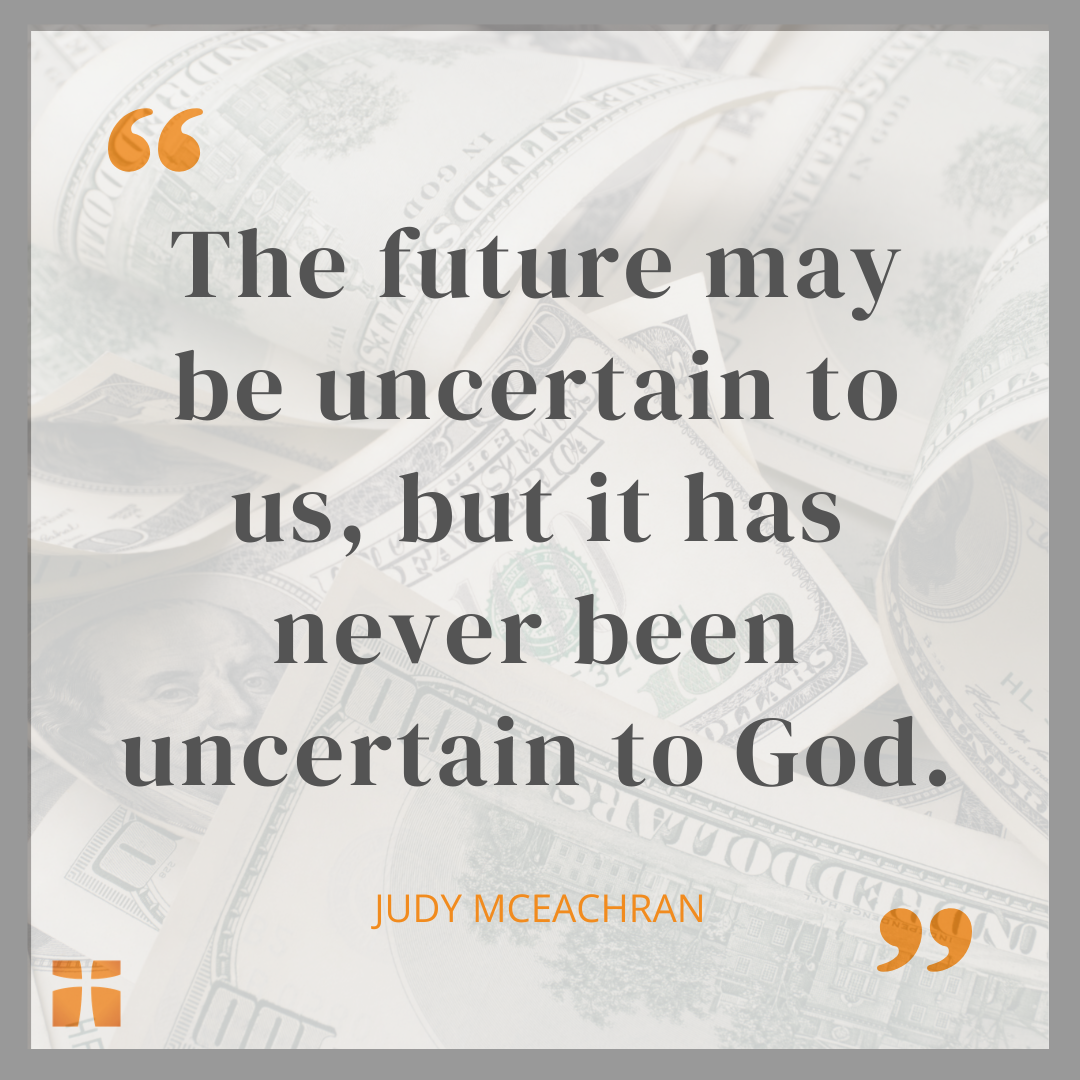
The future may be uncertain to us, but it has never been uncertain to God. He has already walked every tomorrow we fear.
So plan wisely, live faithfully, pray for today's bread, and entrust tomorrow to the Father who has never once forgotten His children.
"The Lord makes firm the steps of the one who delights in Him" (Psalm 37:23). The God who has carried you this far will not abandon you in the years ahead.
The question is not whether we can predict every financial need ahead of us, but whether we will trust the Father who has never failed to meet us in the day of need.
Frequently Asked Questions about Retirement Anxiety and Trusting God
- Is it wrong for Christians to worry about retirement?
Retirement anxiety is a real human concern, but Jesus invites believers to bring tomorrow’s fears to God rather than letting uncertainty steal today’s peace. - Does trusting God mean Christians should not plan for retirement?
No. Scripture honors diligence and wise preparation, but it warns against treating money, savings, or retirement accounts as our ultimate security. - What does daily bread teach us about financial anxiety?
Daily bread teaches believers to depend on God one day at a time, trusting Him for today’s needs and returning to Him again tomorrow. - How can Christians prepare responsibly without anxious hoarding?
Christians can give, save, make a plan, reduce debt, seek wise counsel, and hold every financial decision with open hands before God. - Where should Christians place their hope for the future?
Christians should place their hope in God’s faithful character, remembering that He is already present in every year they cannot yet see.
For Further Reading
- What Does the Bible Say about Retirement?
- Why Should We Not Worry about Tomorrow?
- What Does it Mean to Steward Well What God Has Given Me?
- The Parable of the Rich Fool
- Why Are We Told, “Who of You by Worrying Can Add a Single Hour”?
Photo Credit: ©Getty Images/ Jamie Grill