It was June 28, 1787, in the heat of a Philadelphia summer. For more than a month, the delegates to the Constitutional Convention had struggled with one of the most consequential questions in American history: Could a new nation create a government capable of preserving liberty without destroying the very freedoms it fought to protect?
The Convention had been meeting since May 25. Fifty-five delegates had gathered to determine whether the Articles of Confederation could be repaired or whether an entirely new form of government was necessary. The debate had become increasingly contentious.
There was the Virginia Plan, which envisioned a strong national government based largely on proportional representation. There was the New Jersey Plan, which sought to preserve greater equality among the states. Alexander Hamilton had offered an even more ambitious proposal for a powerful national government.
Each plan had its supporters. None had the majority necessary to prevail.
The delegates were exhausted. Tempers were rising. Some were threatening to leave. Others were beginning to wonder whether the Convention could accomplish what it had been called to do.
When Benjamin Franklin Asked the Founders to Pray
It was at this moment of political uncertainty and frustration that Benjamin Franklin made a remarkable proposal.
Franklin was not simply another delegate. He was one of the most respected figures in America and one of the most intellectually accomplished men of his generation. Yet he was also an unlikely person to call upon the delegates to consider this motion.
Franklin’s religious views were complicated. He was widely regarded as a deist and was not known as an orthodox or traditionally observant Christian. If one were looking for the delegate most likely to invoke divine intervention in the middle of a heated political debate, Franklin would hardly have been the obvious choice.
And yet he did exactly that.
Franklin rose and appealed to something beyond the political wisdom of the men assembled in Philadelphia. He said:
“I have lived, Sir, a long time and the longer I live, the more convincing proofs I see of this truth—that God governs in the affairs of men. And if a sparrow cannot fall to the ground without his notice, is it probable that an empire can rise without his aid?”
Franklin then invoked Scripture, warning that without divine assistance, the delegates might fare no better than the builders of Babel. He concluded with a motion:
“I therefore beg leave to move—that henceforth prayers imploring the assistance of Heaven, and its blessings on our deliberations, be held in this Assembly every morning before we proceed to business, and that one or more of the Clergy of this City be requested to officiate in that service.”
Consider the significance of those words.
The delegates were not meeting to conduct a religious convention. They were attempting to design a government based upon reason, representation, law, and consent. They were debating the distribution of political power and the structure of government.
And yet, at the very moment when their political deliberations were approaching an impasse, Franklin suggested that they begin their deliberations by asking for the assistance of Heaven.
The Motion the Convention Never Voted On
His motion was seconded and debated. The principal objection was practical: there was no money available to pay a chaplain to conduct the prayers.
But something extraordinary happened.
The motion was never voted upon.
That seemingly minor procedural detail may be one of the most significant aspects of the entire Convention.
If the delegates believed prayer had no place in their deliberations, they could have rejected the motion. If they believed that government and prayer were fundamentally incompatible, they could have voted against it. If they wanted to eliminate the issue entirely, they could have tabled the motion.
They did none of those things.
Instead, the motion simply remained unresolved.
Why?
We cannot know with certainty. The historical record does not provide a definitive answer. But the absence of a vote is itself worthy of reflection.
Imagine the significance had the Convention formally rejected Franklin’s proposal.
Such a vote would have made a powerful statement: that the men responsible for creating the nation’s new government believed prayer had no legitimate place in the deliberations of that government.
But that is not what happened.
Nor did they adopt the motion and make prayer a formal requirement.
Instead, they left the question outside the realm of law.
And perhaps that was fitting.
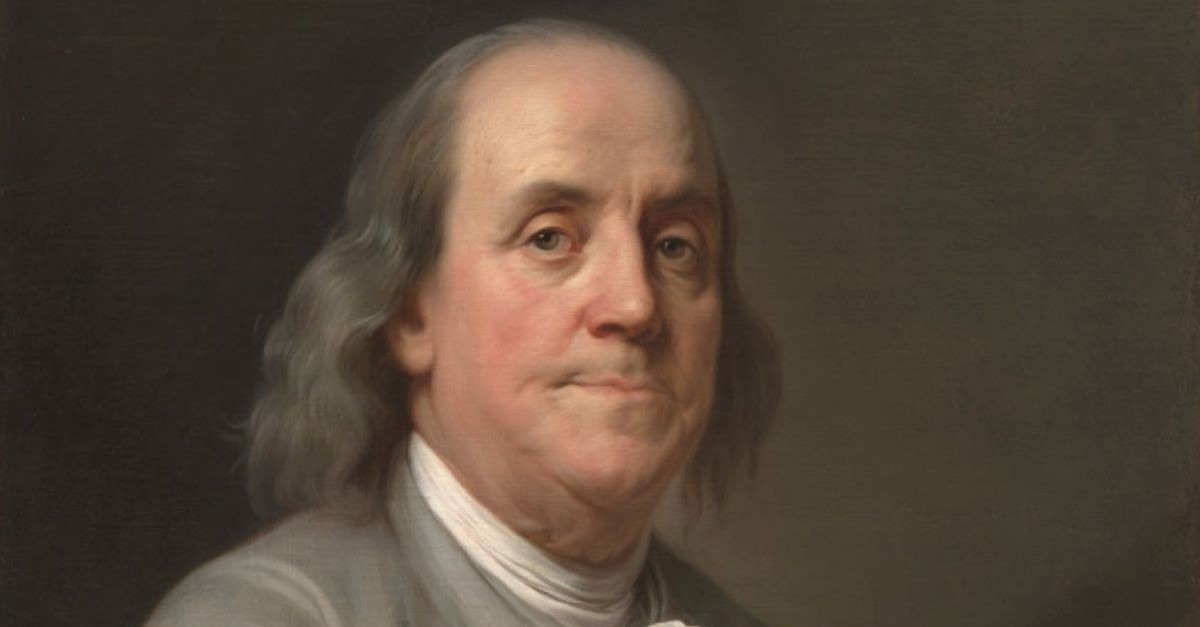
Photo Credit: ©GettyImages/Heritage Images
Religious Liberty Is Not the Absence of Faith
The Founders were creating a government that, among other things, would protect religious liberty, not establish a national religion. They understood the dangers of government dictating matters of faith. At the same time, many of them understood something else: protecting religious freedom is not the same thing as excluding faith from public life.
That distinction is often lost in modern debates.
The First Amendment would eventually prohibit Congress from establishing a religion while simultaneously protecting the free exercise of religion. It did not declare that faith must be removed from the public square. It did not require public officials to be secular. And it certainly did not require the government to pretend that questions of faith, morality, and divine providence did not exist.
Franklin’s motion provides an extraordinary illustration of this principle.
The delegates did not vote to make prayer a requirement of government.
But neither did they vote to prohibit it.
They left room for conscience.
That may be one of the most important lessons of the Founding.
America was not founded as a theocracy. But neither was it founded upon the proposition that religion had no legitimate role in the lives of its citizens or in the moral foundations of the republic.
The Founders understood that government could establish laws, but it could not manufacture either morality or virtue. Government could create institutions, but it could not create strong moral character. Government could protect liberty, but it could not guarantee that citizens would have the moral conviction to use that liberty wisely. Morality could not be created or enforced through legislation alone; it was rooted in the principles of faith, and that faith shaped the character of individuals and, ultimately, the nation.
Those responsibilities ultimately belonged to the people.
What Franklin Understood about Human Wisdom
This is why Franklin’s question remains so relevant.
“If a sparrow cannot fall to the ground without his notice, is it probable that an empire can rise without his aid?”
Franklin was not arguing that the delegates could simply pray and abandon their political responsibilities. Quite the opposite. They were expected to debate, negotiate, compromise, and ultimately make difficult decisions.
His point was that the Convention’s struggles revealed something important: human wisdom, even at its best, is not sufficient on its own.
The delegates had spent weeks arguing. They had competing plans and competing interests. They represented different states and different constituencies. Each believed his own position had merit, yet they could not find a way forward.
Franklin’s proposal, therefore, functioned less as a demand for a religious ceremony than as a reminder of perspective—an appeal to humility in the face of a task that exceeded any one mind or faction.
That is precisely what makes this event in America’s history so powerful.
The Constitutional Convention succeeded not because the delegates agreed with one another, but because they learned how to disagree without destroying the enterprise they had undertaken. They compromised. They listened. They reconsidered. And they ultimately produced a framework that could hold together competing interests.
There is another remarkable irony here.
Benjamin Franklin—the man whose religious beliefs were sufficiently unconventional that few would identify him as a traditional Christian—was the man who reminded the Convention that the success of their political experiment might depend upon divine providence.
Perhaps that is why this Motion deserves to be remembered.
Did Franklin make this Motion because of the influence of his friend, the Reverend George Whitfield, founder of the Great Awakening Movement? Or did he make this Motion because he knew that the question of Divine involvement in the formation of this nation was essential to acknowledge? These questions may never be answered.
The Motion does challenge the assumption that the American founding can be understood exclusively through the categories of secular politics.
The Founders certainly believed in reason, science, representative government, individual liberty, and the rule of law. But many of them also believed that human beings were morally accountable to something beyond government itself.
They understood that a government powerful enough to protect liberty could also become powerful enough to destroy it. They understood that laws alone could not preserve a free society. And they understood that the survival of the republic would ultimately depend upon the moral character of its citizens.
In fact, it was another Founding Father, John Adams, in a speech he delivered to the Officers of the Militia of Massachusetts in 1798, said. “Our Constitution was only for a moral and religious people. It is wholly inadequate to the government of any other.”

Photo Credit: ©GettyImages/sgolan20
Prayer, Public Life, and Freedom of Conscience
That is why Franklin’s motion matters.
It was never adopted as a constitutional requirement. Prayer was not written into the Constitution. The Founders did not create a government in which citizens would be compelled to pray.
But neither did they create one in which prayer was forbidden.
Instead, the American system left room for faith, conscience, and individual conviction.
And that tradition continued.
When the First Congress met in 1789, it began its opening session with prayer. That practice was not created by constitutional command. It was not imposed as a matter of law. It developed as a tradition—one that began at the first Continental Congress in 1774 and one that reflected the belief that public service could appropriately begin with humility and an acknowledgment that those entrusted with political power do not possess all wisdom.
That distinction remains important today.
Prayer in public life is not the same thing as government-established religion.
A prayer does not establish a church.
A prayer does not compel other citizens to believe in a particular faith.
A prayer does not require a particular faith.
What prayer can do is remind those entrusted with public power that they are human beings, that their decisions affect millions of other people, and that their own wisdom is imperfect.
Perhaps that is exactly what Franklin intended.
The Lesson America May Need to Hear Again
The American experiment was born during a moment of extraordinary uncertainty. The delegates did not know whether their new government would survive. They did not know whether the states would ratify the Constitution. They did not know whether the republic they were creating would last a decade, much less more than two centuries.
But they knew they were attempting something unprecedented.
And in the middle of that uncertainty, Franklin asked them to pause.
To pray.
To acknowledge that human wisdom has limits.
The delegates never voted on his motion.
Perhaps history should be grateful that they did not.
Had they voted against it, they might have established a precedent that prayer had no place in the proceedings of the national government. Had they voted for it, they might have transformed a matter of faith into a matter of law.
Instead, they left the question where it belonged: with the conscience of each individual.
That may have been one of the Convention’s most important acts of restraint.
The Founders understood that the government should protect the freedom of conscience rather than dictate the contents of conscience.
And so Franklin’s unanswered motion has endured for more than two centuries.
The Founders created a government of laws. They trusted reason. They embraced debate. They demanded compromise. And they recognized that sustaining such a system would require more than institutional design alone.
But, at a moment when their political experiment appeared to be failing, one of America’s most celebrated Founders stood and asked his fellow delegates to seek the assistance of Heaven.
That was not a demand that America become a religious government.
It was something more fundamental.
It was an acknowledgment of humility.
And perhaps that is a lesson America needs to hear again.
A free people must have the wisdom to govern themselves—but also the humility to recognize that they do not possess all wisdom.
Franklin understood that in 1787.
The question is whether we still understand it today.
Photo Credit: ©CanvaPro/skodonnell from Getty Images Signature

Over the course of his career, Mr. Ross has developed deep expertise in public policy, legislative strategy, and governmental oversight. Elected to Congress in 2010, he represented Florida’s 15th Congressional District for four terms. During his tenure, he served on several key committees, including the House Financial Services Committee, the House Judiciary Committee, the Committee on Education and the Workforce, and the House Oversight and Government Reform Committee. He also served as Chairman of the Subcommittee on the Federal Workforce and United States Postal Service, where he led oversight efforts and advanced reforms to improve government efficiency and accountability.
In addition, Mr. Ross is a Florida Supreme Court Certified Circuit Court Mediator and serves as President-Elect and Board Member of the Former Members of Congress Association. He previously served on the Board of Trustees of Ariel University in Israel.
Mr. Ross resides in Lakeland, Florida, with his wife, Cindy. They have two sons and three grandchildren.