
Prior to 1980, the 10 Commandments were found in nearly every public school. It wasn’t necessarily a declaration of faith, but part of the values on which our nation was built. For 150 years, these commandments weren’t just posted in schools, but taught by general education teachers to their students. After the Supreme Court ruled in 1980 that mandatory postings were unconstitutional, however, the rule was deemed a violation of the First Amendment’s Establishment Clause, which prohibits Congress from establishing a national religion.
Today, the Ten Commandments debate isn’t just political, but deeply spiritual, cultural, and personal. Recently, legislation in states like Texas, Louisiana, and Arkansas has passed laws requiring public schools to post 10 Commandments posters, and many other schools are considering similar proposals. For many Christians, this feels like a huge win and a return to biblical values in public life. For others, however, this raises concerns about religious freedom and the role of government in spiritual affairs.
On March 17th, 2026, however, a more permanent decision was made by U.S. District Judge Timothy Brooks, who ruled that this law violates the Establishment Clause and the free exercise rights of the plaintiffs. His decision has now permanently blocked the Ten Commandments from being displayed at several Arkansas school districts, causing other states and schools to pause. This conversation has shifted from posters displayed in classrooms to how faith is lived, represented, and perceived in a pluralistic society.
As Christians, are we called to advocate for the public display of the Ten Commandments in schools, or to focus more on embodying them in our lives and witness? Furthermore, what is the purpose of God’s law, and how is it meant to function amidst a secular world?
Photo Credit: ©Unsplash/javier trueba

1. What the Ten Commandments Originally Meant in Scripture
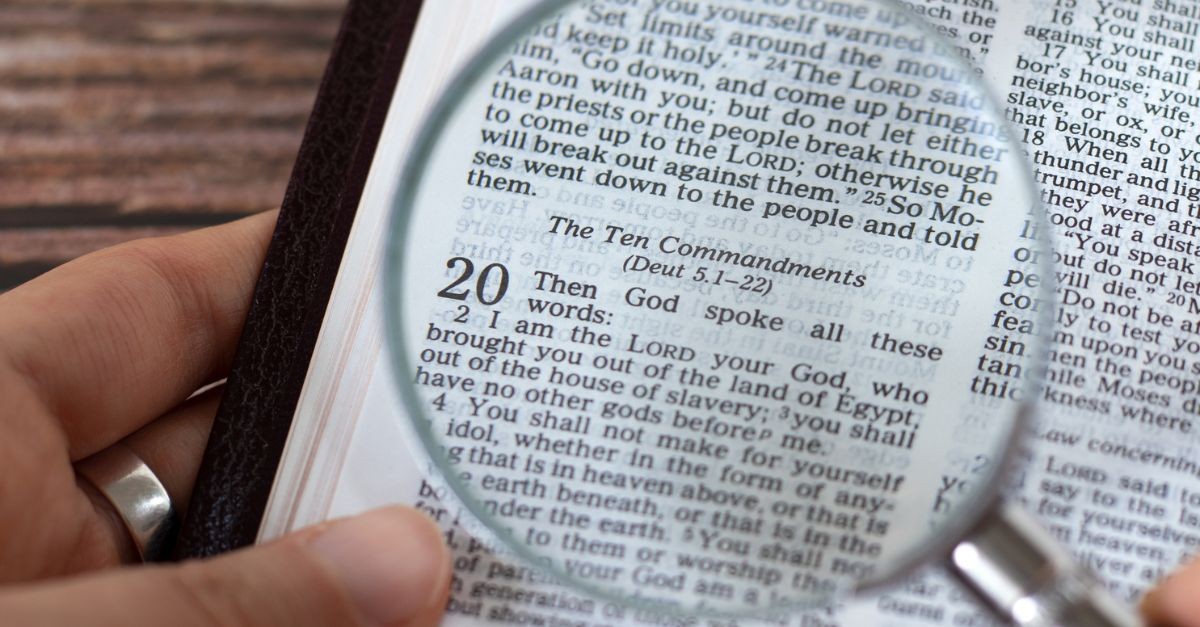
If we trace the 10 Commandments back to their origin, these biblical principles were given in Exodus 20 and Deuteronomy 5 as part of God’s covenant with Israel. They were intended for a specific group of people at a specific time, in a specific covenant relationship. This wasn’t necessarily a universal civic code for all nations, but the words Moses gave the Israelites to keep them close to God’s heart. As we read the commands, we see things that highlight dedication, surrender, and obedience to God. The purpose of these laws wasn’t to control these people, but to help them live the best lives possible. Think of it like this: A good parent gives a child rules to help protect them, not control them for no reason.
The 10 Commandments reveal God’s character as holy, just, and relational. But they also expose human sin and our need for God (Romans 3:20). At the time, these guidelines served as a moral foundation pointing to Jesus and the need for salvation. When Jesus came, He fulfilled the Law (Matthew 5:17), emphasizing internal transformation over external obedience. Because the Law was always about the heart. Underneath the rules and regulations, it summarizes the commands into two key principles: Love God and Love others (Matthew 22:37-40).
Today, you and I live in a world much different than the Israelites. While the Ten Commandments are foundational, they were never meant to function as a standalone tool for societal transformation apart from a relationship with God. Mike Leake, lead pastor at Calvary of Neosho, MO, explains it this way:
“As we reflect on these commandments for our day, we should remember their fulfillment in Christ. His role in this is not just a passing thought but the center of our interaction with these commandments. We, as humans, have already broken the covenant; we have already broken the law. As such, we stand as condemned law-breakers. But this is not true of Christ. He has kept each commandment perfectly, not only by letter but, more importantly, in the heart and spirit. Thankfully, His record becomes ours. As we reflect upon these commandments, we don’t attempt to fulfill them alone or for a right standing with God. That has already been secured through the work of Christ. No, we pursue these because we are accepted. We pursue these because we agree with God about how we should live. We live out the Ten Commandments because we are enthralled with the kingdom of God, and we want to love God and people, fostering a sense of connection and compassion.”
Photo Credit: Getty Images/Marinela Malcheva

2. Why Some Christians Support Posting the Ten Commandments in Schools
Now that we’ve gotten some needed context on the purpose and history of the 10 Commandments, let’s look at why posting them in classrooms has become such a major debate.
On the one hand, the desire to reintroduce these commands brings about objective moral standards. Our generation has concerns about relativism (the view that truth is subjective). Providing these commands would offer some moral clarity in a confusing culture, given their historical influence. For decades, biblical principles have shaped Western law and ethics in the past (for example, the Bill of Rights). Many individuals believe that removing practices like the Ten Commandments, the pledge of allegiance, or prayer directly contributes to moral decline.
Those same individuals believe that reintroducing the commandments in schools could create further evangelistic opportunities. They hope that exposure to some Scripture, even through a poster or a brief teaching, could spark curiosity or faith among the most secular students. Passive exposure can still plant seeds. Remember: We can plant and water, but God is ultimately who makes them grow.
3 Questions to Help You Reflect On this Debate:
- Could reintegrating the commandments reclaim Christian heritage in America?
- Even in spaces where faith is being pushed out of public spaces?
- While these motivations may come from a sincere place, they do raise the question: Can morality be restored through visibility alone?
Photo Credit: SWN Design

3. Biblical Concerns About Displaying the Ten Commandments in Public Schools
Christians remain on the fence about this issue, equally divided. On one hand, faith can’t be legislated. Genuine and authentic faith requires personal conviction, not external forced means. Even when the Israelites had the 10 Commandments, it wasn’t about outward appearance, but the condition of their hearts. Romans 10:9 emphasizes this belief and confession over exposure or mere intellectual knowledge. Sadly, posting commandments in schools won’t automatically produce hearts of transformation. It’s a good start, but not the final solution.
When we place all of our eggs in this basket, students may see Christianity as a list of rules rather than a personal and intimate relationship. We risk them viewing Christianity as superficial, which could reinforce legalism rather than grace. Instead of appreciating the Gospel for what it is, they may see it as behavior modification for “good rewards.”
Since the 1980s, public schools have served students of many different faiths, cultures, and backgrounds. Part of that uniqueness is that these schools aren’t built on any one particular religion, but are supportive of many. If schools begin mandating one religious text, it could create division, resentment, or the requirement to integrate all religious texts when asked.
No matter the decision, we as Christians are called to love our neighbors regardless of their beliefs. Especially in a world where Scripture has often been used as a tool of control rather than liberation, we must be careful not to damage the credibility of our Christian witness. This doesn’t mean backing down or not standing up for our beliefs, but doing so respectfully in a way that makes sense. Because when Christianity is tied too closely to government enforcement, it can distort the message of Jesus, and that’s the last thing we want to happen.
Photo Credit: ©Unsplash/ Jeswin Thomas

4. What the Ten Commandments Still Mean for Christians Today
Regardless of whether the Ten Commandments are placed in schools today, they do still reveal God’s design for human growth and flourishing. They point to values that matter, such as honesty, faithfulness, and respect. They also show us where we fall short and need grace, and lead us toward dependence on Jesus.
As Christians, we must live out the spirit of the Law, and not just the letter. We must live with love and allow love itself to guide us into obedience. The commandments are powerful, but they’re most powerful when they’re lived out, and not just merely posted.
How Christians Can Learn to Pursue an Effective Response
- Live a life marked by the attributes of these commands— a life full of integrity, humility, and love.
- Invest in discipleship—teach young adults what it means to follow these commands and why it matters. Create safe spaces for asking questions and engaging in honest conversations.
- Engage with culture, but don’t become consumed by it. Speak truth with gentleness and respect, and always avoid fear-driven or combative approaches.
- Keep the Gospel front and center. The Gospel changes hearts, but the Law alone cannot.
Questions to Consider Before Responding
- Am I more passionate about displaying Scripture or living it?
- Do my actions reflect the heart behind the commandments, or am I seeking cultural power?
The Ten Commandments are incredibly powerful, but they were never meant to stand alone. Without context, love, and a personal relationship with Jesus, we risk portraying the Lord as a dictator. Our world will be transformed not by what’s posted, but by the love they receive. As Maya Angelou once wrote,
“People will forget what you said, people will forget what you did, but people will never forget how you made them feel.”
In a culture watching us closely, Christians have an opportunity to show that God’s commands are not burdens, but pathways to life. And maybe the bigger question isn’t whether we should post these in schools, but whether these commands are visible in us?
To answer frequently asked questions on this topic, refer to the following articles:
- What are the 10 Commandments and Are They Still Relevant for Today?
- What are the 10 Commandments? List, Origin, and Bible Meaning
- Why Did God Have to Give His People the 10 Commandments?
- Judge Blocks 10 Commandments from Being Posted in Arkansas School District
Photo Credit: ©Unsplash/ Brooke Cagle

Originally published Tuesday, 24 March 2026.

Was this resource helpful? Add Christianity.com as a trusted source for Biblical content.