Table of Contents
- Why Does America Feel So Spiritually Dark Right Now?
- What Does the Bible Say About Light and Darkness?
- Was America Founded On Biblical Principles?
- How Does a Nation Drift into Darkness?
- How Should Christians Respond to Spiritual Darkness?
- What Does Carrying the Light Look Like Practically?
- How Can Believers Carry the Light Right Now?
- Why the Light Has Not Left
- Frequently Asked Questions About Spiritual Darkness in America
- For Further Reading
Every morning in Arizona, the sun rises without apology. Having spent a lifetime in the Midwest, where November skies are gray for weeks at a stretch — cloud cover pressing down nine days out of ten — I am still moved by the sheer audacity of desert light. Full, brilliant, unwavering sunshine greets the day, changing everything. Light makes people feel better. See better. It lifts the spirit, sharpens the mind, and steadies the soul. So I find myself asking a question that has nothing to do with the weather and everything to do with our nation: Why is it so dark in America right now?
It is not a political question, though politics reflect it. It is not merely a cultural observation, though culture embodies it. It is a spiritual diagnosis — one that Scripture anticipated, that history confirms, and that the people of God are called to address.
America feels spiritually dark right now because biblical truth has been pushed to the margins while moral confusion has moved toward the center. This article explores what Scripture says about light and darkness, how the nation drifted from its earlier biblical foundations, and how believers are called to carry the light faithfully in this moment.
Why Does America Feel So Spiritually Dark Right Now?
America feels spiritually dark right now because when truth is rejected, moral clarity fades with it. Scripture teaches that God is light, and where His truth is dismissed, confusion grows. The deeper issue is not simply politics or culture, but a spiritual drift away from the God whose light brings order, meaning, and life.
What Does the Bible Say About Light and Darkness?
The Bible does not merely use light as a poetic device. It declares light to be the very nature of God. “God is light, and in Him is no darkness at all” (1 John 1:5). When Jesus walked the earth, He did not say He brought light, or taught light, or pointed toward light. He says, “I am the light of the world”. “Whoever follows me will never walk in darkness, but will have the light of life” (John 8:12). This is not a metaphor — it is identity. And it means that wherever His truth is welcomed, there is clarity, direction, and life. Wherever His truth is dismissed, something essential is removed.
Imagine walking into a room you have known for years — same furniture, same layout — but the lights are off. Everything feels uncertain. You move cautiously, questioning what you once navigated with ease. The problem is not the room. It is the absence of light. We are living in that room. The furnishings of our nation — its history, its founding ideals, its moral architecture — have not changed. But the light that once illuminated them has been dimmed, relocated to the margins, and in some cases deliberately removed. The result is a nation groping in familiar hallways, calling uncertainty “progress” and confusion “freedom.” The prophet Isaiah named this pattern centuries ago:
“Woe unto them that call evil good, and good evil; that put darkness for light, and light for darkness…” - Isaiah 5:20
The light has not dimmed; it is the darkness that has expanded in its absence.
Was America Founded On Biblical Principles?
For 250 years, America has stood as an experiment unlike anything the world has seen, historically unprecedented in its durability, its liberty, and its foundational acknowledgment of a Creator to whom all are accountable. Consider the numbers alone: the average governing document in world history lasts between seventeen and nineteen years. France has had fifteen different constitutions. America has had one, and it has held for two and a half centuries. That is a framework anchored in something more durable than political theory. That anchor was Scripture.
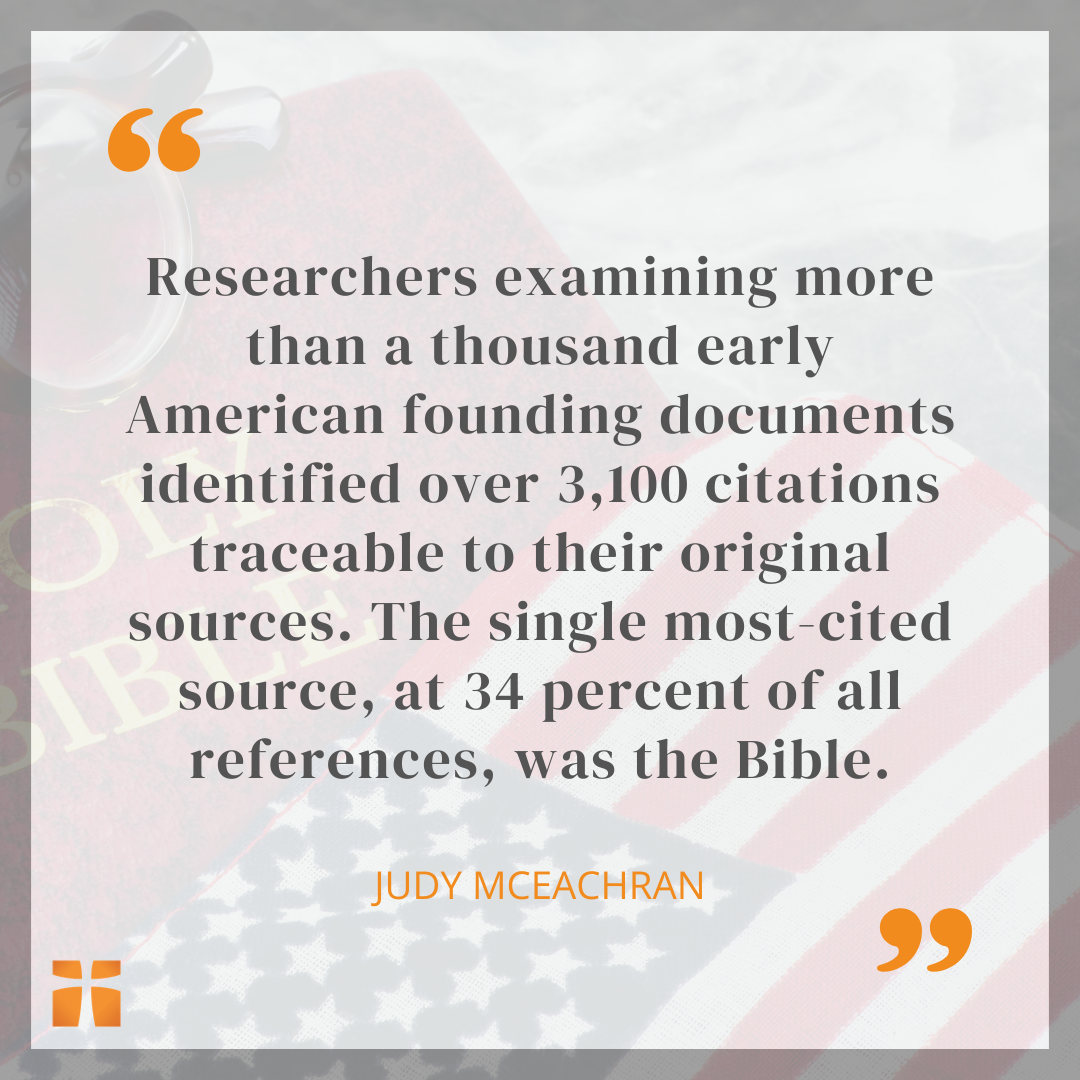
Researchers examining more than a thousand early American founding documents identified over 3,100 citations traceable to their original sources. The single most-cited source, at 34 percent of all references, was the Bible. It outpaced the most influential individual thinkers of the era: Montesquieu, whose two-volume Spirit of Laws shaped legal thinking across the Western world; William Blackstone, whose four-volume Commentaries on the Laws of England trained a generation of American attorneys; and John Locke, whose political philosophy undergirded the Declaration of Independence itself. All of them were influential, but none came close to the prominence of Scripture.
A most persistent myth surrounding our founding is the claim that the Founders themselves were mostly deists, personally indifferent to faith. This claim does not withstand scrutiny of the historical record. Of the 56 who signed the Declaration of Independence, 29 held college degrees from Bible seminaries, receiving formal training in Scripture. These were men whose thinking was saturated in the Word of God, and whose public declarations reflected it. Their own words settle the question. Listen to the signers speak for themselves:
- “My only hope of salvation is in the infinite transcendent love of God manifested to the world by the death of His Son upon the Cross.” “The only foundation for a useful education is religion. Without virtue, there can be no liberty.” — Benjamin Rush, Signer, medical school founder, advocate for Bible-based education.
- “There is no salvation in any other than Jesus Christ.” — John Witherspoon, Signer
- “I am a Christian. I believe only in the Scriptures and in Jesus Christ my Savior.” — Charles Thomson, Signer
- “The fear of God is the beginning of wisdom.” — Richard Stockton, Signer — final words to his children
- “God commands all men everywhere to repent… and believe on the Lord Jesus Christ.” — Roger Sherman, Signer
- “I am grateful to Almighty God for the blessings granted through Jesus Christ upon my beloved country...” — Charles Carroll, last surviving signer of the Declaration
- John Hancock, the president of the Continental Congress whose signature towers above all others on the Declaration, issued twenty-two separate proclamations calling the nation to prayer and fasting — declaring that “the kingdom of Jesus Christ may be established” and calling citizens to “confess our sins and implore His forgiveness.”
This perspective echoed at the highest levels of leadership:
- “Religion and morality are indispensable supports. In vain would that man claim the tribute of patriotism who should labor to subvert the great pillars.” — George Washington, Farewell Address, 1796
- “Our Constitution was made only for a moral and religious people. It is wholly inadequate for the government of any other.” — John Adams, Second President
By 1816, the American government had issued more than fourteen hundred official calls for prayer. Congress itself approved, funded, and distributed a Bible specifically “recommended to the inhabitants of the United States” for use in their schools. This was not religion as a veneer applied to political documents. This was a nation that understood, in the words of Noah Webster, that “the Bible contains more knowledge necessary to man in his present state than any other book in the world” — and that a nation trained in that knowledge was a nation capable of sustaining freedom.
How Does a Nation Drift into Darkness?
How does a nation that began with this foundation find itself in the darkness we now inhabit? The answer is not sudden. Not in one dramatic rejection of God, but in a long series of small substitutions. We have seen this pattern before. The history of ancient Israel is a master study in how a people favored by God drifted so far from His light that catastrophe becomes inevitable. The pattern was never sudden rejection—it was slow substitution. Repeatedly, in the books of the Kings, the same epitaph appears for rulers and nations alike: they honored God on the Sabbath and served Baal on the weekdays. The writer of 2 Kings records the final indictment plainly:
“This happened because they did not obey the voice of the Lord their God, but violated His covenant… they would neither listen nor do it.” - 2 Kings 18:12
The drift in America has followed a recognizable pattern. The Bible, once central to public education and legal reasoning, moved from foundational to peripheral, to optional, to contested. The Ten Commandments, woven into American law since the beginning, were removed from schoolrooms in the 1980s and ordered out of government buildings twenty years later—visible signs of a deeper shift already underway.
The moral consensus that once made a free republic possible has been replaced with whatever feels right to whoever holds the loudest microphone. Before these issues were political, they were Biblical. Abortion — the deliberate ending of the lives of unborn children — mirrors with eerie precision the Old Testament practice the prophets condemned most harshly: the sacrifice of babies to the idol Chemosh, who demanded infant lives as the price of convenience. The redefinition of gender and family, too, is a very old substitution, replacing God’s design with human preference, His categories with ours. “Male and female He created them” (Genesis 1:27). “Be fruitful and multiply” (Genesis 1:28).
These were not cultural suggestions for a particular era. They were the architecture of human flourishing, given by the One who designed the structure. John’s Gospel offers the simplest and most devastating diagnosis of what we are watching: “Men loved darkness rather than light, because their deeds were evil” (John 3:19). The darkness in America is not a mystery. It is the predictable result of a people — including the Church — who grew comfortable with their idols while keeping up the appearances of faith. Slowly, the “other things” crowded out the Light.
How Should Christians Respond to Spiritual Darkness?
But this is not the end of the story. The Word of God and the knowledge of history have preceded every revival. When the Church remembers what was built, and why, and by whose authority, and at what cost — something stirs. The light returns because men and women who carry it refuse to set it down. Jesus did not call His followers to mourn the darkness but to illuminate it. “You are the light of the world. A city set on a hill cannot be hidden” (Matthew 5:14). For 250 years, America has been that city on the hill — a beacon to the nations, imperfect but unmistakable, endowed by their Creator with dignity, freedom, and worth. That light is not extinguished. It must be tended.
What Does Carrying the Light Look Like Practically?
It begins with the Word. Romans 12:1-2 calls believers to the renewal of the mind — a daily, disciplined immersion in Scripture that transforms our thinking, values, and discernment of right from wrong. In an age of noise and narrative manipulation, a believer anchored in God’s Word will not be easily deceived: “Your word is a lamp to my feet and a light to my path” (Psalm 119:105) — a survival strategy.
It continues with prayer — personal and corporate. The Founders called the nation to prayer in times of crisis because prayer changes things. We are invited to the same conviction. It extends into every sphere of home and public life. Christ followers are not called to retreat from culture, but to inhabit it—faithfully living out God’s commands in their homes, workplaces, and communities; serving in positions of public trust; speaking truth without apology; and engaging in civic life in ways that reflect the God-centered principles upon which this nation was founded.
It requires us to know our history — the actual history, not the revision. When we understand who the Founders really were, what they actually believed, and what they deliberately built, we are left with a mandate. They handed us a torch. Will we carry it?
I am grateful for the visible signs of awakening. In this 250th anniversary season, citizens are gathering in Washington to publicly read the entire Word of God, as a national call for rededication and return rises, and believers remember their entrusted heritage. These are not political movements. They are spiritual ones.
How Can Believers Carry the Light Right Now?
Believers carry the light right now by staying rooted in Scripture, refusing confusion, praying with conviction, and living visibly faithful lives in ordinary places. The call is not only to diagnose darkness, but to reflect Christ with clarity, courage, and hope. When Christians speak the truth, love their neighbors, raise their children in biblical wisdom, and remain unashamed of the gospel, the light still shines.
Why the Light Has Not Left
Darkness mirrors evil, and the darkness in America is real—the tangible result of moving the light from the center of our national life to its edges — and in some places, removing it altogether. But light triumphs over darkness: “The light shines in the darkness, and the darkness has not overcome it” (John 1:5).
God is still God. His Word has not changed. His covenant faithfulness has not wavered. Ordinary men and women who carry His presence into the ordinary places of life remain His chosen instrument for pushing back the darkness. Jesus said, “Whoever follows me will never walk in darkness, but will have the light of life” (John 8:12). The city on the hill has not fallen—it simply needs its lights turned back on. Out here in the Arizona desert, the morning light doesn’t ask permission. It spills over the horizon, steady and certain—and the darkness has no choice but to retreat.
Frequently Asked Questions About Spiritual Darkness in America
- Why does America feel so dark right now?
The article argues that America feels dark because truth has been pushed aside, moral confusion has expanded, and the nation has drifted from the light of God’s Word. - What does the Bible say about light and darkness?
Scripture teaches that God is light, Jesus is the light of the world, and darkness represents moral and spiritual confusion apart from Him. - Was America founded on biblical principles?
The article argues that America’s founding framework was deeply shaped by biblical influence and by leaders who saw religion and morality as essential supports for liberty. - How should Christians respond when the culture feels dark?
Christians should respond by renewing their minds in Scripture, praying faithfully, living out truth in public and private life, and carrying the light of Christ into ordinary spaces.
For Further Reading
- What Does “God Is Light” Mean in 1 John 1:5?
- Why Did Jesus Say, “I Am the Light of the World”?
- Where Does the Phrase “A City on a Hill” Come From?
- How to Shine God’s Light in a Season That Glorifies Darkness
- 6 Prayers for Revival in America
Photo Credit: ©Unsplash/Damir Samatkulov + SWN Design via Canva Pro