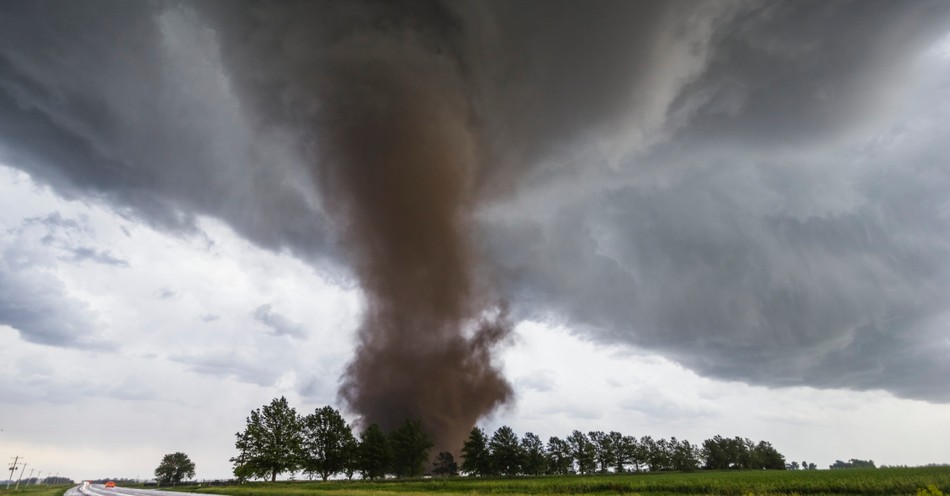
In Three Rivers, Michigan, on Friday, March 6th, 2026, a deadly tornado whipped through, killing 6 people, including a 12-year-old, injuring 12 others, and leaving hundreds reeling from anxiety and terror. Defined as “overwhelming destruction” by the Billy Graham association, the physical calamity was the result of a rare EF3 tornado that touched down in Union City.
With a population of just 1,700 people, several houses in the small town have been completely demolished, while volunteers and first responders are doing what they can to step in and clean up the damage. In the aftermath of damaged homes, settled debris, and closed businesses, neighbors are seen helping each other hold onto hope and what little remains of their belongings.
As the winds have settled, some of the first sounds neighborhoods heard weren’t additional sirens, but faithful, steady prayers. In times of destruction, what does this teach us about our faith?
Christian Chaplains and Volunteers Bring Prayer, Hope, and Help After the Michigan Tornado
While devastating winds ripped homes and lives apart, Billy Graham Chaplains ministered to those in the aftermath of the deadly Michigan Tornado. According to the Billy Graham Rapid Response Team (BG-RRT), chaplains were deployed to the area on Monday, March 9th, 2026, to offer comfort, emotional and spiritual support, and physical resources.
“Entire communities are now facing overwhelming destruction,” Josh Holland, vice president of BG-RRT Global, said. “Our chaplains are going to walk alongside those who are hurting, offering a listening ear, prayer, and the hope that can only be found in Jesus Christ.”
Beyond the BG-RRT, however, many Michigan natives have sought to offer lasting hope and an eternal perspective. On March 8th, 2026, Dan Deazley, a Northville native, carried a giant cross into the scene as a symbol of hope. Traveling to states that are struck by community disasters, his mission is to help people cling to that which can never be taken away from them:
"All I know is this: I've been to a number of these, a number of tragedies. The only thing you can get that'll get them through it is praying to God and letting him into their hearts, and letting him heal them," Beazley said.
Coined as the deadliest tornado to hit Michigan since 1980, Beazley visited the destruction site over the weekend to meet and pray with victims.
"I was able to pray earlier with a young man who had just lost his mom. He had just seen her 30 minutes before that," Beazley said. "A week, a month, even a year later, the community will reach out to me and let me know what the image of the cross meant to them," Beazley added. "After they reflect on it — days, weeks, months later — they know what the cross really means to them and how that touched their lives."
Organizations like the Samaritans’ Purse have also stepped in to help clean up the community. Volunteers are actively sharing the Gospel, sweeping away fallen trees and debris, and praying for victims. But what can you and I do? The Good News of the Gospel is that even from cities or countries away, we can be in prayer for the families affected by this natural disaster.
For more practical steps, one could raise funds to donate towards Michigan’s recovery, organize mission and cleanup crews to head down, provide meals and clothing, host prayer gatherings or worship services, or partner with those already serving the community in need. Regardless, disasters like these teach us that our faith needs to withstand even the greatest horrors. Not because it dismisses the pain we feel, but because it helps us get through it.
Why Does Faith Often Surface After Disasters?
When people experience trauma, it often leads them to search for meaning. They’ve lost everything and have nothing left to cling to. Offering faith alongside practical action steps gives victims language for grief and hope.
According to Calling on and thanking God: the role of faith and faith communities in disaster recovery, faith and faith communities play a critical role in post-disaster recovery because faith is socially shared, a driver of post-disaster recovery, and a catalyst for social capital. The study notes that as a result of these findings, “policymakers must avoid hindering the ability of faith‐motivated entrepreneurs to discover and seize new opportunities. Religious leaders and parishioners have local, context‐dependent knowledge that affords them valuable insights to address their dilemmas entrepreneurially. If public policies serve as barriers to entrepreneurship (including faith‐motivated entrepreneurship), community rebound will be slowed because of increased uncertainty.”
The Center for Disaster Philanthropy adds that these Faith-based organizations (FBOs) and the actions of individuals can meet basic needs, organize and participate in community-led long-term recovery groups, mobilize volunteers, and offer spiritual care. But these practices are things every ordinary Christian can offer to those in need. And they are things all of us should offer.
What Does the Bible Say About Hope after Loss?
In Psalm 46:1, we read that “God is our refuge and strength, an ever-present help in trouble.” Matthew 7:24-25 reminds us that the storms of life (physical, emotional, mental, you name it) will come, but if our house is built on the rock, we will still be standing on a firm foundation.
Living through tragedy is unimaginable to many. I know it’s unimaginable to me, and I won’t try to minimize the suffering our brothers and sisters in Christ are enduring when surviving things like natural disasters. We need to weep with them and support them the best we know how. But we also need to remember that faith doesn’t erase loss, but it does provide grounding during uncertainty. And as these communities begin to physically rebuild, it’s our responsibility to stand by their side in practical action and faith. Love and support and a shift towards realistic hope.
When the physical structures of life collapse, homes, routines, and security, many people discover what their lives are truly built on. This isn’t meant to be a scary threat or a gloom-and-doom reality, but it’s a reminder to continually ask and align yourself with the answer to this question: When life’s storms strip away what feels secure, what foundation are you standing on?
In the meantime, pray for those who are recovering from the disaster in Michigan. Ask God to provide for each of their needs, but also ask Him how you could support them. Is it prayer? Donating money? Physically going to serve? Whatever the action, know that you can support those who are suffering through a community of faith. And as Galatians 6:2 reminds us, it’s our responsibility and honor to help bear one another’s burdens, and so fulfill the Law of Christ.
A Prayer for Those Suffering Loss from Michigan Tornados
Dear God,
Today, we pray for those in Michigan impacted by the deadly tornado. We ask Lord, that in times like these, you wrap your loving arms of protection and strength around them. Remind them that you are with them and care about what they’re experiencing. Grieve with those who are grieving and let your presence be known in a way that only you can provide. We ask that courage may rise, communities may be strengthened through this, and that all needs would be met abundantly and overflowing. Please let our fellow brothers and sisters in Christ know that we’re here fighting and praying for them. We love you, Lord. Thank you, Jesus.
Amen.
Photo Credit: ©Getty Images/Mike Hollingshead