
Schools across the United States are rapidly shifting their approach to artificial intelligence in education, moving from outright bans to structured experimentation and partnerships. The U.S. isn’t the only country integrating AI into education: China, Estonia, Canada, and South Korea are offering educational experiences with AI in the classroom. With many high school students already using generative AI for schoolwork, educators are working to establish boundaries that allow AI to support tasks, like lesson planning or studying, without replacing critical thinking. New initiatives and training sessions are helping teachers learn how to use these tools responsibly. At the same time, experts want to emphasize clear rules and ongoing conversations to prevent AI from turning into a shortcut rather than a resource. The broader goal is to figure out how to help students think deeply, learn honestly, and use technology like AI with purposeful intention rather than lazy dependence.
In many ways, all these guides, conversations, and training sessions are trying to figure out how to teach stewardship. Teachers and parents are trying to figure out how to develop wisdom and discernment in an environment where young people are surrounded by immediately available and unending knowledge. They want our kids to recognize that character, not convenience, leads to long-term success and responsible citizenship in the world. They don't want students to outsource their thinking to a machine. Does access to shortcuts and quick answers change the methods with which critical thinking should be developed? How do we steward technology in the development of character and critical thinking so it does not impede such things?
In 1 Kings 3:4, God appears to Solomon and says, “Ask for whatever you want me to give you.” If we were there in that moment and could sit with Solomon, showing him everything we could do with AI, I don’t think that would have changed his request to God. Solomon asked for a discerning heart and to be able to distinguish between right and wrong (see 1 Kings 3:8). This is what we want to develop in our young people: discerning hearts and the ability to distinguish between right and wrong. That is character. It is critical thinking with an anchor in God.
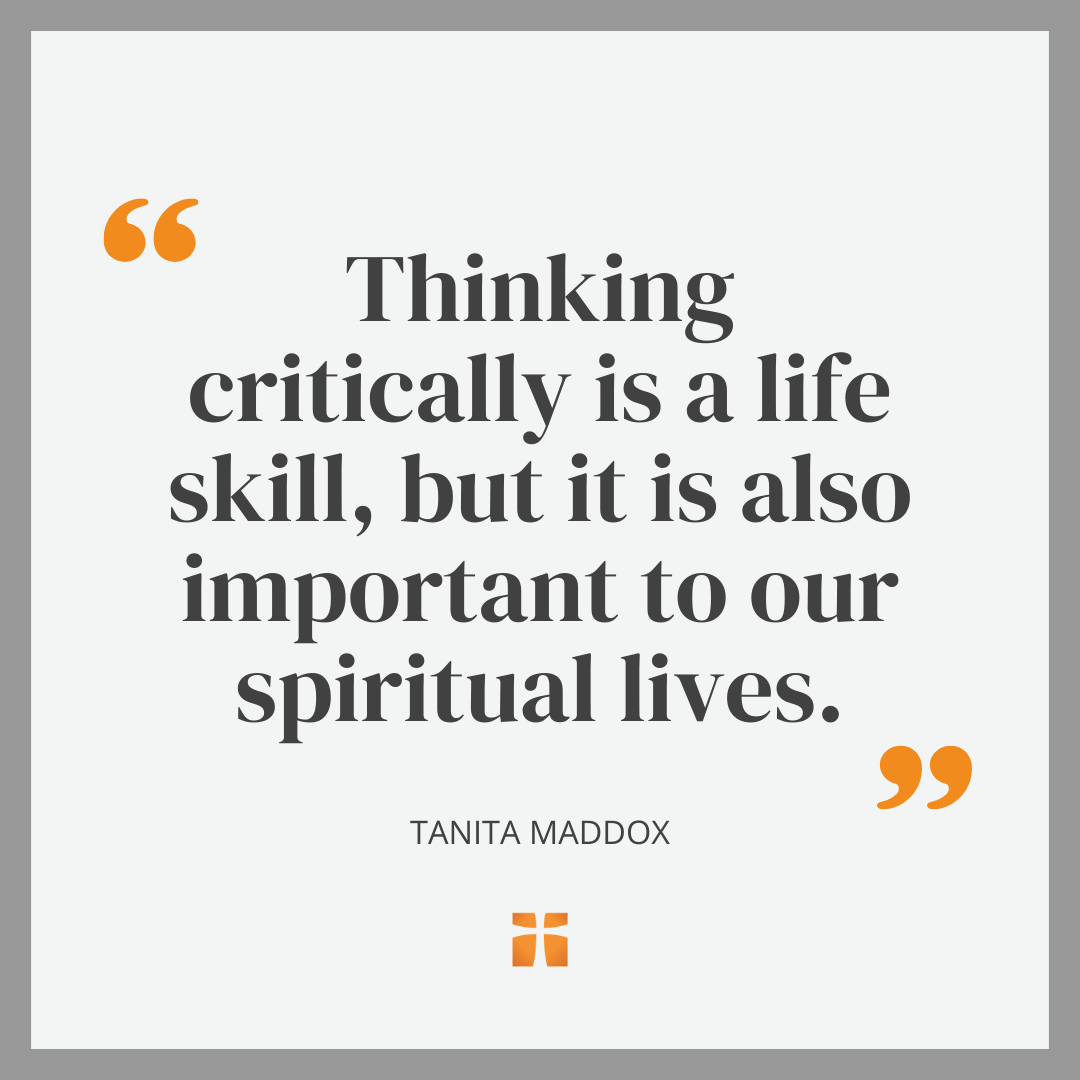
Thinking critically is a life skill, but it is also important to our spiritual lives. Many days, as we engage Scripture and the world around us, we are attempting to process and make sense of the mysteries of God. For example, how did everything come to be? The short answer is that God created the universe and all that is in it. However, it’s not enough to have a simple answer to a complex problem (AI can do that). There is always the “but why?” But why did God create all of this? It is in this “but why” question that we begin to explore so much of what makes God praiseworthy. His love, creativity, power, relational capacity, goodwill, and much more all contribute to why God created. It is part of what makes him a good Creator. The “but why” pushes us to a deeper understanding, and hopefully a deeper love and reverence, for God. We need critical thinking anchored in God, who also created critical thinking.
Many parents have been the recipient of the question, “But why?” And this starts from a young age. My kids were still toddlers when they began to ask, “But why?” But why did they need to wash their hands? But why did they have to hold hands with an adult to cross the street? But why couldn’t they have soda with dinner? The “but why?” is the introduction to critical thinking. It is not a rejection of the answer or premise presented to us, but a request for explaining why it is so.
The “but why?” is our hope for our young people as they grow up in a world with AI readily available at their fingertips. We have an opportunity to curate the “but why?” curiosity and critical thinking in our children as parents and in our students as teachers. This should make all of us think twice before defaulting to the passed-down retort of: “Because I said so.” I’m in for a healthy respect of parental authority (See Exodus 20:12, Ephesians 6:2), but even the Bible explains the “but why” to honoring one’s father and mother: “so that it may go well with you and that you may enjoy long life on the earth” (See Ephesians 6:3).
Let’s take it one step further. When I ask my kids, “But why is something true, right, or fair, I don’t want them to respond, “Because AI said so.” I don’t want them to implicitly accept the responses Alexa, Siri, ChatGPT, or any AI source gives them. I want them to ask, “But why?” It’s not simply about the answers, but the reasons for them. It is similar to the cliche: “It is about the journey, not the destination.” The “but why” helps us better understand the journey.
I minored in mathematics in college, and there were a lot of “proofs” I had to complete. I remember being assigned to prove why (-1)x(-1)=(+1). That one blew my mind, but I learned that it wasn’t enough to simply know that negative one multiplied by negative one equals positive one. I had to be able to know why. The professor pushed us to think critically because he asked: But why? That was when critical thinking kicked in. Think back to high school geometry, and the practice of not only finding the answer, but proving it. It is this kind of proving, through critical thinking, that ultimately helps us to figure out how to identify truth: can you prove it? “Can you prove it?” is another way to say, “But why?”
What if we turned the tables and started asking our children and our students: but why? Start when they are young. When my child asks me what’s for dinner, I can not only respond with the answer, but I can also ask my child, “But why?” Why am I making this for dinner? My child might shrug and say, “I don’t know.” Of course, my child has never critically thought about dinner preparation, but I can invite my child into my process:
-What ingredients and supplies did I have in the house?
-What components of a meal did I want to include (protein, vegetable, starch, etc.)?
-How does this meal fit with the flow of the week or even of that particular day?
-How much time does this meal take to make, and how much time did I have available to prepare the meal?”
-Are there any foods close to their expiration date that need to be used before they go bad?
Yes, my child may immediately regret asking the question. I may even get an eye roll and heavy sigh, but I am giving an invitation into understanding how we think about nutrition, problem-solving, scheduling, and even food preferences and flavors.
Asking “but why?” could become a little too much fun for parents and teachers as we finally get to ask this question after being asked countless times. However, we have an opportunity to set a norm of critical thinking. We can not only provide a response to questions, but then follow up with, “but why?”
This question becomes a wonderful partner in stewarding AI. It normalizes discernment, examination, and critical thinking, rather than simply accepting an AI-generated response or product. Asking “but why?” doesn’t eliminate the helpfulness of AI and doesn’t resign to only relying on AI’s answers. It teaches young people to think critically about the information that is presented to them. It encourages further investigation. It could even encourage prayer if we teach and model seeking God’s wisdom as a key part of the “but why” journey, illustrating a modern Solomon-like posture.
The “but why?” must be cultivated in our kids as an antidote to thoughtless dependence on technology. Encourage our kids to ask, “But why?” We can do so by continuing to ask them, “But why?”
Photo Credit: ©Unsplash/Kenny Eliason