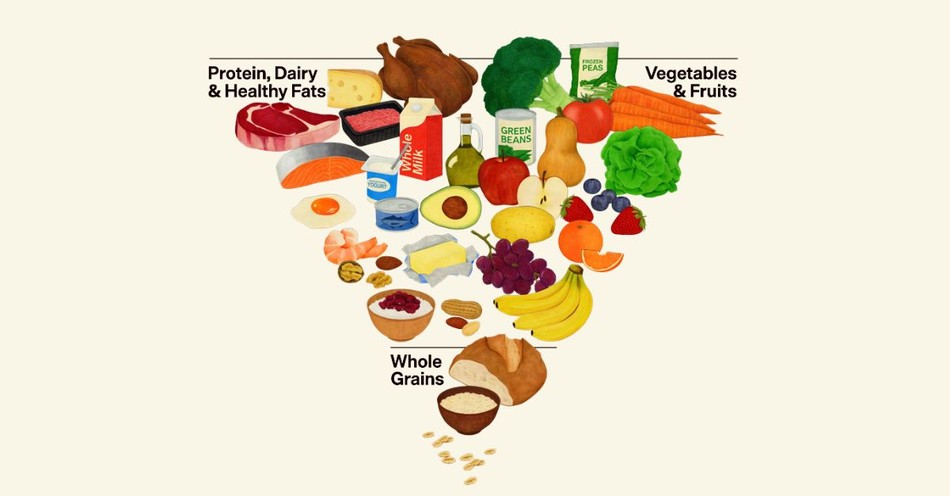
The Trump administration announced new federal dietary guidelines earlier this month that replace the 2011 MyPlate model with a redesigned, inverted food pyramid that prioritizes protein, dairy, fruits, vegetables, and healthy fats while urging Americans to avoid highly processed foods. Additionally, the new pyramid places less emphasis on whole grains, departs from strict limits on all fats, and encourages Americans to consume more protein. Instead of specific daily alcohol limits, there is now broader guidance to drink less. This update marks a significant shift in how Americans are advised to eat and care for their health.
Shifting Nutrition Advice Invites Us to Reconsider Physical Care
Although we are spiritual beings, we are also physical beings. The Bible says our temple is the Holy Spirit. As we know, Christ dwells in us, and God is with us. Additionally, the Bible says our bodies were bought at a price, so we are not our own, but we are to glorify God with our bodies (1 Corinthians 6:30).
Even though this body will fade away, we must take care of it while we are alive. So many are sick today because of years of neglect of proper physical care. In America, we have a very high obesity because of all the processed food we eat, from chips to fast food restaurants. There is an endless supply of food. Regarding restaurants, these companies grow their businesses through the promotion of many items and by meeting their customers' needs. Additionally, there are seasonal items available only for a limited time. We see it through commercials, advertisements, billboards, and social media, which subsequently draws in more customers who are intrigued. After all, it is food, and there’s always a need for it. Therefore, the more appetizing it is, the more customers will buy those food items.
The New Food Pyramid Brings Overconsumption to Our Attention
Fast food aside, overconsumption of food leads to weight gain. Typically, we are supposed to consume 2000 calories per day. Yet we tend to go overboard, consuming more than we should. It’s even worse when there is no exercise in one’s life where one can burn those excessive calories. It doesn’t matter if you are an athlete; a sedentary lifestyle doesn’t do the body good, especially in maintaining a healthy weight.
The Shift to a Long-term Healthy Lifestyle
On the flip side, there are negative effects of diet, as they aren’t effective in the long term. Despite losing weight, we end up gaining it back the moment we step away from it, also known as yo-yo dieting. It makes sense that people would want to end something outside of their diet because it is too restrictive. Believe me, it gets tiring real quick if you don't have variety in your food. Although it is good for a time when wanting to lose some weight, it is not sustainable long-term.
Physical Deficiencies Caused by Unhealthy Dieting
There are also deficiencies that result from dieting. The first is a physical deficiency caused by a lack of nutrients in one’s diet. For instance, a deficiency in fiber, vitamins, calcium, and protein can result in fatigue, constipation, weakened immunity, and muscle loss. That being said, these deficiencies would only be detrimental in the long term, not just to the body but also to the mind.
Psychological Deficiencies Caused by Unhealthy Dieting
But that’s not all, dieting can result in psychological deficiencies such as anxiety and guilt. There is always the feeling of “never enough,” no matter how much you do, or you end up comparing yourself to others who are in better shape than you. But even so, it is easy to overlook what others are feeling despite their success or growth. Everyone struggles to some degree. The problem is that our comparisons leave you feeling fatigued because you are trying so hard to improve. You may have asked, “If only I were more like so and so, then I’ll be happy,” to no avail. As a result, you are not at rest because your mind is not at peace.
The Christian Desire to Glorify God through Wise and Faithful Physical Care
As Christians, we recognize the value of our bodies even more since we’re made in His image and we belong to Him, bodies included. We don’t even have authority over our bodies, for they belong to Him. Therefore, it should motivate us to think about how we eat and take care of our bodies. We tend to think that only the spiritual aspect of our life matters, since we know the body fades away and Christians will be given a resurrected body (see 1 Corinthians 15). Until that glorious day, we are still on Earth in this body, so we must take care of it. What we consume matters, as it will affect us in the long term as we age.
Ultimately, we recognize that our existence is to glorify God. The first question of the Westminster Catechism asks, “What is the chief end of man?” Which is followed by the response, “the chief end of man is to glorify God and enjoy Him forever.” Scripture confirms this truth as all things were created by Him, through Him, and for Him (Colossians 1:16). The apostle Paul says in Him, we live, move, and have our being (Acts 17:28). This harkens back to my previous point that our lives are not our own, including our bodies. Therefore, we are to glorify God with them.
Therefore, it is through the acknowledgement that our chief end is the glory of God that it should be our motivator in every facet of our lives, including our diet, according to His will. He creates us, provides for us, and sustains us, and likewise, we must play our part too in our physical care. Having this divine reality in our lives will make us discern more carefully what we consume. It makes us value our bodies that much more because we are temples of the Holy Spirit. Think about that, the same God who dwelt in tabernacles and temples now dwells in us by His Spirit. Should we not honor Him with our temple, that is, our bodies? Let there be no place for overconsumption, fear, or paranoia. Let us consider what foods do us more good than harm and follow through consistently without over-restriction. It is okay to want to eat out, but only in moderation, such as with friends, family, or by yourself. Additionally, let our fellowship with our brothers and sisters in Christ not be tainted based on diet.
“Let not the one who eats despise the one who abstains, and let not the one who abstains pass judgment on the one who eats, for God has welcomed him. Who are you to pass judgment on the servant of another? It is before his own master that he stands or falls. And he will be upheld, for the Lord is able to make him stand.” - Romans 14:3-4 ESV
Whether your diet is everything, vegan, pescatarian, and so forth, the apostle stresses that we are not to pass judgment on one another because we have been welcomed by God. We are all one in Christ; thus, we are also one with one another. Therefore, division must be nonexistent. Let us treat each other with kindness and love and serve one another. May we keep everything shared here in mind as we walk humbly before our Lord to His glory.
Image Credit: https://realfood.gov/#resources