With the 2026 State of the Union (SOTU) behind us, Christians face a familiar temptation: to confuse a friendly stance toward religion with a commitment to advancing the Christian faith. For Christians who feel they have been sidelined culturally, dismissed by institutions, mocked by popular culture, and pressured to adopt “leftist” ideologies, the instinct to exhale in comfort is understandable. An administration that doesn’t seem hostile, a president who speaks of God, celebrates the return of religion, and seeks to preserve religious liberty feels like a welcome change. Religious liberty matters. An administration’s basic posture toward religion is far from trivial. Christians should be grateful for aspects of any administration that align with the good, the true, and the beautiful.
Gratitude, however, should not keep us from exercising discernment. It cannot push us toward complacency, but reminds us that all goodness, truth, and beauty come from the Triune God. We don’t ignore what is good—we point beyond it to the source of the good as we bear witness to our Lord. As such, we must recognize those times when the good is used in ways that obscure our vision of God or point away from him. This is not a political question, but a theological one. When we hear the language of God and religion, we must recognize the value of gesturing toward transcendence while also acknowledging its limits. Civil religion, particularly American Civil Religion, presents itself as Christianity’s ally while quietly, but persistently, working against it.
What Is American Civil Religion (ACR)?
What’s so dangerous? I still think sociologist Robert Bellah says it best in his analysis of American Civil Religion (ACR):
“The American civil religion was never anticlerical or militantly secular. On the contrary, it borrowed selectively from the religious tradition in such a way that the average American saw no conflict between the two. In this way, the civil religion was able to build up without any bitter struggle with the church powerful symbols of national solidarity and to mobilize deep levels of personal motivation for the attainment of national goals.”
I’ve emphasized portions of Bellah’s quote to underscore the danger of ACR.
3 Reasons American Civil Religion Can Be Dangerous
- It borrows selectively from religious tradition.
While many want to assert that America is a Christian nation, ACR would likely suggest that it is, at best, religious rather than Christian. By selecting from religious traditions, ACR leaves out the most essential aspects of Christianity and thus does not deserve the name. - ACR, like other cults that claim Christianity, uses the language of Christianity while abandoning the substance.
The similarities in language make it difficult to distinguish one from the other. While “Christ” or “Jesus” is normally avoided and, thus, the claim that “Jesus is Lord,” words like “Christian” are employed, but the concepts behind them are changed (see Serpents and Doves for discussions of the use of “Christian” and various biblical texts and theological ideas that are often co-opted for political purposes). Essentially, ACR pulls off a bait and switch that fools us into thinking there is no major difference (if any at all) between ACR and our faith. - ACR aims at something that Christianity does not.
Christianity seeks to make disciples in the name of the Father, Son, and Holy Spirit (Matt 28:18-20). ACR seeks to “build up…powerful symbols of national solidarity and to mobilize deep levels of personal motivation for the attainment of national goals.” It has no vested interest in making disciples for Jesus Christ. While Bellah may be right that ACR is not “anticlerical” in an aggressive or antagonistic sense, ACR is in competition with Christianity. It simply has different aims.
How the 2026 State of the Union Reflects Civil Religion
The religious language in President Trump's 2026 State of the Union (SOTU) address is genuinely different from previous administrations, particularly that of Joe Biden. Compared to Biden’s 2024 SOTU, Trump’s speech includes explicit religious language and an endorsement of religion as a societal good. Biden references certain spiritual ideas like “the soul of the nation,” as well as calling for actions that would resonate with Christians (e.g., care for the vulnerable, equal dignity, etc.), but does not do so with particularly religious language. Trump leans into ACR-like comments, endorsing religious practice, whereas Biden remained generically moral.
To say ACR is problematic is to put it too mildly. It stands opposed to Christianity even when it stands next to Christianity. Its expression as Christian nationalism poses a similar theological problem. The theological problem does not simply involve ACR’s efforts to form people into something other than Christ’s image (though that is a major problem), but its confusion of the distinction between itself, the nation, and Christianity.
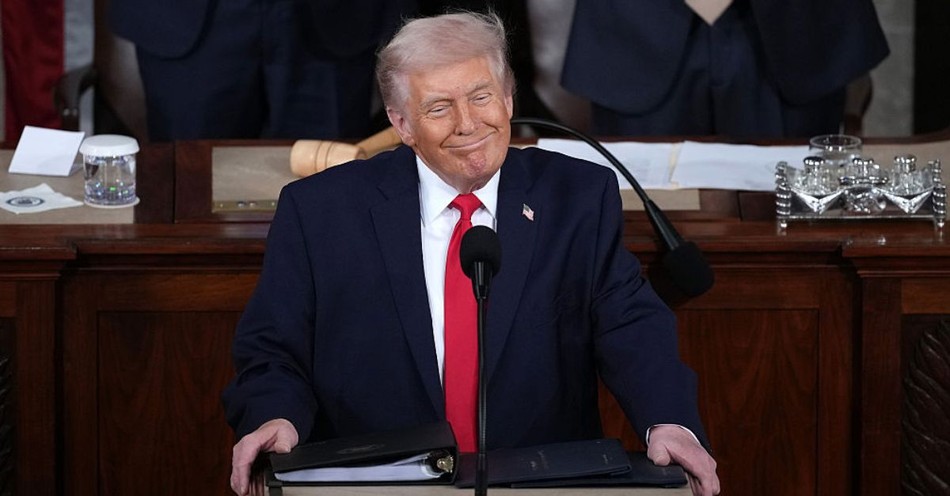
What does all of this have to do with the 2026 SOTU? While President Trump never explicitly references ACR or uses the term 'Christian nationalism,' at least three statements in the 2026 SOTU reflect its assumptions and deserve theological scrutiny.
Before addressing those statements, I want to make clear that my critique is separate from any analysis of President Trump’s fitness or effectiveness. I am as concerned with drifting too far left or right as I am with the tendency to assume that salvation lies in the center. As a Christian, I believe God’s people need to seek the welfare of our nation (Jer 29:7) and respect governing authorities (Rom 13:1-4; 1 Pet 2:13), while refusing to compromise our faith in the face of social, cultural, and economic pressures (Rev 13:16-17; 14:12; 18:4). My concern is not political in any proper sense, but Theo-political in so much as the language used in the 2026 SOTU specifically and ACR more broadly distorts reality, particularly the reality of the Triune God.
3 Statements from the 2026 State of the Union Address That Reflect American Civil Religion
- “When God needs a nation to work his miracles…”
I begin here because it makes explicit the theological assumptions that quietly undergird the earlier statements. This section ultimately illustrates Bellah’s point about ACR. The language draws on religious phrases such as “God,” “miracles,” “providence,” and even “destiny,” but the concepts behind those words do not conform to biblical meanings. Trump notes:
“When God needs a nation to work his miracles, he knows exactly who to ask. There is no challenge Americans cannot overcome, no frontier too vast for us to conquer, no dream too bold for us to chase, no horizon too distant for us to claim. For our destiny is written by the hand of providence, and these first 250 years were just the beginning.”
Suggesting that God needs a nation to work his miracles is theologically problematic on a number of levels.
- God doesn’t generally ask. The nations are already working for him. He is the one who causes nations to rise and fall (Jer 25:8-14; cf. Job 12:23; Dan 2:21). Though I’m inclined to see the first line as rhetorical, it underscores the spirit of the rest of the statement: America is God’s instrument.
- This spirit represents the second theological problem. In presenting America as a robust and capable nation that God can call on, there is at least an implicit message that we are, like the Blues Brothers, “on a mission from God.” The reference to providence makes it clear that America’s past and future exploits have not simply been allowed by God, but are miracles done on his behalf.
I am not suggesting that Trump is constructing a new theology. Instead, I am suggesting the problem is that this language seems relatively natural. If we don’t look too closely, it resonates. It has become part of what we understand ourselves to be as a nation, and it is theologically incorrect. For this sort of language to work rhetorically, it has to be rooted in a shared understanding of reality. That shared understanding is not aligned with God’s self-disclosure. That is the problem.
2. “We love religion, and we love bringing it back.”
Early in the address, Trump says, “I'm very proud to say that during my time in office, both the first four years and in particular this last year, there has been a tremendous renewal in religion, faith, Christianity and belief in God. We love religion, and we love bringing it back.”
- The claim of a “tremendous renewal” is tenuous. Pew Research Center's December 2025 report found that key measures of religiousness in the United States have leveled off — but explicitly concluded that “no revival has been detected among young people.” Pew stated directly that their data shows “no clear evidence that a nationwide religious resurgence is underway” and “no indication that young men are converting to Christianity in large numbers.” A long decline appears to have stabilized, and that is genuinely encouraging news; but stabilization is not revival, and conflating the two overstates what has actually happened.
- Isolated from its context, it could easily be read as suggesting that God has used the Trump administration as God cultivated revival. The statement, however, is uttered as part of a political speech. As such, it is difficult to see it as anything but a claim that his leadership, policies, and allies have made religion great again. It is hard not to hear it as an echo of Eric Trump’s claim that his father’s administration is “saving Christianity…saving God.”
Whatever one may think about the Trump administration’s association with religion and conservative Christianity in particular, Christians of all stripes need to take care not to affirm claims that, at best, lack theological precision. If Trump is saying something similar to Nebuchadnezzar in Daniel 4:30, we should not say, “Amen.” We need to correct such statements, not encourage them.
3. “And martyred, really, martyred for his beliefs.”
The third statement involves Trump’s assertion that Charlie Kirk was martyred. I do not intend to determine whether that is actually the case or not in this piece—not because the question is unimportant, but because my theological concern with the SOTU does not depend on its answer. My concern is not the actual state of things, but the language President Trump uses to describe Kirk’s assassination in the following passage:
“Charlie was violently murdered by an assassin. And martyred, really, martyred for his beliefs. In Charlie’s memory, we must all come together to reaffirm that America is one nation under God. And we must totally reject political violence of any kind. We love religion, and we love bringing it back.”
The way martyrdom is structured within Trump’s argument reflects a mix of politics and religion. Trump never mentions Christ in speaking about Kirk. While he mentions that Kirk was martyred for his beliefs, those beliefs aren’t made explicit. We may assume “Christian beliefs” or “conservative beliefs.” If the ambiguity is intentional, that may well be the point—let those listening fill in the gaps as they desire.
My understanding is that Kirk was a Christian, yet Trump speaks in terms drawn from ACR rather than in explicitly Christian terms. For instance, he encourages all Americans to “reaffirm that America is one nation under God” “in Charlie’s memory” and references the return of “religion.” Both “God” and “religion” are relatively generic and ambiguous (like “beliefs”). Again, his language avoids the potentially alienating, exclusive claims that “Jesus is Lord” that the Triune God is the only God, and that religion can, in general, be good for society, but only Christianity brings new life. ACR avoids such claims because the goal is not to make disciples of Christ, but, as Bellah notes, “to build up…powerful symbols of national solidarity and to mobilize deep levels of personal motivation for the attainment of national goals.”
For Christians, martyrdom involves someone suffering or dying as a direct result of their faith, acting as a witness to Christ and his resurrection. Stephen in Acts 7 is a good example. Trump paints Kirk as more of an American martyr than a Christian martyr. Kirk is credited with helping the Trump administration bring young people back to religion, but he is also used as a ready illustration of the political problems Trump is confronting. As Trump concludes, “Above all, unleashing America’s promise requires keeping our communities safe. We have made incredible strides, yet dangerous repeat offenders continue to be released by pro-crime Democrat politicians again and again.” Trump’s activation of martyrdom does not point us to Christ or encourage us to live with uncompromising faith, but to his administration and to a renewed commitment to ACR.
How Can Christians Be Discerning towards American Civil Religion?
I am of the mind that political authorities are instituted by God to promote the good. I also believe that in every administration, we can find actions and policies that make our country healthier and sicker. My purpose in this piece is not to convey “doom and gloom.” I have no interest in venerating or demonizing Trump. I do, however, have an interest in the church bearing faithful witness by thinking like Christians rather than adherents to ACR.
ACR makes this difficult. Christians need to recognize that ACR has permeated much of public discourse because its assumptions have, to some extent, become ingrained in our collective imagination. The language of ACR works rhetorically because it resonates with beliefs we already hold about ourselves as Americans.
We need to be diligent about identifying assumptions, interrogating them, and rejecting them when they run counter to Scripture.
Thinking Christian (see “The Thinking Christian Framework”) means beginning with an uncompromising commitment to Christ, allowing allegiance to him to shape theological dispositions—a theological sense of how the world works. It means committing to what I call theo-logic, a patient, cruciform, and faithful way of thinking that recognizes obedience as our best option in every situation. It also means engaging in discipline inquiry. We have to take the time to form theological understandings rather than accepting or rejecting something based on our initial feelings. We have to ask more than “Is this administration friendly to religion?” We have to ask, “Do these words, claims, and assumptions conform to the reality of God and what he has revealed to us in his Son and his word?”
The problem is not political in the sense that we normally think of it. The fight between “left” and “right” can become a distraction from a more deeply rooted problem: the co-opting of Christian theological language, biblical passages, or the church to “build up…powerful symbols of national solidarity.” National solidarity is, no doubt, important, but if God’s people are going to build something, they should build the body of Christ for the glory of God and for the sake of the world. That is why we are here. ACR, as passive and friendly as it may seem, stands against the work of the church, sowing confusion and complacency so that God’s people settle for wholesomeness when only holiness will do.
Photo Credit: ©Unsplash/Andrew Harnik / Staff