
Table of Contents
- What Is Bounce Back Culture?
- Myth 1: All Women’s Bodies Recover the Same Way
- Myth 2: Every Mom Has the Resources to Bounce Back
- Myth 3: Mothers Need Perfect Bodies and Perfect Minds
- How Can New Moms Resist Bounce Back Pressure?
- Frequently Asked Questions About Bounce Back Culture
- For Further Reading
From the moment a mother brings her baby into the world, whether her first or fifth, she feels the pressure of the “bounce back” culture. As a woman who just gave birth to her second baby mere weeks ago, I share this from experience. Day after day, morning after morning, I stand sideways and look at my stomach in the mirror, wishing away this little mom pouch that seems more stubborn than I am.
I’ve always been a small, petite gal, thanks to my gene pool, so after baby two, when this loose skin didn’t bounce back in a matter of days (like it did with my first), my brain hit the panic button. How will I fare with swimsuit season around the corner? What will my husband think? My slim body is the one thing I've always felt confident about…now what?
These are the thoughts that plague my mind (though my husband couldn’t care less about my weight and everyone knows I hate the beach), so I wasn’t surprised to find that the healthcare world has seen a surge in freshly postpartum mamas buying into the GLP-1s (weight loss pharmaceuticals, like Ozempic).
Bounce back culture tells new moms that their bodies should recover quickly, their resources should be enough, and their motherhood should look nearly perfect. This article challenges those lies and argues that postpartum recovery is not a competition, motherhood is not a performance, and freedom is found not in perfection but in grace.
What Is Bounce Back Culture?
Bounce-back culture is the pressure mothers feel to quickly return to their pre-pregnancy bodies, energy, appearance, and confidence after childbirth. It often treats postpartum recovery like a race instead of a deeply personal physical, emotional, and spiritual process. For many women, that pressure creates shame, comparison, and unrealistic expectations rather than true health or peace.
I believe this sad stat reveals a few cultural and social concerns regarding motherhood and the burden of perfection it demands. It reveals myths that need to be not only addressed but also busted:
Myth 1: All Women’s Bodies Recover the Same Way
No woman’s body is the same as the next, and the chasm of differences surges following pregnancy and labor. Genetics, medical history, and pregnancy and delivery complications create a unique physical profile for each woman, making it impossible for any woman’s recovery to be the same.
Almost ten years ago, a portion of my cervix was removed, which means conceiving a child should have been complicated. Praise the Lord, it never was. Nonetheless, I still had two drastically different deliveries, and a sweet angel baby in between my boys that I will have the honor to meet one day in heaven.
With my first son, my water broke quickly, but my body wouldn’t dilate. After hours of my body not progressing and endangering my son, I had to take Pitocin. My second son allowed my body to dilate naturally, but it took hours for my water to break. My first son was only four quick pushes, and he was out! Hallelujah! My second son took rounds and rounds of pushing before he debuted. I tore with neither son, but I bruised my tailbone with my second.
I share all this to say that if I am the exact same woman I was when I birthed my children, and my body responded so differently to each delivery, why on earth do we expect women with a completely different set of genetics and circumstances to be evenly compared to any other woman? The only trait across the board that we can guarantee for mamas is that they were handed a divine calling by God Almighty, gifted a body to carry and bring a new baby into the world. For that, all women’s bodies are, quite literally, part of God’s miraculous work and holy, redemptive plan.
Who would ever want to bounce back from that?
Myth 2: Every Mom Has the Resources to Bounce Back
As a former personal trainer, I am all for keeping your body healthy. I recognize the physical and mental benefits of exercising and eating properly. But I also understand that the idea of “bouncing back” often means looking like a size zero swimsuit model and having all the time, money, and childcare to live in the gym and eat all-organic meals. That’s not life, mamas. That’s not the real world. No matter how hard I try, no matter the gym hacks I know and implement, this girl’s hips will never fit into a size zero pair of pants. My bone structure isn’t designed that way. Meanwhile, I’m married to a commercial pilot who is constantly gone, so please tell me when I have the time to hit the gym (especially since I don’t have family nearby to help watch my kiddos).
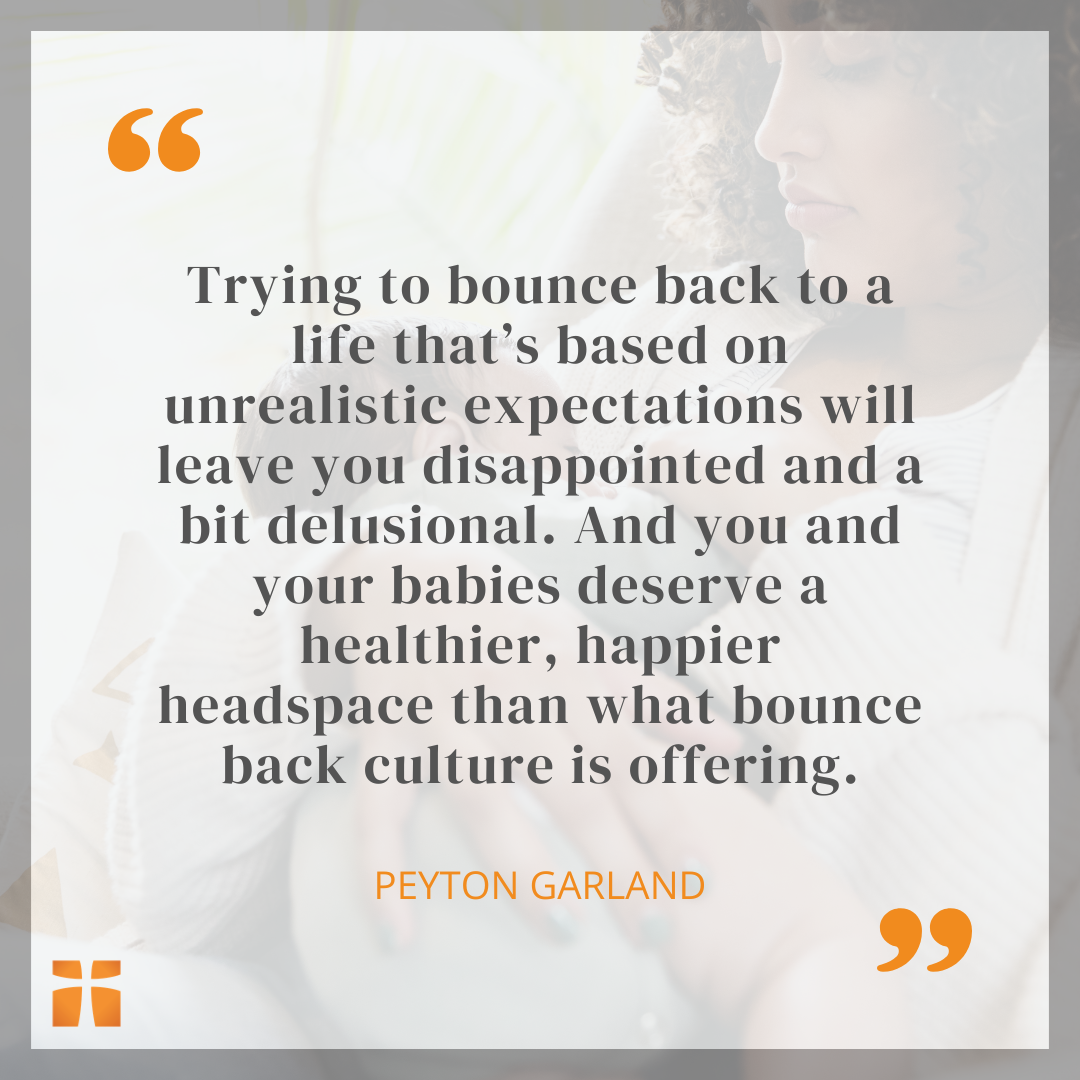
Bounce back culture is founded on unrealistic requirements, which means that all women—all women—can’t and won’t meet its requirements. Think about it: do any of you ever hear how the tabloids bash even Hollywood mamas when they don’t look red-carpet royal just weeks after having a baby? And these are the women who, in theory, should have all the resources necessary to meet the mark. Trying to bounce back to a life that’s based on unrealistic expectations will leave you disappointed and a bit delusional. And you and your babies deserve a healthier, happier headspace than what bounce back culture is offering.
Again, as a former personal trainer, I promise that these quick Instagram hacks and TikTok workout videos are built on unattainable premises. Take care of your body. Get some sunshine. Drink water. Find pockets of space to indulge a hobby to protect your headspace. But don’t chase the shallow promises of a social media reel. Your growing family will offer you far more contentment than that. I guarantee it.
Myth 3: Mothers Need Perfect Bodies and Perfect Minds
I often tell God, “Let me show them the way, but not get in the way.” I want my babies to know Jesus because He’s the only one who can truly protect, save, and keep them. Not me. Do I like this truth? Not really. Do I still try to be the perfect super mom? Absolutely. And I fail miserably. Every time. Nonetheless, I try to remember what my wonderful therapist told me, “You know the difference between healthy families and unhealthy families? It’s the recovery. It’s not if you make the mistake. It’s how you choose to respond after the mistake.”
Raising your children in God’s grace means accepting it for yourself. It means asking forgiveness in front of your children. It means being human. Being messy. Not meeting the mark. And still saying that God is good and there’s joy to be found here on earth. Society, particularly social media content, will convince you that you need a perfect mind and body for motherhood. But the only prerequisite you ever needed was a divine calling from God, and the moment you discovered you were expecting, you had received the calling. The prerequisite was met. Fulfilled by God, with heaven on your side. What more could you or your child need to ensure that you’re enough for the job?
I’m preaching to myself here, as I spend every evening running through lists of things I did wrong or didn’t do well enough for my boys, but if I pitch my mental tent there and dwell on where I didn’t meet my own standards, I’ll always be trapped by guilt and insufficiency. My boys deserve more than that. They deserve a mama who shows them the joy of being forgiven, the peace that comes with saying, “That one’s on mama. I’m sorry,” and the love that flows from a heart that’s free from the burden of perfection.
How Can New Moms Resist Bounce Back Pressure?
New moms can resist bounce back pressure by choosing truth over comparison. That may mean limiting social media that fuels insecurity, caring for the body with patience instead of punishment, and refusing to measure worth by appearance. It also means remembering that postpartum recovery is not proof of discipline or failure. It is a season of healing, adjustment, and grace, and it deserves to be treated with tenderness instead of pressure.
Mama, you can stop making those lists of maternal mess-ups. You can stop turning sideways and looking in the mirror, too. I promise, the beauty you radiate from being free will not only scream louder than any “bounce back” workout photo. Better still, it will last throughout eternity, as you leave a legacy of God-ordained joy for your children to carry through the ages.
“I am reminded of your sincere faith, which first lived in your grandmother Lois and in your mother Eunice and, I am persuaded, now lives in you also.” - 2 Timothy 1:5 (NIV)
Frequently Asked Questions About Bounce Back Culture
- What is bounce back culture?
Bounce-back culture is the pressure mothers feel to quickly return to their pre-pregnancy bodies, appearances, and energy levels after childbirth. - Why is bounce-back culture harmful?
It is harmful because it compares women unfairly, ignores different postpartum realities, and places unrealistic pressure on mothers during a season that already requires healing and adjustment. - Do all women recover the same way after pregnancy?
No. The article itself makes this point clearly: genetics, medical history, pregnancy complications, and delivery experiences all shape recovery differently. - What does God say to moms who feel they are not enough?
The article’s strongest biblical answer is that motherhood is not sustained by perfection, but by God’s calling, grace, and faithfulness. Moms do not need flawless bodies or flawless performance to be enough for the work God has given them.
For Further Reading
- Why Letting Go of Perfection Might Heal Us
- 3 Sneaky Idols Destroying Motherhood Today
- 5 Lies About Motherhood That Are Not Biblical
- 4 Burdensome Lies Mothers Tell Themselves
- What Does the Bible Say about Keeping Our Physical Body Healthy?
Photo credit: ©GettyImages/Olga Pankova