
Restored by Jesus’ Grace
Your Nightly Scripture
Evening Scripture
John, Chapter 21
Afterward Jesus appeared again to his disciples, by the Sea of Galilee. It happened this way: Simon Peter, Thomas (also known as Didymus), Nathanael from Cana in Galilee, the sons of Zebedee, and two other disciples were together. “I’m going out to fish,” Simon Peter told them, and they said, “We’ll go with you.” So they went out and got into the boat, but that night they caught nothing.
Early in the morning, Jesus stood on the shore, but the disciples did not realize that it was Jesus.
He called out to them, “Friends, haven’t you any fish?”
“No,” they answered.
He said, “Throw your net on the right side of the boat and you will find some.” When they did, they were unable to haul the net in because of the large number of fish.
Then the disciple whom Jesus loved said to Peter, “It is the Lord!” As soon as Simon Peter heard him say, “It is the Lord,” he wrapped his outer garment around him (for he had taken it off) and jumped into the water. The other disciples followed in the boat, towing the net full of fish, for they were not far from shore, about a hundred yards. When they landed, they saw a fire of burning coals there with fish on it, and some bread.
Jesus said to them, “Bring some of the fish you have just caught.” So Simon Peter climbed back into the boat and dragged the net ashore. It was full of large fish, 153, but even with so many the net was not torn. Jesus said to them, “Come and have breakfast.” None of the disciples dared ask him, “Who are you?” They knew it was the Lord. Jesus came, took the bread and gave it to them, and did the same with the fish. This was now the third time Jesus appeared to his disciples after he was raised from the dead.
When they had finished eating, Jesus said to Simon Peter, “Simon son of John, do you love me more than these?”
“Yes, Lord,” he said, “you know that I love you.”
Jesus said, “Feed my lambs.”
Again Jesus said, “Simon son of John, do you love me?”
He answered, “Yes, Lord, you know that I love you.”
Jesus said, “Take care of my sheep.”
The third time he said to him, “Simon son of John, do you love me?”
Peter was hurt because Jesus asked him the third time, “Do you love me?” He said, “Lord, you know all things; you know that I love you.”
Jesus said, “Feed my sheep. Very truly I tell you, when you were younger you dressed yourself and went where you wanted; but when you are old you will stretch out your hands, and someone else will dress you and lead you where you do not want to go.” Jesus said this to indicate the kind of death by which Peter would glorify God. Then he said to him, “Follow me!”
Peter turned and saw that the disciple whom Jesus loved was following them. (This was the one who had leaned back against Jesus at the supper and had said, “Lord, who is going to betray you?”) When Peter saw him, he asked, “Lord, what about him?”
Jesus answered, “If I want him to remain alive until I return, what is that to you? You must follow me.” Because of this, the rumor spread among the believers that this disciple would not die. But Jesus did not say that he would not die; he only said, “If I want him to remain alive until I return, what is that to you?”
This is the disciple who testifies to these things and who wrote them down. We know that his testimony is true.
Jesus did many other things as well. If every one of them were written down, I suppose that even the whole world would not have room for the books that would be written.
Evening Reflection
Even Christians have moments where we quit or follow our own path for a time. Fortunately, we have a redeeming, restoring God. We didn’t deserve his mercy the first time, or else it wouldn’t be mercy. The same is true of grace—God’s loving and empowering nature to save and keep us on the right path.
In John 21, we find a narrative with insight into God’s restoration. The night before Jesus’ death, Peter denied being Christ’s disciple. Peter was one of the three closest to Jesus. His denial was extreme. After the resurrection, Jesus seeks out Peter and leads him through a process. First, Christ makes it about love. He keeps asking, “Do you love me?” God doesn’t want someone obligated to follow him. He seeks our hearts first. The greatest commandment is to love God with our whole lives. Jesus brings Peter back to this core, and he does the same with us. Nothing can move forward without establishing, “Do we love him?”
Next, Jesus shifts the focus from Peter to the apostles’ mission—others. God has called us to Himself first, and then to serve others. He’s given each of us a supernatural gift for this. The second greatest commandment, inseparable from the first, is to love others. Our restoration includes loving others freely from our love for God, and his for us. As Jesus did with Peter, our restoration by grace will recenter our hearts on our love for God and others.
Evening Prayer
Heavenly Father,
You restore me when I wander and choose my own way. You show me mercy I never earn and grace that empowers me to follow you. You search my heart and ask what matters most: Do I love you? Draw me again to love you fully, with all I am. Recenter my life on you. Then send me to love others with the same grace you give me. Let my redemption become compassion for the broken, speaking truth and hope to them. Strengthen me to follow you faithfully, anchored in your love.
In Jesus’ Name,
Amen.
How did tonight’s scripture speak to you? Share your thoughts in the Your Nightly Scripture forum discussion.
Photo Credit: ©GettyImages/Tony Rowell
Scripture quoted by permission. Quotations designated (NIV) are from THE HOLY BIBLE: NEW INTERNATIONAL VERSION®. NIV®. Copyright © 1973, 1978, 1984, 2011 by Biblica. All rights reserved worldwide.

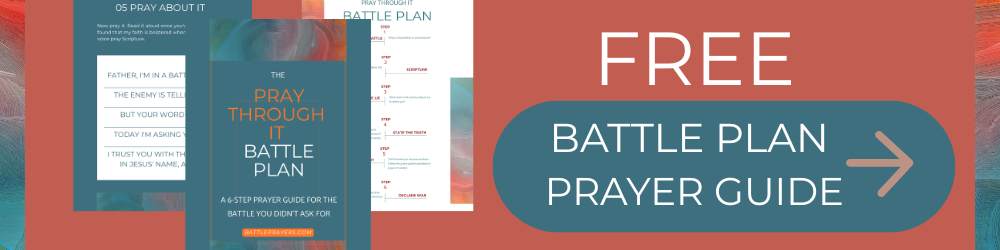
Related Resource: Battle Plan Prayer Guide
For anyone facing a battle they weren't prepared for and didn't know was coming. Inside the Battle Plan, you’ll walk through the same prayer pattern that’s carried me through some of the hardest seasons of my life. Just click below to get your FREE Battle Plan prayer guide.

Was this resource helpful? Add Christianity.com as a trusted source for Biblical content.


