As the Church steps into another year, we do so amid a constant hum of noise—arguments and counterarguments, accusations and counteraccusations. The issues commanding our attention are not trivial. Politics. Failing states. Immigration. Health care. Economic inequality. Climate change. Women’s rights. Gaza. Ukraine. A rapidly shifting global order. These are weighty matters, each carrying real human consequences. They require wisdom, compassion, and moral seriousness. And certainly, our response as the Church of Jesus Christ.
And yet, as I observe how we are engaging this moment, I find myself unsettled—soberingly so. Not because the Church is indifferent to suffering, but because of the manner of our concern.
There is a difference between moral seriousness and perpetual reaction. Increasingly, it feels as though the Church is being drawn into a state of constant agitation—always responding, always reacting, always contending. We are busy. We are loud. We are visibly engaged. And yet, I am not so sure we are truly effective.
The apostle Paul offers a caution that feels particularly timely: “So that Satan might not outwit us. For we are not ignorant of his devices” (2 Corinthians 2:11). This is not a casual aside. Paul assumes the presence of strategy—patterns of influence that succeed precisely because they appear reasonable, urgent, even righteous. Ignorance, in this sense, is not a lack of information. It is a failure of discernment.
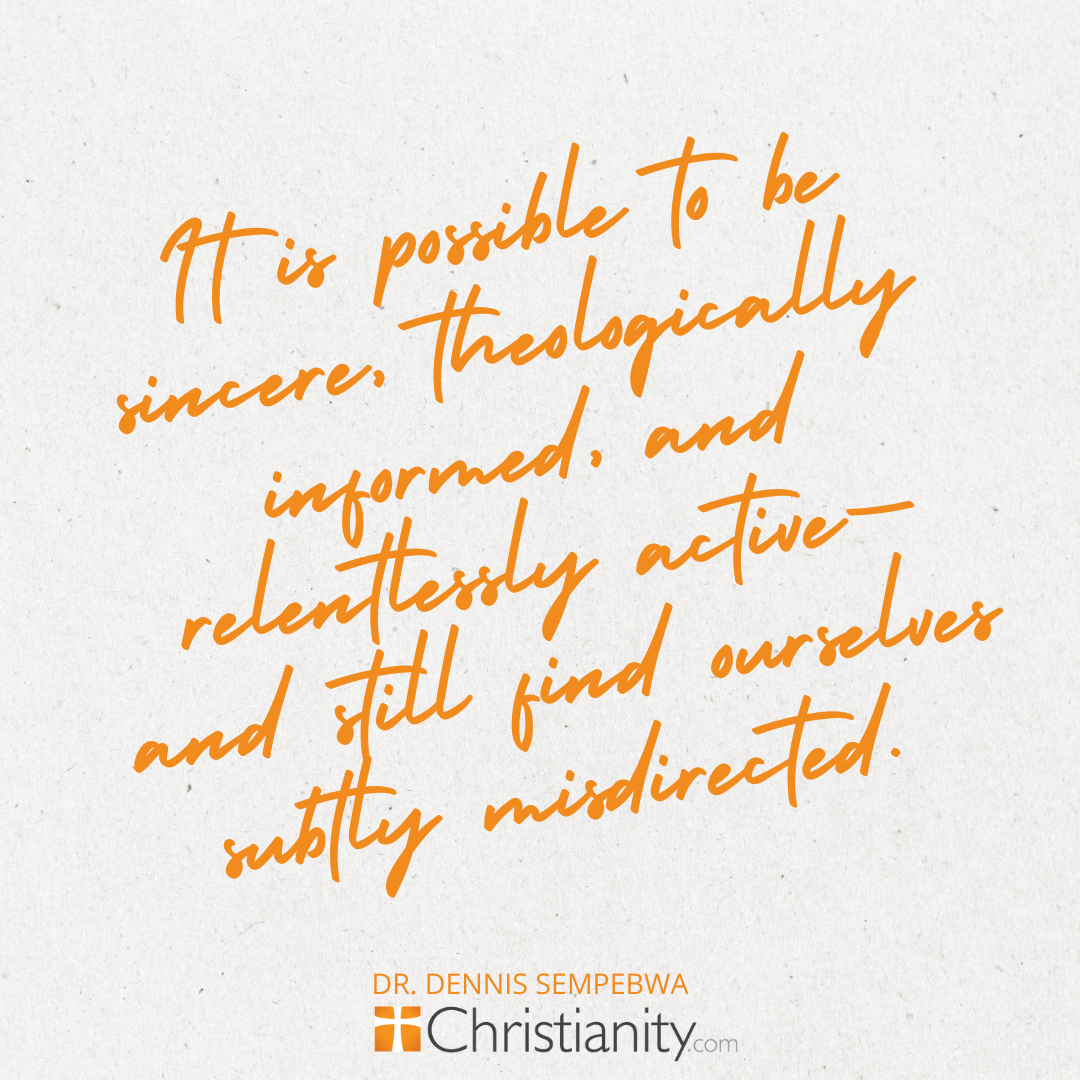
It is possible to be sincere, theologically informed, and relentlessly active—and still find ourselves subtly misdirected. Few tactics are more effective than keeping the people of God perpetually reactive, expending enormous energy while losing sight of what actually shapes hearts to build God’s Kingdom.
History offers a sobering lesson about how wars are lost through misdirection. By the early 1940s, Adolf Hitler was convinced of his own inevitability. A string of victories had hardened into hubris. He no longer saw himself as merely winning battles; he imagined himself reshaping history. A modern emperor. Europe, he believed, would fall.
When the Allied forces prepared to land in Normandy, they did not confront Germany’s strength head-on. Instead, they deceived it. Inflatable tanks. Dummy camps. False radio transmissions. Entire phantom armies. Every signal pointed toward Calais. Germany shifted its best troops to the wrong battlefront. Normandy fell. And with it, the momentum of the war. Germany did not lose because it lacked power. It lost because it was looking in the wrong direction. Spiritual warfare often works the same way.
There is a quiet assumption many believers never pause to question: If I’m fighting, I must be faithful. If I’m busy, I must be winning. But activity is not the same as accomplishment. Movement is not always progress. Our enemy rarely attacks what is most vital first. He targets what is most visible. He pulls us into emotional, public conflicts that seem righteous, but they distract from what truly strengthens God’s Kingdom.
The apostle Paul reminds us, “We wrestle not against flesh and blood” (Ephesians 6:12). The moment people become our primary enemies—political opponents, cultural adversaries, ideological rivals—the Church is misdirected. The struggle shifts from spiritual formation to confrontation. And in that shift, something costly is exchanged, often slowly and unnoticed. We trade formation for contention. Authority for polarization. Witness for factionalism. Faithfulness for populism. Discernment for personality. Depth for the image. These are not minor losses, but strategic ones.
This is not theoretical for me. I grew up in Uganda during the years of civil war. The Church did not face abstract hostility; it faced imprisonment, violence, and death. At a certain point, believers had to ask a hard and clarifying question: Which kingdom are we going to build?
There was real pressure to become primarily political—to speak to foreign media, to appeal to international powers, to counter brutality with rhetoric. Indeed, advocacy mattered, but beneath those pressures lay a deeper decision about emphasis. Would the Church anchor itself in formation: prayer, holiness, endurance, and obedience? Or would you choose reaction? We chose the harder road. And in doing so, we preserved something precious: moral authority. Not because we were loud, but because we were faithful.
The New Testament is unambiguous on this point. Writing to Titus, a young pastor shepherding a fragile church, Paul offers direct counsel: “Avoid foolish controversies… they are unprofitable and worthless” (Titus 3:9). This is not retreat. It is discipline. Simply put, not every battle deserves engagement.
Jesus himself modeled this clarity. Again and again, he is baited into political debates, moral controversies, and public spectacles. And again and again, he refuses to fight on terms set by his critics or anyone else. His life is ordered around one unyielding priority: obedience to the Father. Anything—even something that sounds reasonable—that pulls him from that center is treated as a distraction. So here we are, at the beginning of a new year. Paul’s warning still stands:
“So that Satan might not outwit us. For we are not ignorant of his devices.” - 2 Corinthians 2:11
The Spirit of God is inviting the Church to choose wisely once again. To resist the seduction of constant reaction in a very noisy world and instead rediscover who we are called to be—not merely for this moment, but for the long haul. For our children, and for their children. We must direct our strength, our attention, and our resources toward the real battlefront. Because victory there is what sustains victory everywhere else. If we fight rightly—if we refuse false battlefront—we will not merely survive these times. We will build the Church of Jesus Christ with clarity and endurance. We will form people who are not easily distracted, not easily provoked, and not easily outmaneuvered. And in doing so, we will prepare the Bride of Christ—not for endless skirmishes, but for His triumphal return.
May you have a victorious 2026!
Photo Credit: ©Getty Images/ skynesher