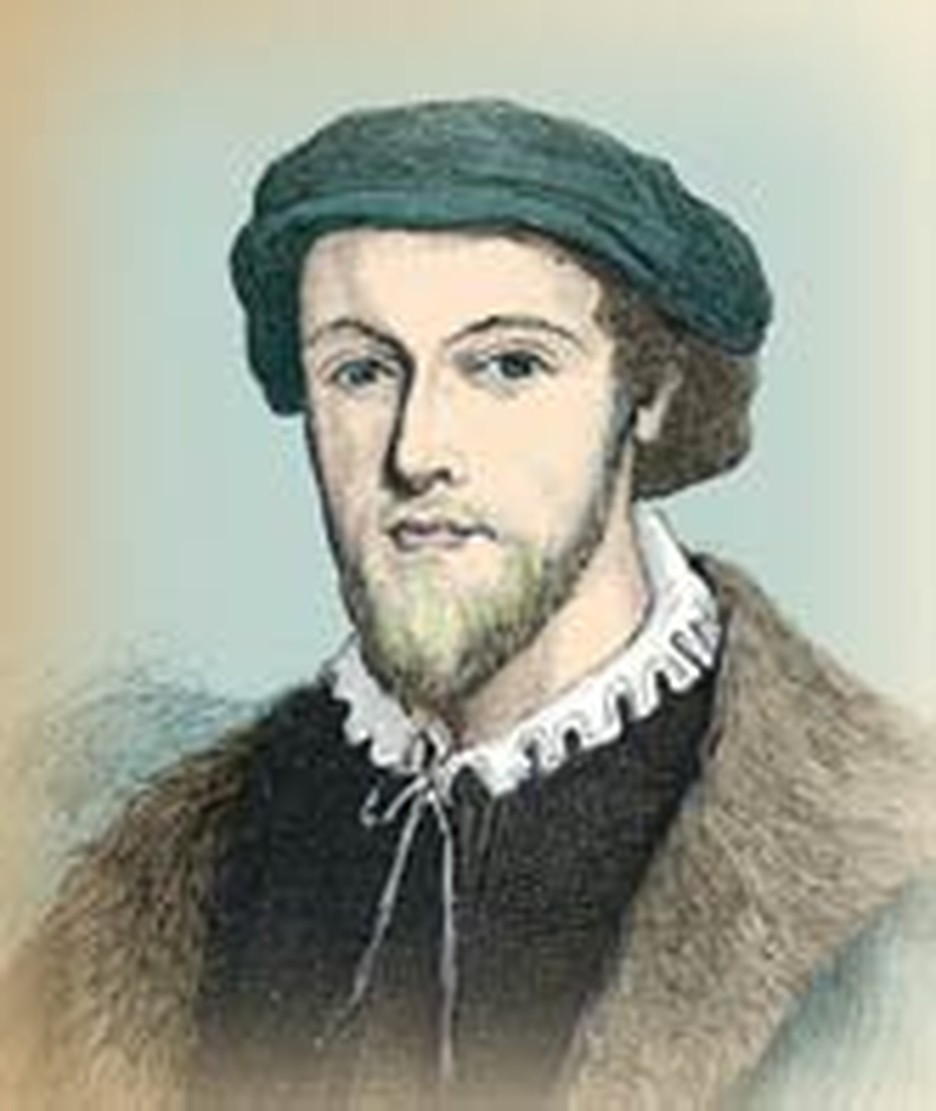
If you think the art of preparing Glimpses for you is easy, then we assure you it is not. This issue is a case in point. Our perennial problem is digesting the massive wealth of material and having to cut so much we'd love to include.
This issue was scheduled to be devoted to John Knox -- the fiery reformer and most influential man in the history of Scotland. But to tell his story, we needed to set the stage for his tumultuous career by noting the catalytic role in his life played by his friend George Wishart. The problem is we found it incredibly difficult to just skip over Wishart with a paragraph or two. He kept growing on us. In short, the issue became Wishart's. Knox will have to wait. Well, not completely, because the following account is abridged and paraphrased from Knox's History of the Reformation in Scotland.
The Place: Pre-Reformation Scotland
The Time: Early 1540s
George Wishart was a man so full of grace there was none that had come before to whom we could compare him. He was unusually gifted intellectually, excelling not only in general studies but also in spiritual insight. In fact, we came to recognize that he was also endowed with the spirit of prophecy, and some of his predictions that were later fulfilled were heard firsthand by many. One instance was what happened at Dundee.
He was at Dundee teaching from the Epistle to the Romans. But Cardinal Beaton recruited a leading citizen of Dundee, Mr. Robert Myll, to publicly interrupt Wishart's teaching and warn him in front of everyone gathered that he was to stop preaching and stop troubling the town right away -- that they would put up with no more of it. Wishart paused a long time, looked up to heaven, then looked upon Myll and the crowd that gathered and said: "God knows that I came here not to trouble anyone but to bring comfort. If you are being troubled, I assure you that bothers me more than it does you. But you must realize that to silence me from explaining to you God's word, and to chase me out of town, is not going to preserve you from trouble. It is just the opposite. It will increase your troubles."
So he left and went to the western region where his teaching was received warmly by many. But again the Cardinal stepped in and influenced the Bishop of Glasgow to interfere. This kind of opposition spread so that George was not allowed to enter churches to teach. Local parishioners who wanted to hear him got so upset they were ready to take over the churches by force to allow him place to teach. But Wishart would not hear of it. There was to be no bloodshed for the sake of gaining a place to preach the Word. He was bringing a word of peace. He reminded them how the Lord Christ Jesus was just as potent in the open fields as inside the walls of a synagogue. So on a pleasant and hot day he went up upon a dyke at a moor's edge on the southwest side of Mauchline and preached for over three hours. There was a large and attentive turnout, and the power of God was manifested. In fact one of the most wicked nobles in the area, Lawrence Rankin, was wonderfully converted that day, tears streaming down his face even in front of the others gathered. And I can tell you even now that his conversion was genuine and has lasted right up till this time.
"More Trouble" Back at Dundee
Four days after he was forced to leave Dundee, the terrible plague broke out there. The death count grew rapidly. Every day more people were dying. When Master George heard of this he went back there right away against the advice of his colleagues. Many rejoiced at his return to minister to them again. He preached at the East Port of the town and taught how death need not be feared if God be trusted. And he did more than preach. Master George attended to the sick, rich and poor alike, tending both body and soul, without concern for his own well being.
Murder Attempt on His Life
During this time, the Cardinal was not idle. He paid a desperate priest named John Wigton to kill Wishart. One day after Wishart had preached, the priest waited until the people disbursed with a dagger in his hand concealed underneath his garment. As George came near to the priest, he perceived something amiss. He said to him, "My, friend, what do you want to do?" As he said that, he rammed his hand upon the priest's concealed hand, shaking loose the dagger which fell to the ground. The priest knew he had been caught and fell down before George and confessed. Some nearby overheard what was going on and started yelling for the priest to be delivered into their hands. Master George protected the priest. He put his arms around him and warned the angry mob that if they were going to hurt the priest, they would have to hurt him also and said, "I am not hurt. But this priest has really done us all a great favor, showing us what we are up against. Now we will know to be more careful and vigilant." That settled the crowd down, and thus both Wishart and the priest had their lives spared that day.
Another Plot Fails
The Cardinal would not give up though. On another occasion he had a phony letter written to Wishart as if it were from his friend, a nobleman John Kinnear, saying he had been taken suddenly sick and urging George to come to him right away. The cardinal had about sixty armed men hidden along the road a mile and a half from Kinnear's house. George left without delay but en route suddenly stopped. "I will not go on. God is restraining me," he exclaimed. Knowing that George was the one they wanted, his companions went on ahead and discovered the gang waiting to finish off George. When the news got back to him, George replied: "I know that I shall finish my life in that bloodthirsty man's hands; but it will not be of this manner."
George was now like an outlaw on the run and had to be careful where he went. He stayed briefly at different places with those who supported his preaching and teaching. He spent a night with James Watson. Let me tell you what happened there, which I know to be reliable because it was reported by John Watson and William Spadin, both credible men who saw this with their own eyes. It was before sunrise and Master George Wishart got up and went outside. John and William were awake and followed him secretly. George went some distance away and entered an alley where he fell down on his knees and began sobbing and groaning. It became more intense. He fell on his face upon the ground. The men who followed, hidden away at a discreet distance, could hear him praying and crying to the Lord. This went on for about an hour. Then he finished, and as he began to get up the two men slipped out of sight and hurried back to the house. George soon returned and headed back to bed. The two men, not acknowledging that they had followed him, questioned him as to where he had gone. He didn't want to answer, but they told how they had observed him and asked why he was in such an emotional state while praying. George related how in that time God showed him, "My end is drawing close." He added: "So pray with me that I will not shrink from the test when things really get tough." These words deeply upset John and William, who began weeping themselves. Master George consoled them with these words: "God shall send you comfort after me. Our homeland shall be illuminated by the light of Christ's Gospel as clearly as any nation has ever experienced since the days of the apostles. And," he added, "this is all going to happen rather soon." --------
Editor's Note
Wishart's end did come soon. Cardinal Beaton arranged to have him apprehended through a trusted nobleman who promised protection. Bishops were convened to condemn Wishart. He was strangled and burned at the stake on March 1, 1546, at the age of 33. His enemies thought they had solved their problem with this pesky advocate of reform. Nothing could be further from the truth. His death set loose forces in Scotland that could never be contained. Shortly after Wishart's execution, a band of men, led by John Leslie, got into the Cardinal's castle early on the morning of May 29, 1546, assassinated him and then rudely disgraced his body. Sympathizers of reform thrust a reluctant Knox into leadership. Knox had been a bodyguard for Wishart. Wishart's impact on Knox's life affected him to the core. He would go on to spearhead national reform and become the most influential man in Scotland•s history. That we will take up in another issue.
From His Friend Foxe
From his famous Book of Martyrs, Wishart's contemporary gives us this firsthand report on Wishart: "About the year of our Lord 1543, there was, in the University of Cambridge, one master George Wishart of Benet's College. He was a man of tall stature, polled-headed, and on the same a round French cap of the best. He was judged to be of melancholy complexion by his physiognomy, black-haired, long-bearded, comely of personage, well spoken after his country of Scotland, courteous, lowly, lovely, glad to teach, desirous to learn, and well travelled. He had for his clothing a frieze gown to the shoes, a black millian fustian doublet, and plain black hosen, coarse new canvas for his shirts, and white falling bands and cuffs at his hands. "He was modest, temperate, fearing God, hating covetousness; for his charity had never end, night, noon, nor day. He went without one meal in three, one day in four for the most part, except for something to comfort nature. He lay hard upon a puff of straw and coarse, new canvas sheets, which, when he changed, he gave away. He had commonly by his bedside a tub of water, in which (his people being in bed, the candle put out and all quiet) he used to bathe himself. He loved me tenderly, and I him. He taught with great modesty and gravity, so that some of his people thought him severe, and would have slain him; but the Lord was his defense. And he, after due correction for their malice, by good exhortation amended them and went his way. Oh, that the Lord had left him to me, his poor boy, that he might have finished what he had begun!"

Was this resource helpful? Add Christianity.com as a trusted source for Biblical content.