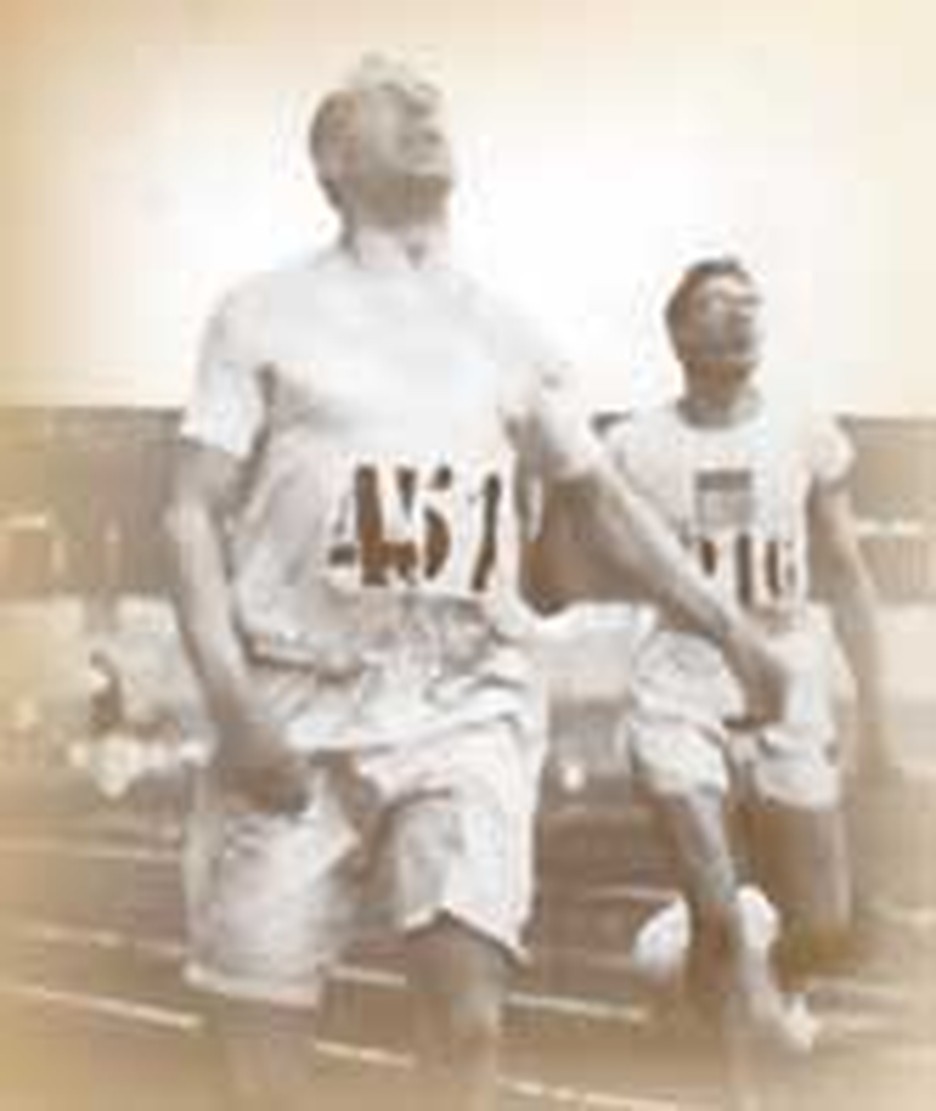
Athletes all around the world dream of winning Olympic gold. It is the ultimate achievement, the pinnacle of success. Imagine you are at the top of your game, the best in the world, if only for a short while. But what do you do next? How do you top an experience that exhilarating? What else can command the single-minded focus and energy that was once given over to the dream of winning Olympic gold?
Few Olympians have responded to these questions as did Eric Liddell. Millions have seen the story of his Olympic triumph portrayed in the film Chariots of Fire, but the movie tells only a part of Eric's heroic story. Following his stunning victory in the Olympic 400-meter dash in Paris in 1924, Eric chose to follow God's call as a missionary in China. Here is the rest of his story.
After the Race
Eric returned from the Paris Olympics a national hero, but he did not choose to live the life of a professional athlete. The following year, at the age of 23, he returned to China, the land of his birth, to join his parents and his older brother Rob on the mission field. After 14 days on the Trans-Siberian Railway, Eric arrived at his destination. His first assignment was teaching at the Anglo-Chinese College in Tientsen. In addition to his teaching responsibilities, he was also Sunday school superintendent at Union Church, where his father was the pastor.
Marriage in Mind
Before long, Florence Mackenzie caught Eric's eye. Under normal circumstances, Eric would have probably begun a traditional courtship, but circumstances were not normal. Florence was only seventeen years old (Eric was 27 at the time) and a senior in high school. Because he did not feel he could single her out, Eric befriended the whole senior class at Florence's school. This way, when he invited them to tea or an outing, his attentions to Florence would not appear suspicious.
That year, affection grew into love, and Eric asked Florence to marry him the following summer. She accepted, but the wedding would not occur for several years. That fall, Florence returned to Canada to begin her training as a nurse. While Flo was pursuing her education, Eric returned to Great Britain on furlough and was ordained as a minister in July of 1932. Following his ordination, he spent six weeks with Flo and her family in Toronto, and their wedding date was set for March 1934. By September of 1932, Eric had returned to Tientsen.
Two Names in a Hat
Two years passed quickly, and Eric and Flo were married at Union Church in Tientsen on March 27, 1934. Patricia Liddell was born about a year later, and Heather joined her older sister Patricia within two years of her parents' marriage.
Florence Liddell was fond of recounting the story of how Heather got her name. Although Eric wanted to name his daughter Heather after the purple flowering shrub that grew in his native Scotland, Flo was less than enthusiastic about the name. Eric offered to solve the dilemma by putting both his choice and Flo's into a hat. They agreed that their daughter's name would be whichever was drawn from the hat. When the name "Heather" was drawn, Flo stood by their agreement and announced that would be their daughter's name. But Eric could not keep a straight face. He reached into the hat and withdrew the other slip of paper, which also had "Heather" written on it!
What is sometimes missed in talking about Eric the athlete or Eric the missionary is his sense of humor and deep devotion to his family. His oldest daughter, Patricia, once stated that the most important thing she remembered about her parents was their great sense of joy together.
Increasing Danger in China
Although the Liddell family's happiness shone brightly for all to see, around them clouds of unrest and threats of war darkened the horizon. As China sought to control her own destiny, fighting ensued between Communist and nationalist factions. In addition to internal conflict, there was also the threat of an invasion from Japan.
The London Mission Society approached Eric about the possibility of leaving the city and ministering to those in the war-torn Chinese countryside. Siao Chang on Northern China's Great Plain was one of the hardest hit areas. Eric's brother was already working in the hospital there, and Eric agreed to join him. It was not an easy decision, however. Eric knew that it would be unsafe to bring Flo and the girls to Siao Chang, so he reluctantly parted with them.
Challenges at Siao Chang
In December of 1937, Eric boarded a boat to make the ten-day journey to Siao Chang. There, he stayed in the mission compound he had once lived in as a small boy when his parents ministered in the area. The Chinese called him by the same name they had once called his father‚ Li Mu Shi. Li was a shortened form of his last name and Mu Shi was the Chinese term for "pastor."
Upon his arrival, Eric was faced with the enormity of the task to which he had been appointed. Siao Chang was the center for mission activity in the surrounding area of over ten thousand villages. Eric's responsibilities included traveling from village to village, encouraging the Chinese Christians and holding evangelistic meetings for those who had never heard the Gospel. Eric and his interpreter, Wang Feng Chou, traveled the countryside on bicycle. Often, however, the road was rough and potholed, and it was not uncommon for Eric to return from a trip with his body covered with bruises from falls sustained on the rough roads.
Eric's influence was quickly felt in this war-torn area. Before his arrival, the London Missionary Society Hospital refused to treat Communist and Japanese soldiers for fear of angering the Chinese government. But Eric helped anyone who needed help, regardless of their affiliations. When asked why he helped "the enemy," Eric answered simply that they were loved by God. Others soon began following his example.
Parting from Family
In 1939, Eric and Flo left China on furlough. They took Heather and Patricia to meet family members in both Canada and the UK. But when they returned to China the following year, they found that unrest and violence had increased while they were gone. Siao Chang was now occupied by the Japanese military, and conditions had deteriorated considerably. It was soon evident to Eric that he and his family were not safe in China. He was shot at on the road, and when he witnessed a doctor being beaten by a Japanese soldier, he realized that even the hospital was not safe.
A mere five months after his return to Siao Chang, the Japanese ordered all foreigners to evacuate the area. Returning to Tientsen to be with his family, Eric realized that conditions were not much better there. Flo was expecting their third child, and they reluctantly decided that it would be safer for her and the girls to leave China. Eric would stay in China and continue his ministry, but the rest of his family would travel to Canada and remain there until the war ended.
Ministry in Captivity
By 1942, it seemed to Eric that he could no longer minister effectively in China. The Japanese had banned meetings of more than ten people and quarantined foreigners with electrified fences. Eric had hopes that he would soon be able to join his family in Canada, but in March of 1943, all foreigners that Japan considered its enemies were ordered to prepare for detention in the Weihsien Internment Camp. Eric never saw freedom again.
Rather than resenting his captivity, however, Eric found numerous ways to serve others, especially the young people, and make their captivity lighter. When one of the teenage girls expressed an interest in chemistry, Eric took it upon himself to organize a chemistry class. Since there were no textbooks or equipment, he spent hours sketching equipment and detailing the results of experiments they could not perform. Eric also organized athletic events for the children, and his door was always open to any of them who needed him. His fellow prisoners would remember Eric as a man who did whatever he could to help people, and they were especially impressed by the way he lived out the Sermon on the Mount.
But while Eric was helping the children of Weihsien, his own children were missing him, almost as much as he was missing them. Florence gave birth to their third daughter, Maureen, after leaving China, and it bothered Eric greatly that he never held his youngest daughter in his arms. Eric poured his heart out in his letters to his family, and he told Flo in a letter on March 27, 1944, that she seemed "very near today." Eric's oldest daughter, Patricia, often asked tearfully why her father was not with her. This question remained unanswered in her mind until she met the children her father helped in the internment camp. Many of them were separated from their parents, and as Patricia realized, God used her father to help ease their suffering.
A Final Request
In the winter of 1944, Eric's friends began to notice changes. His quick and witty repartee slowed, and he thought before speaking, something they were not used to. Eric was not one to complain, but he mentioned severe headaches with increasing frequency. It became evident that he was severely ill. He was soon confined to the infirmary, and his health quickly deteriorated. Knowing this, some of his friends who had formed a Salvation Army Band stood outside his window to play for him. Eric requested to hear Sibelius' tune "Finlandia," usually sung with the text "Be Still, My Soul." The lyrics to this song are especially poignant, considering that Eric died just a few weeks later.
Be Still, My Soul
Be still, my soul! The Lord is on thy side.
Bear patiently the cross of grief or pain.
Leave to thy God to order and provide.
In every change, He faithful will remain.
Be still, my soul! Thy best, thy heavenly friend,
Through thorny ways, leads to a joyful end.
Be still, my soul! The hour is hastening on
When we shall be forever with the Lord.
When disappointment, grief, and fear are gone,
Sorrow forgot, love's purest joys restored.
Be still, my soul! When change and tears are past,
All safe and blessed we shall meet at last.
Eric's Legacy
Although Eric was acclaimed as a national hero because of how he ran his Olympic race in Paris on July 11, 1924, this is not why we remember him as a hero. Dozens of other Olympians won gold in the 1924 games, and few, if any, are remembered today. The athletic heroes of yesteryear are seldom considered heroes by succeeding generations, since they are often quickly replaced by the newest sports sensation. Eric Liddell remains a hero today because of how he ran the race of life. He did not live his life to earn prizes or the applause of other people. Rather, he lived his life and ran his race to glorify God. His legacy lives on in the people he influenced for God and the example he leaves for all of us to follow.

Was this resource helpful? Add Christianity.com as a trusted source for Biblical content.