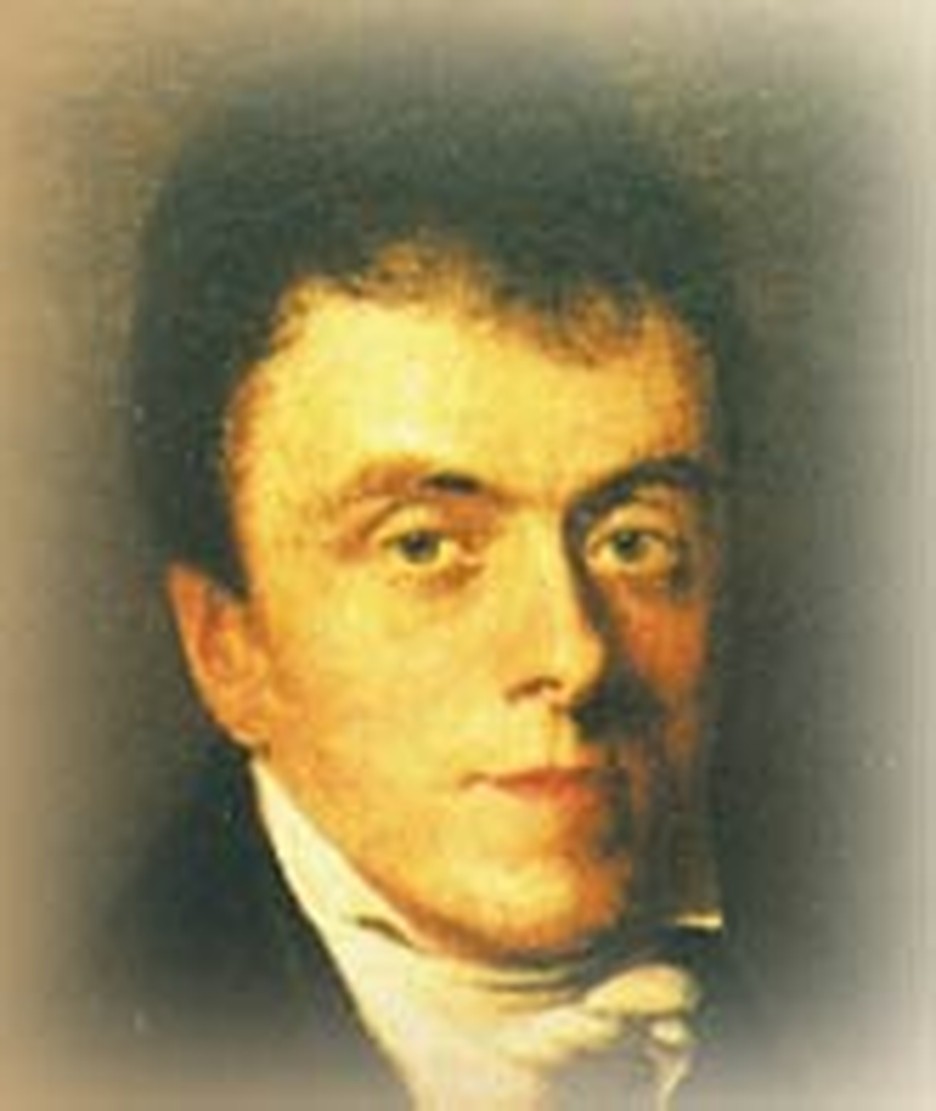
Now let me burn out for God!" exclaimed Henry Martyn when he arrived in Calcutta in April, 1806. But he probably had little idea how fast the blaze would consume him. He died six years later at the age of 31. Eager to devote his life to the Lord's work in India, with an incredible determination and unselfish dedication, Martyn compressed a lifetime of service into those six years.
Born in 1781 in Cornwall, England, Martyn had planned to study law, but while at Cambridge, Pastor Charles Simeon of Holy Trinity Church stirred Martyn's interest in the Far East with stories of William Carey's work in India. The shoe cobbler Carey had gone to India in 1792, and within ten years had established a strong gospel witness in the region of Bengal. Martyn was also deeply moved by reading the journals of David Brainerd, the Puritan missionary in North America who passionately labored among the Native Americans in the cause of Christ.
More interested in profits than eternal souls, the British East India Company didn't want missionaries in their territories upsetting the population and trade. Charles Simeon, however, quietly worked with Charles Grant on the East India Company board to have evangelical men appointed as chaplains to the East India Company. While ministering to the English in India, such men could also take advantage of their opportunities to spread the gospel among the natives! Henry Martyn became one of several of Pastor Simeon's young men who went to India as East India Company chaplains.
As if Every Friend was Dead
Sailing from England, Henry left family, friends, and Lydia, the woman who had captured his heart. He shed tears and thought of the roaring seas, which would soon be rolling between me and all that is dear to me on earth .... My feelings were those of a man who should suddenly be told, that every friend he had in the world was dead. It was only by prayer for them that I should be comforted; and this was indeed a refreshment to my soul, because by meeting them at the throne of grace, I seemed to be again in their society.
Once in India, Martyn spent the first five months in Serampore, waiting for his assignment. He lived with the Rev. David Brown and his family. Another protégé of Simeon's, Brown was chaplain of Fort William in Calcutta and a Hebrew scholar who encouraged Bible translation into the many Oriental languages. William Carey's Baptist missionary group was also at Serampore, and Martyn was able to meet the "Father of Modern Missions." Carey was delighted with Martyn and declared that wherever Martyn was, no other missionary would be needed. Martyn's zeal for the gospel, humble spirit, and facility with languages made him a natural missionary.
Henry Martyn ministered as a chaplain in India from 1800 to 1810, first in Dinapore, then in Cawnpore. During that time he translated the New Testament and the Anglican Book of Common Prayer into Hindustani. At his own expense he established numerous schools for the native population. He became an able preacher to the natives, though often under threats of personal violence. Martyn also translated the New Testament and Psalms into Persian. Persian was spoken at the Moslem courts in India and was the language of judicial proceedings under the British government in Hindostan. Understood from Calcutta to Damascus, it seemed that a quarter of the globe could then understand the Persian language. Martyn's New Testament was the first translation into Persian since the fifth century.
Working relentlessly in his mission, Martyn's health soon weakened. Suffering from the tuberculosis which had already killed his parents and sister, doctors recommended a sea voyage for his health. In January, 1811, he left India for Persia (modern Iran). Though refreshed by crossing the Indian Ocean, the overland journey to the Persian cultural center of Shiraz further sapped Martyn's strength as he traveled in intense heat, often over 120F. But once he reached the coolness of the mountains around Shiraz, some of his strength returned. Martyn stayed at Shiraz almost a year refining his Persian and his New Testament translation. He had frequent discussions with Moslem intellectuals, upholding the divinity of Christ and the truth of the Gospel message. The only Christian in this setting, Martyn's letters and diaries reveal his spiritual struggles and always the faith in God which was His strength:
I cast all my care upon Him who hath already done wonders for me, and am sure that, come what will, it shall be good, it shall be best. How sweet the privilege, that we may lie as little children before Him! I find that my wisdom is folly, and my care useless, so that I try to live on from day to day, happy in His love and care.
The Last Journey
Often in a fever, Martyn headed home to England for his health. Traveling overland to Constantinople, Martyn succumbed to illness. He died and was buried by strangers and unbelievers at Tocat, Turkey, on October 16, 1812. His genius was coupled with humility, and his love for God was reflected in his passion for the Scriptures.
Martyn's Mentor: Charles Simeon
Charles Simeon, pastor of Holy Trinity Church, Cambridge from 1782-1836, was a leader of Evangelicalism in the Church of England of his day. He was influential in establishing the British and Foreign Bible Society, the Religious Tract Society, the Church Missionary Society, and other influential Evangelical organizations. His spiritual influence on the young Cambridge men over the decades is incalculable. By helping in the appointment of evangelical chaplains to India, Simeon encouraged the gospel's spread in the country when the East India Company would not yet allow missionaries. Besides Henry Martyn, his protégés who became chaplains in India include the following:
- David Brown (1763-1812) -- first came to India in 1786 as a chaplain to the brigade at Fort William in Calcutta. Devoted to the cause of Christian missions in India, both of the Church of England and other denominations, he remained in India 28 years. He established a translation library in Bengal with 4000 volumes in Arabic, Persian, Hindustani, Bengali, Chinese, Portuguese, English, Marrate and other languages. His three sons also became Christian ministers in the East.
- Thomas Thomason -- was a curate of Simeon's and an intimate friend of Henry Martyn. In 1808 accepted a chaplaincy in Bengal and followed Martyn to India.
- Daniel Corrie (1777-1837) -- appointed a chaplain in Bengal in 1806. Met Martyn in Calcutta at the home of David Brown and the two became close friends. Did missionary work among the Indians in addition to serving as chaplain among British troops. Served in India 30 years and appointed Bishop of Madras a year before his death.
[Henry Martyn was deeply influenced by the diaries of David Brainerd (1718-1747), a missionary to the American Indians. And like Brainerd, Martyn would also die while still a young man (Brainerd at 29, Martyn at 31). Both lived intensely but accomplished much. Both left behind letters and diaries that were to enjoy an even wider influence than their own earthly ministry. In their writings, both men spoke candidly and passionately of the spiritual warfare they waged. Their influence continues to move missionaries and Christians today. Here are two excerpts from Martyn's diary:]
April 30 [1806] Shortly after arrival in India
Walked by moonlight, reflecting on the Mission. My soul was at first sore tried by desponding thoughts; but God wonderfully assisted me to trust him for the wisdom of his dispensations. Truly, therefore, will I say again, 'Who art thou, O great mountain? before Zerubbabel thou shalt become a plain.' How easy for God to do it; and it shall be done in good time: and even if I never should see a native converted, God may design by my patience and continuance in the work to encourage future missionaries. But what surprises me is the change of views I have here from what I had in England. There my heart expanded with hope and joy at the prospect of the speedy conversion of the heathen! But here the sight of the apparent impossibility requires a strong faith to support the spirits.
Oct. 6 [1812] Last written words
No horses being to be had, I had an unexpected repose. I sat in the orchard, and thought, with sweet comfort and peace, of my God; in solitude my company, my friend and comforter.
Henry Martyn was "Senior Wrangler" at the prestigious Cambridge University. That meant he graduated first among the honor students in his class. His field was mathematics.
When he arrived in India he was met and welcomed by William Carey, who had left school by age 13 to become a cobbler's apprentice.
Henry Martyn arrived in Calcutta as a chaplain employed by the East India Company. When William Carey landed there some twelve years earlier, he was in effect an "illegal alien." He couldn't work in Calcutta because of the opposition from the East India Company. They did not want missionaries there upsetting local beliefs and practices because it might turn out to be bad for their business.
Evangelical leaders labored to see that East India Company policy changed when its charter came up for renewal with the British government. Charles Simeon, that incredible pastor at Cambridge worked with political leader William Wilberforce on this so the gospel could be shared in India and those like William Carey could carry on their work.
Do they not provide an example for us today when persecution of Christians is rampant in many countries? Indeed, some observers claim the present wave of persecution is unparalleled in size and scope in Christian history. The need is urgent for Christians to prod our government leaders to act on behalf of persecuted fellow believers in other lands.
As this issue is in preparation, I anticipate that when it reaches you I will be retracing the steps of Henry Martyn and William Carey in India at work on a dramatic film on Carey's extraordinary mission. This project has been one long struggle to get on track. It's taken some six years, but finally it now looks like a "go." Your prayers on our behalf are needed and earnestly requested.
--Ken Curtis

Was this resource helpful? Add Christianity.com as a trusted source for Biblical content.