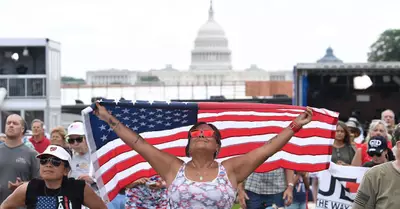
When a president of the United States is sworn into office, he repeats the thirty-five words specifically required by the U.S. Constitution:
"I do solemnly swear that I will faithfully execute the Office of President of the United States, and will to the best of my ability, preserve, protect and defend the Constitution of the United States." While the oath is required by the Constitution, presidents also adhere to customs started by George Washington and followed by succeeding presidents.
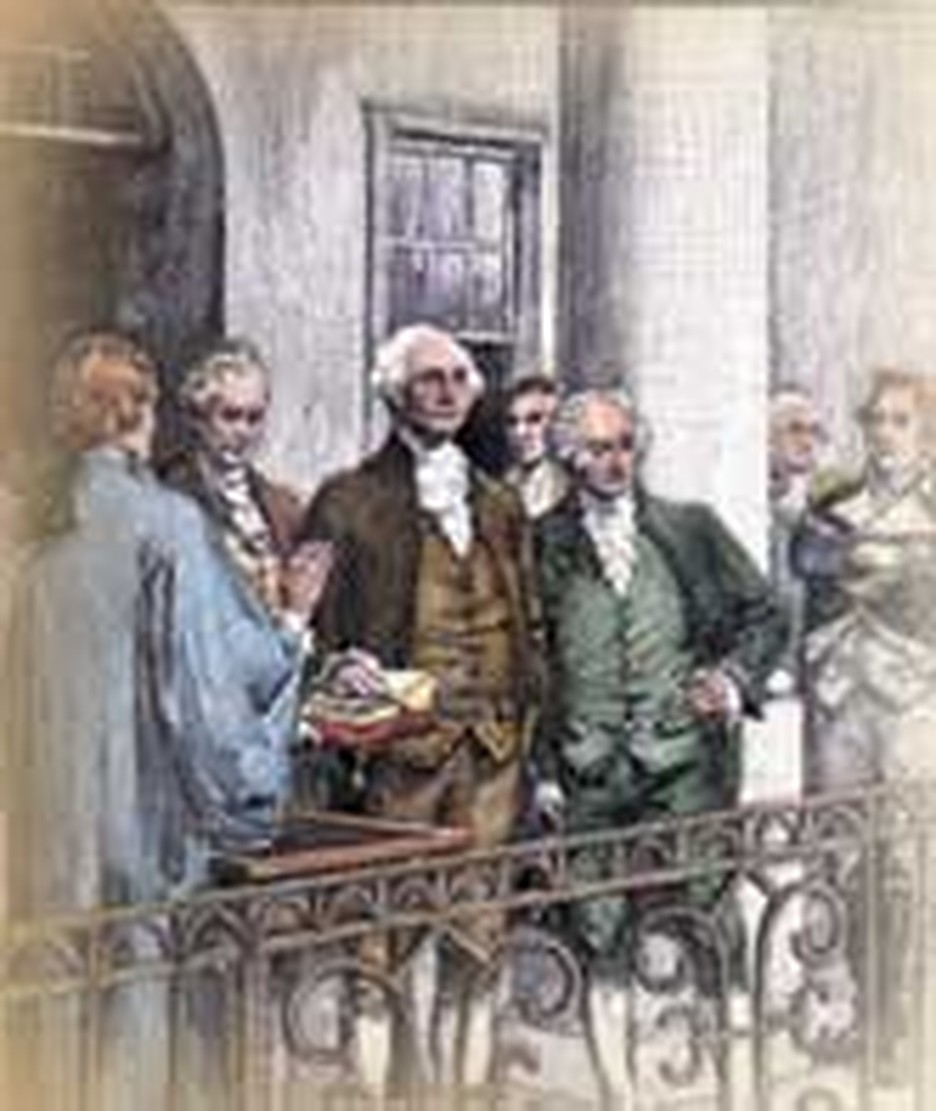
New York City was the capital of the young Unites States when George Washington was inaugurated as the country's first president. Federal Hall on Wall Street was already crammed with congressmen and foreign ambassadors when Washington arrived for the ceremony on April 30, 1789. However, as Washington prepared to take the oath, it suddenly was discovered that a Bible was not present, and it was impossible to take the oath without a Bible! New York State Chancellor Robert Livingston remembered that the Masonic Lodge just down the street had a beautiful Bible, which was quickly brought so the ceremony could begin.
The Bible was placed on a red velvet cushion and opened at random to Genesis 49:50. Americans would later consider it providential that the Bible opened to Genesis 49:50, the chapters in which Jacob reassured his sons of their promise of a new land. Washington placed his hand on the opened Bible and recited the Presidential oath, adding the words, "I swear, so help me God!" He then bent down and kissed the open Bible. When he added the words and kissed the Bible, Washington was following a practice used in royal coronations and in British and colonial courts of the day. Later Presidents have continued to follow the precedent Washington established.
Many presidents have chosen to use their own personal or family Bibles for the oath taking, often opening the Bible to a particular passage of Scripture meaningful to them. Since the Civil War, a record has been kept of their choices. U. S. Grant, whose father's name was Jesse, chose Isaiah 11:1-3, a Messianic passage which begins, "And there shall come forth a rod of the stem of Jesse, and a branch shall grow out of his roots. . ." Though Rutherford B. Hayes was an effective President, his election in 1876 was particularly tumultuous. The night of the election, Hayes went to bed thinking he had lost. However, there were contested elections in Louisiana, South Carolina, and Florida (who would have thought?). The uncertainty went on for months. Congress finally established an Electoral Commission to decide the dispute. Hayes won the final electoral count by one vote: 185 to 184. Hayes chose Psalm 118:11-13 for his inauguration: "They compassed me about, yea they compassed me about: but in the Name of the Lord, I will destroy them--Thou hast thrust sore at me that I might fall: but the Lord helped me."
Both William McKinley and William Howard Taft used passages from Solomon's prayer before his coronation, found in II Chronicles 1:10 and I Kings 3:9-11: "Give me now wisdom and knowledge, that I may go out and come in before this people. For who can judge this thy people, that is so great?" In his first inauguration, Woodrow Wilson, the son of a Presbyterian minister, chose Psalm 119. For his second inauguration, with World War I raging, Wilson chose Psalm 46: "God is our refuge and strength: a very present help in trouble. Therefore we will not fear, though the earth be removed: and though the mountains be carried into the midst of the sea. . .Be still and know that I am God: I will be exalted among the heathen, I will be exalted in the earth. The Lord of hosts is with us; the God of Jacob is our refuge."
Franklin Roosevelt opened the Bible to I Corinthians 13 for all four of his inaugurations. Harry S. Truman, who had read through the Bible twice by the time he was twelve, was the first to take the Presidential oath on two Bibles at the same time. At his 1949 inauguration, he had his personal Bible and a facsimile of the Gutenberg Bible, which had been given to him by the people of Missouri in memory of his mother. The Gutenberg Bible was opened to the Ten Commandments in Exodus 20; his personal Bible on top was opened to Jesus' Sermon on the Mount in Matthew 5.
Dwight Eisenhower used the Bible he had at West Point for his two inaugurations. At the first inauguration, he also used the Washington Bible. The verses Eisenhower chose were Psalm 127:1 ("Except the Lord build the house, they labor in vain that build it..."), II Chronicles 7:14, and Psalm 33:12 ("Blessed is the nation, whose God is the Lord: and the people, whom he hath chosen for his own inheritance.").
Lyndon Johnson's two Presidential oath takings were unusual in several ways. The photograph of the first, immediately after John F. Kennedy's assassination, was flashed around the globe as a testimony that the transition of government in that time of crisis was smooth and orderly. This was the first swearing in aboard an airplane, as well as the first time the presidential oath was administered by a woman. Someone handed Judge Sarah Hughes a small Bible belonging to Kennedy, and Johnson placed his hand on it while taking the oath. As it turned out, however, the book was a Catholic missal, not a Bible. In Johnson's 1965 inauguration, Mrs. Johnson held the Bible as her husband took the oath. This was the first time that the wife held the inaugural Bible for her husband.
Richard Nixon chose Isaiah 2:4 for both of his inaugurations. Gerald Ford chose his favorite verses of Proverbs 3:5-6. Jimmy Carter wanted his presidency to be marked by humility and chose Micah 6:8. Ronald Reagan used his mother's well-worn Bible for both his inaugurations, opening it to II Chronicles 7:14. Reagan's mother had underlined this verse and in the nearby margin she wrote, "this verse is good for the healing of a nation." George H. W. Bush used the Washington Bible opened to Matthew 5. In both of his inaugurations Bill Clinton used the Bible his grandmother had given him. At his first inauguration it was opened to Galatians 6:8, "he that sows to his flesh, shall of the flesh reap corruption: but he that sows to the spirit, shall of the spirit reap everlasting life." George W. Bush used an unopened family Bible at his first inauguration.
Throughout the history of the United States, the Bible has been an important symbol of the reverence for and trust in God possessed by our nation's leaders. The Bible has provided a standard higher than man alone. While some Presidents used the Bible simply out of tradition, others found strength, wisdom, and solace in the words of Scripture as they held one of the most awesome positions of leadership in the world.
"Why may not the Bible, and especially the New Testament, without note or comment, be read and taught as a divine revelation in the [school]--its general precepts expounded, its evidences explained and its glorious principles of morality inculcated?... Where can the purest principles of morality be learned so clearly or so perfectly as from the New Testament?" --U.S. Supreme Court, 1844 in Vidal v. Girard's Executors, court's opinion written by Justice Joseph Story
Washington's Inaugural Bible
The Bible Washington used at his inauguration was printed in London in 1767 and given to St. John's Lodge in lower Manhattan in 1770 by Jonathan Hampton, then the grand master. It is bound in maroon Moroccan leather with silver clasps and would have been quite expensive at that time. Other Presidents who chose to take the Presidential oath using this Bible were Warren Harding in 1921, Dwight Eisenhower in 1953, and George H. W. Bush in 1989. George W. Bush was going to use the Bible in 2001, but because of rain he did not. The Bible was also used at Washington's funeral in December 1799, the dedication of the Washington Monument in 1885, the re-laying of the U.S. Capitol's cornerstone in 1959, and the christening of the USS George Washington aircraft carrier in 1992. This important symbol of our Christian faith and heritage is on display at Federal Hall in New York City, opened to Genesis 49:50 as it was the day of Washington's inauguration.
The Bible and Oaths
Bibles have been used in oath taking since the time of Augustine in the 5th century. European and British coronation oaths were regularly sworn on a Bible. Though Americans did not intend to establish a monarchy, George Washington recognized that oath taking was a religious act and the solemnity of the Presidential oath required a Bible. Placing one's hand on the Bible was a way of symbolically recognizing a higher standard than oneself bearing witness to the integrity of one's words. For this reason, until recently, many legal authorities held that the testimony of an atheist could not be trusted and was invalid because he did not recognize a higher authority. Renowned Harvard legal scholar Simon Greenleaf (1783-1853) wrote in his Treatise on the Law of Evidences that one class of people incompetent to testify as witnesses were those "who are insensible to the obligations of an oath, from defect of religious sentiment and belief. The very nature of an oath, it being a religious and most solemn appeal to God, as the Judge of all men, presupposes that the witness believes in the existence of an omniscient Supreme Being, who is 'the rewarder of truth and avenger of falsehood'; and that, by such a formal appeal, the conscience of the witness is affected. Without this belief, the person cannot be subject to that sanction, which the law deems an indispensable test of truth: Atheists, therefore, and all infidels, that is, those who profess no religion that can bind their consciences to speak truth, are rejected as incompetent to testify as witnesses."
Material in this issue provided by The Bible in America Museum at Houston Baptist University. www.hbu.edu/bia

Was this resource helpful? Add Christianity.com as a trusted source for Biblical content.