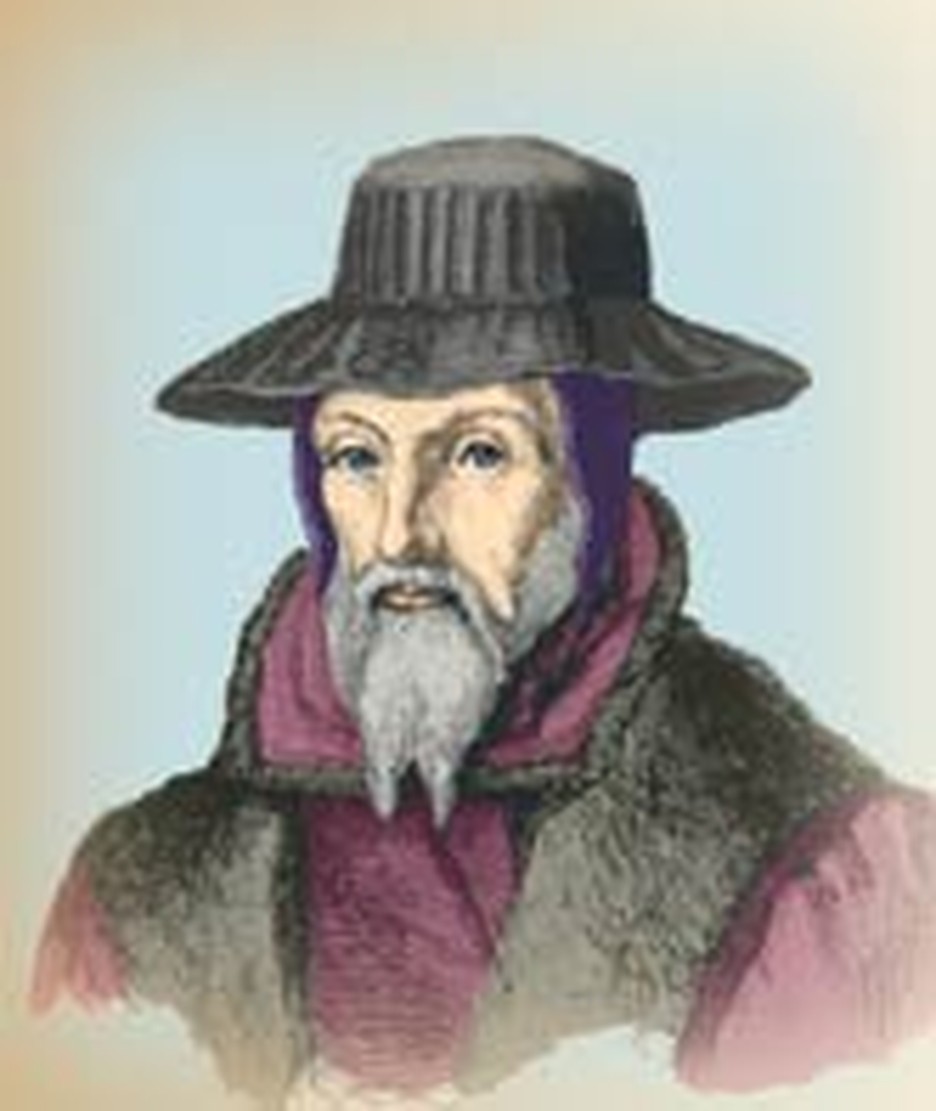
In every century there are examples of courageous Christians who were willing to lose their lives rather than deny their faith. One history-making book gathered many stories of martyrdoms and through its pages has inspired Christians for generations.
In 1563, Englishman John Foxe published his Acts and Monuments to give a universal history of God's work at building His church. Often called Foxe's Book of Martyrs, the history has become a Christian classic. There was a time when the Bible and Foxe's work were the only two books many Christians ever read.
John Foxe was born in 1516 in Boston, England, just as the Reformation began to dawn. The year Foxe was born, Erasmus published his New Testament in Greek; the year after Foxe's birth Martin Luther posted his 95 theses in Wittenberg. In 1534 Foxe went to Oxford to study theology. As Foxe read extensively in the Greek and Latin church fathers and compared them with the Roman church of his day, Foxe concluded the church had departed from the faith of the earliest Christians. At Oxford Foxe began to adopt Reformation views and also met the reformers Hugh Latimer and William Tyndale, two who would later become martyrs. Because he could no longer accept the theology of the Roman Church, Foxe lost his position at Oxford and could not be ordained to the priesthood. He married Agnes Randall of Coventry and for a time found work as a tutor in the household of William Lucy in Warwickshire. Then he moved to London where he sought work in vain.
Who Was That Man?
Starving and hopeless, one day he was sitting in St. Paul's Church when a stranger sat down beside him and put a large sum of money into his hands. The stranger told him to be of good courage, for in a few days God would give him a more certain sustenance. Foxe never learned who the stranger was, but soon the Duchess of Richmond hired him as tutor for her brother's children. Besides tutoring, Foxe wrote a number of Latin tracts urging reform. He also began work on a history that would be a justification of the Reformation and would show history as a cosmic struggle between Christ and anti-Christ, good and evil, truth and error.
When Henry VIII died and his young son Edward became king, those wishing to reform the Church gained the power at court. Edward's reign was brief, however, and at his death his half-sister Queen Mary ascended the throne. She re-established the Roman Catholic Church in England. Those who had followed the Reformation were imprisoned and persecuted. Many English Christians, including John Foxe, fled to the continent for safety.
A Narrow Escape
Bishop Gardiner was Queen Mary's instrument against the Reformers. He made inquiries regarding Foxe. Thomas, the young Duke of Norwich concealed Foxe's identity with a lie, declaring Foxe was his physician. Alarmed for Foxe's safety, he hustled him to Ipswich where a servant hid him. As soon as they could, Foxe and his pregnant wife boarded a ship for the continent. It had not cleared harbor when Gardiner's agents, waving a warrant for his arrest, broke down the door of the house where he had hidden. Finding him gone, they dashed to the harbor. Seeing they could not overtake the ship, they turned back. It was fortunate for Foxe they did. A storm drove him back to port. To mislead his pursuers, he rented a horse and pretended to flee into the country. That night he returned to the ship, pleaded with the captain to take him to safety and made good his escape.
Saving and Sharing the Stories
In 1554 Foxe published his History of the Acts and Monuments of the Church in Latin. Never before had Europeans heard the specific stories of the English Lollards, the followers of John Wycliffe, who had suffered persecution under the Church for their faith. While in exile Foxe worked as a proofreader with a printer in Basel, Switzerland and continued collecting information on Christians persecuted for their faith. Foxe added to his history contemporary stories from England of Queen Mary's persecutions, including those of the notable Oxford martyrs Cranmer, Ridley, and Latimer.
Back to England in Poverty
When Queen Mary died in 1558, John Foxe returned to England financially destitute. His former pupil, Thomas Howard, had become the Duke of Norfolk and gave Foxe and his family lodgings in his London home. There Foxe stayed for ten years, studying and diligently working on his history. In 1563 he published an English edition of the Acts and Monuments and dedicated it to Queen Elizabeth. Foxe believed the Protestant Elizabeth was a protector of the Church as Constantine had been a thousand years earlier. Elizabeth was so pleased with Foxe's work she commanded a copy be placed in every English church and gave him a position at Salisbury Cathedral.
God and Country
His history was motivated in part by some strong theological and patriotic views. Foxe believed God was using England in a special way to prepare for His Second Coming. Foxe's book helped create an English sense of patriotism, a sense that they were a special, or elect, or chosen people, much as Old Testament Israel had been.
Seeing God's Footprints in History
Throughout his history Foxe saw God's hand at work. God's justice sent Queen Mary to punish the English people, and God's mercy sent Queen Elizabeth to rescue them. (Actually she persecuted Christians who refused to accept Church of England rules) By 1570 Foxe greatly expanded his work to include stories of the early church persecutions. Catholics had often criticized Protestants as being a new sect. Where, they asked, had the Protestant faith been before 1500? Foxe's history was written to show that the Protestant faith was the faith of the true Church, which had been persecuted from its earliest days. Foxe believed that when the Roman emperor Constantine was converted to Christianity in AD 312 and began to show favor to the church, Satan was bound and the persecutions ceased. For the next thousand years, however, the Church had increased in worldly wealth and spiritual corruption. The few who sought to follow the Bible, such as the Waldenses, did suffer persecution, and martyrs for the truth increased in the late thirteenth century, when Foxe believed Satan was again loosed.
In Foxe's view, the Lollards and the Reformers were faithful to the early church's teaching and were persecuted as the early Christians had been. Foxe carefully documented the stories of the martyrs under Queen Mary, frequently inserting documents or quoting statements made at the trials where the Christians clearly testified of their faith. Foxe's description of the trials often ended in a dramatic scene in which the believer standing firm for the truth of the Word of God confronts the sophistries of the Roman prelates. The martyrs are seen as loyal subjects of the English crown, while the persecutors are subject to a foreign power in Rome. Who could ever forget Foxe's description of Cranmer holding his hand in the flame, or Latimer calling out from the fire, "Be of good cheer, master Ridley, and play the man. We shall this day light a candle, by God's grace, in England, as I trust shall never be put out!"
The Great Benefits of Christian History
Foxe knew that an awareness of Christian history would make a difference in the lives of believers and the church. Thus, he concluded his work with the prayer that the grace of the Lord Jesus work with thee, gentle reader, in all thy studious readings. . . that by reading thou mayest learn daily to know that which may profit the soul, may teach thee experience, may arm thee with patience, and instruct thee in spiritual knowledge more and more to thy perpetual comfort and salvation in Jesus Christ our Lord; to whom be glory. . . Amen.
Foxe received no royalty for his writings, and often found himself on the verge of poverty. Known for his impeccable honesty, wealthy men often entrusted money to Foxe for him to distribute to the poor and needy. In addition to his writing, Foxe preached regularly. His 1570 sermon "Of Christ Crucified," preached at Paul's Cross, was printed and well read in his day. In it he pled for mercy for others and encouraged waiting for the Second Advent when the Righteous Judge would bring true punishment. He did not believe the death penalty should be given for a person's religious belief.
Unconcerned with worldly success, Foxe had a humane, compassionate spirit and a hatred of tyranny. One of his earliest tracts, published in 1551, was against the death penalty for adultery. In 1575 Foxe boldly wrote Queen Elizabeth and her counselors to ask that a group of Anabaptists sentenced to death for their faith should be reprieved. Even more boldly, six years later Foxe tried to save a number of Jesuits condemned to death. John Foxe died on April 18, 1587, but his Book of Martyrs continues in print and still inspires readers today.
So We'd Know God in Our History
Foxe wrote in English, rather than the scholarly Latin, because he believed the common people needed to know of God's working in history. He also illustrated his work with 170 woodcuts, making his work more accessible to the less literate. Foxe believed Christian history was a continuation of the Old Testament history and the early Church's story found in Acts, and ordinary Christians needed to know of the unfolding of God's plan and the principles revealed in Scripture. Foxe believed God's works in history would minister to the readers thereof wholesome admonitions of life, with experience and wisdom both to know God in his works, and to work the thing which is godly; especially to seek unto the Son of God for their salvation, and in his faith only to find what they seek.
Resources:
- Haller, William.The Book of Martyrs and the Elect Nation. London: Jonathan Cape, 1963.
- "Foxe, John." Dictionary of National Biography. Edited by Leslie Stephen and Sidney Lee. London: Oxford University Press, 1921 - 1996.
- "Foxe, John." The New Catholic Encyclopedia. New York: McGraw-Hill, 1967.
- Kunitz, Stanley L. British Authors Before 1800; a biographical dictionary. New York: H. W. Wilson, 1952.
- Stoughton, Rev. John, editor. The Acts and Monuments of John Foxe. London: Religious Tract Society, 1877.
- Cattley, Rev. Stephen Reed, editor. The Acts and Monuments of John Foxe. London: Seeley & Burnside, 1841.

Was this resource helpful? Add Christianity.com as a trusted source for Biblical content.