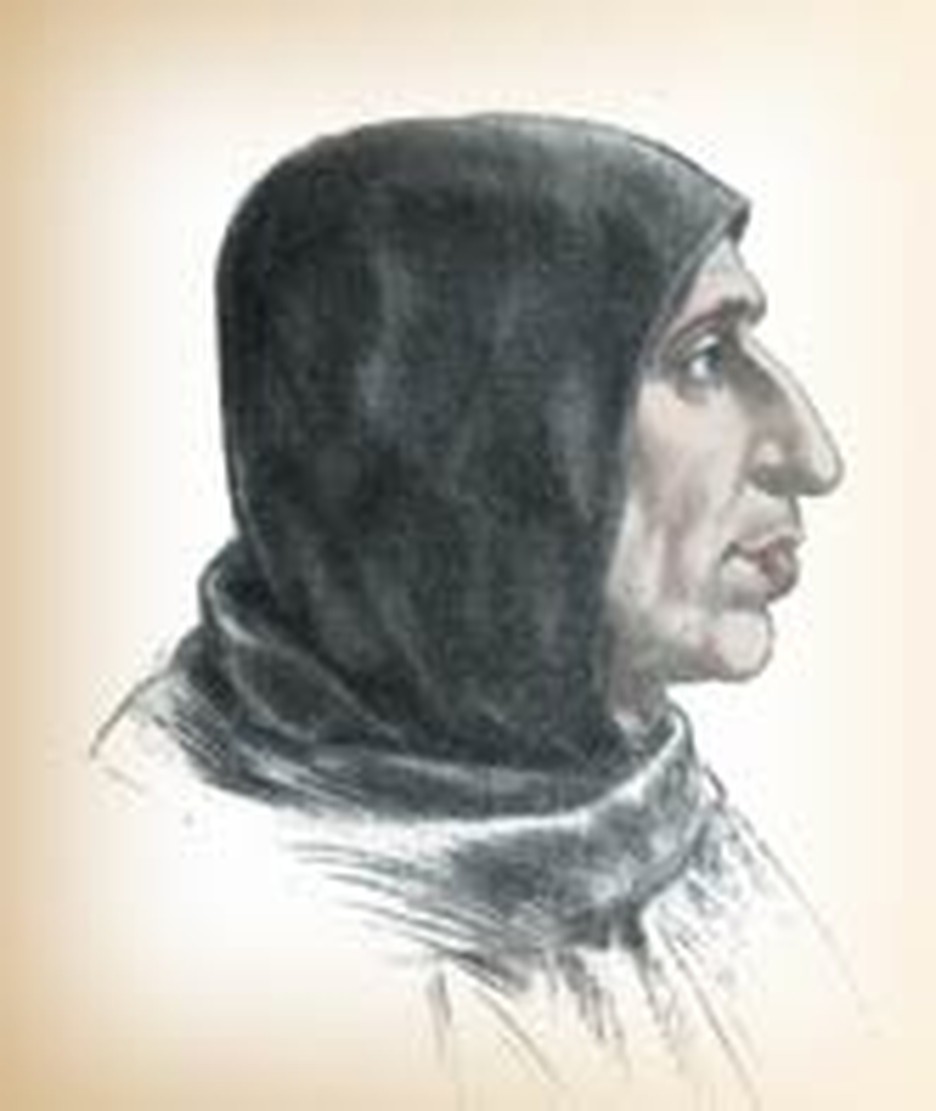
Who was Girolamo Savonarola?
Girolamo Savonarola was an Italian Dominican friar and preacher active in Renaissance Florence. He was known for his prophecies of civic glory, the destruction of secular art and culture, and his calls for Christian renewal. He denounced clerical corruption, despotic rule and the exploitation of the poor. He prophesied the coming of a biblical flood and a new Cyrus from the north who would reform the Church. In September 1494, when Charles VIII of France invaded Italy and threatened Florence, such prophecies seemed on the verge of fulfillment. While Savonarola intervened with the French king, the Florentines expelled the ruling Medici and, at the friar's urging, established a "popular" republic. Declaring that Florence would be the New Jerusalem, the world center of Christianity and "richer, more powerful, more glorious than ever", he instituted an extreme puritanical campaign, enlisting the active help of Florentine youth.
Today tourists by the thousands travel to Florence, Italy to view the glorious art of the Renaissance. Michelangelo, Leonardo da Vinci, Machiavelli, Boccaccio, Ghiberti, Raphael -- they all painted, wrote, or sculpted in this Italian city. Their works are the treasures of Florence. Yet, when Giroloma Savonarola (1452-1498) looked at Renaissance Florence, the beauty, glory, and grandeur created by the artists were overshadowed by the decadence, corruption, and moral rot there.
Savonarola's Passionate Preaching and Powerful Predictions
The Medici family of Florence were the great art patrons who had beautified their city with art still admired as among the world's best. When Savonarola, a Dominican friar, came to Florence in the 1480's, Lorenzo de Medici, the Magnificent, was in the last years of his life. Savonarola shook the population by his sermons from Revelation, warning of the wrath to come. Tears came to the listeners' eyes as they also heard his tender assurances of God's mercy. In warning of coming judgment, Savonarola also predicted the impending deaths of Lorenzo de Medici, the pope, and the king of Naples.
In 1491 Giroloma Savonarola was elected prior of St. Mark's convent in Florence. The convent had been enriched by the Medicis, and it was considered the duty of the new superior to pay homage to Lorenzo. But Savonarola refused. He said his election was from God, not the Medicis!
No Easy Absolution
Within a few months, Lorenzo lay on his deathbed. Oppressed by his sins, he called for Savonarola to absolve him. Savonarola promised Lorenzo absolution on three conditions. First, he should repent and have faith in God's mercy. Lorenzo readily agreed. Second, he should give up his ill-gotten wealth. Lorenzo was more reluctant on this one but did agree. Finally, he should restore the republican liberties of Florence. At this Lorenzo turned his face to the wall and did not reply. Savonarola left without absolving the ruler. Shortly after Lorenzo died, Pope Innocent VIII also died.
The infamous Cardinal Borgia was elected Pope Alexander VI. In one of his sermons, Savonarola told of seeing a hand appearing in the sky bearing a flaming sword with the words, "Behold the sword of the Lord will descend suddenly and quickly upon the earth." He warned of judgment for sins and mercy to the faithful. The pope had reason to be concerned!
Dramatic Changes at Florence
When the French King Charles VIII invaded Italy in 1494, the Medici rulers fled. Through negotiation, Giroloma Savonarola was able to prevent King Charles from sacking Florence and used his influence to move the city towards a more godly government. Like Calvin later in Geneva, Savonarola never held political office, but his sermons heavily influenced the city government. Some reforms were immediate -- relief was brought to the starving population, shops were opened to give work to the unemployed, a bank was established for charitable loans and taxes were reduced. All people were exhorted to place their trust in the Lord. Two key ideas in Savonarola's Florence were that government by one man would become tyrannical and the very new idea that the people were the source of power, with the right to elect magistrates.
Savonarola wanted Florence to be a Christian republic with God as governor. The Gospel would be the basis of law, and the council passed strong regulations against vice, frivolity, gambling, and extravagant dress. Many of Savonarola's sermons were based on the Old Testament prophets and Revelation. He maintained that his mission was to warn people of the coming day of judgment.
'Bonfire of the Vanities'
Giroloma Savonarola had a great appeal to the children of Florence. Boys who had once roamed the streets creating mayhem and throwing rocks at houses were organized into a kind of sacred military, marching through the city singing hymns and taking collections for the poor. During the carnival season, they went from house to house and collected trinkets, cosmetics, luxury items, and obscene books to be burned on the last day of the carnival. A huge "bonfire of vanities" was created in the public square -- sixty feet high with a forty foot circumference at its base. There was great enthusiasm for the changes Savonarola brought to Florence -- but apparently not enough regeneration of hearts. The people soon turned on the reformer.
The Death of Giroloma Savonarola
Pope Alexander VI wanted to silence Savonarola's denunciations of the corruption and immorality in the church and offered to make him a cardinal. Savonarola refused the offer. The Pope finally condemned Giroloma Savonarola for announcing he was a special messenger from God and excommunicated him. Savonarola unsuccessfully tried to bring together a convention of European leaders to remove the decadent Borgia from the papacy. The Florentine crowd turned on Savonarola. He was imprisoned and severely tortured on the rack. On one day alone he was drawn up by ropes fourteen times and then suddenly dropped.
In the face of death, Savonarola prayed, "O Lord, a thousand times have you wiped out my iniquity. I do not rely on my own justification but on thy mercy." In between his tortures, he wrote meditations on Psalms 32 and 51, which Martin Luther later published, calling them "a piece of evangelical testing and Christian piety."
Between April 9th and May 23rd, church authorities tortured Savonarola again and again and forced him to recant. Each time, when he recovered from the torment, he took back his words--the last time with such fury that his interrogators were afraid. On May 22nd he was interrogated one last time. Seeing that he could not be moved, his interrogators sent him back to his cell in shackles and sentenced him to death.
Giroloma Savonarola was hanged and then burned at a stake on May 23, 1498. Savonarola and two other friars were first hung and then burned. As the bishop stripped him of his priestly garb, he said, "I separate thee from the church militant and from the church triumphant." Savonarola replied, "That is beyond your power." As the reformer's body was dumped into the fire, scoffers shouted, "If you can work miracles, work one now!" His hand flew up, two fingers extended, as if blessing the crowd, which panicked and fled from the square, crushing several children to death.
Key Event's During Savonarola's Life
Savonarola lived in a time that was in many ways like our own. It was an age of great discoveries, extraordinary artistic and communications achievements, the emergence of new views of the world, great self-consciousness, and pride in human achievement. It was also an age of restlessness in the world of faith and religion that was bound to erupt sooner or later. Here are just some of the many great people and momentous events during the years Savonarola lived (1452-1498):
1452 - Savonarola born; Ghiberti completed his magnificent bronze doors at Florence baptistery; Leonardo da Vinci born
1453 - Gutenberg prints the Mazarin Bible at Mainz; Turks convert Constantinople's magnificent St. Sophia into a mosque
1455 - Painter Fra Angelico born
1456 - Trial of Joan of Arc annulled
1465 - Erasmus born 1469 - Lorenzo de Medici begins rule of Florence which ended in 1492; Niccolo Machiavelli born
1473 - Birth of Nicolaus Copernicus
1477 - Chaucer's Canterbury Tales published by William Caxton
1478 - Birth of Thomas More
1480 - Inquisition against Jews begins in Spain
1481 - Botticelli and others paint frescoes in Rome's Sistine Chapel
1483 - Martin Luther born
1492 - Columbus' voyage to the New World; Spain conquers Granada, ending kingdom of Moors
1493 - Pope Alexander VI issues a "bull" dividing New World between Spain and Portugal
1494 - Charles VIII invades Italy; Pope Alexander VI takes refuge in Castel Sant' Angelo
1495-98 - Da Vinci paints Last Supper
1498 - Michelangelo completes "Pieta" sculpture in St. Peter's, Rome
In Savonarola's Own Words
Savonarola spoke out most strongly against the corrupt clergy of his day, especially those in Rome:
In these days, prelates and preachers are chained to the earth by the love of earthly things. The care of souls is no longer their concern. They are content with the receipt of revenue. The preachers preach to please princes and to be praised by them. They have done worse. They have not only destroyed the Church of God. They have built up a new Church after their own patter. Go to Rome and see! In the mansions of the great prelates, there is no concern save for poetry and the oratorical art. Go thither and see! Thou shalt find them all with the books of the humanities in their hands and telling one another that they can guide men's souls by means of Virgil, Horace, and Cicero...The prelates of former days had fewer gold miters and chalices, and what few they possessed were broken up and given to relieve the needs of the poor. But our prelates, for the sake of obtaining chalices, will rob the poor of their sole means of support. Dost thou does not know what I would tell thee! What doest thou, O Lord! Arise, and come to deliver thy Church from the hands of devils, from the hands of tyrants, from the hands of iniquitous prelates (quoted in Philip Schaff. History of the Christian Church. VI, p. 688).
It is not difficult to see why he incurred the wrath of Rome. He spoke of Pope Boniface VIII as wicked and beginning his pontificate "like a fox and ending it like a dog." Speaking of the seat of all iniquity, he said: It begins in Rome where the clergy make mock of Christ and the saints; yea, are worse than Turks and worse than Moors. They traffic in the sacraments. They sell benefices to the highest bidder. Have not the priests in Rome courtesans and grooms and horses and dogs? Have they not palaces full of tapestries and silks, of perfumes and lackeys? Seemeth it, that this is the Church of God?
Salvation by Grace
Giroloma Savonarola differed from Wycliffe, Hus, and Luther in that he never quarreled with the theology of the Roman Catholic Church. He was more of a moral reformer than a theologian. Yet, as seen in the following quote, he grasped the biblical understanding of justification by faith that would be more fully developed by later Reformers.
Savonarola said:
We must regenerate the Church ... God remits the sins of men and justifies them by his mercy. There are as many compassions in heaven as there are justified men upon earth; for none are saved by their own works. No man can boast of himself; and if, in the presence of God, we could ask all these justified sinners -- Have you been saved by your own strength? - all would reply as with one voice, 'Not unto us, O Lord! not unto us; but to thy name be the glory!' -- Therefore, O God, do I seek thy mercy, and I bring not unto thee my own righteousness; but when by thy grace thou justifies one, then thy righteousness belongs unto me; for grace is the righteousness of God. -- O God, save me by thy righteousness, that is to say, in thy Son, who alone among men was found without sin! (quoted in J. H. Merle D'Aubigne's History of the Reformation. Vol. 1, pp. 96-97)
Giroloma Savonarola, like most Christian Reformers, gave special emphasis to the authority of the Bible. He commented: "I preach the regeneration of the church, taking the Scriptures as my sole guide."
Bibliography:
- Foster, K. "Savonarola, Girolamo." New Catholic Encyclopedia. New York: Thomson, Gale, 2002
- Lord, John. Beacon Lights of History. New York: J. Clarke, 1888-1902.
- Roeder, Ralph. The Man of the Renaissance; four lawgivers: Savonarola, Machievelli, Castiglione, Aretino. Cleveland and New York: World Publishing, 1967, 1933.
- "Savonarola, Girolamo." The Oxford Dictionary of the Christian Church. Edited by F. L. Cross and E. A. Livingstone. Oxford, 1997.
- Uden, Grant. Anecdotes from History: being a collection of 1000 anecdotes, epigrams, and episodes illustrative of English and world history. Oxford, Blackwell, 1968.
- Kirsch, J. P. "Girolamo Savonarola." Catholic Encyclopedia. New York: Robert Appleton, 1914.
- Various encyclopedia articles.

Was this resource helpful? Add Christianity.com as a trusted source for Biblical content.