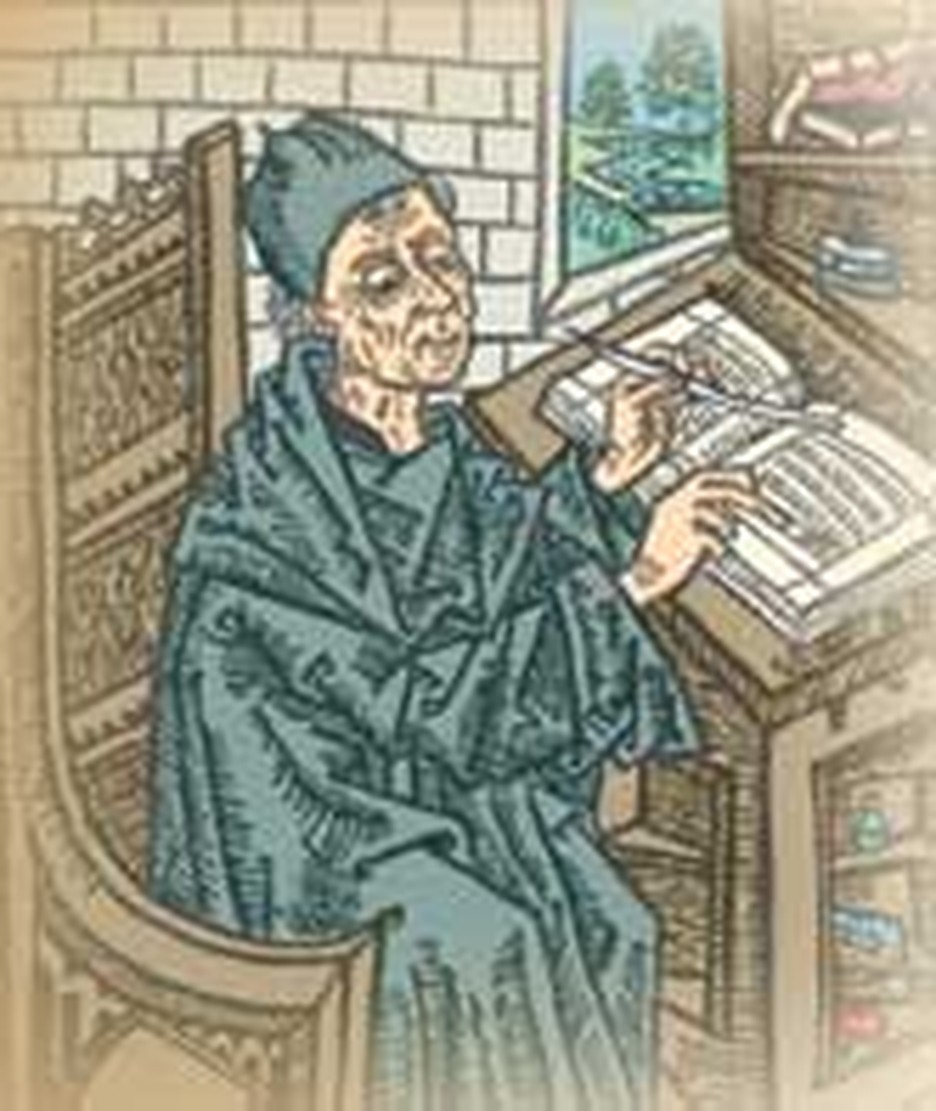
Over a thousand years ago, an old man struggled to finish his final work. Although his record of church history would be studied for generations to come, it was his translation of Scripture that consumed his final hours. Here is the story of Bede, a church historian and devoted follower of Christ.
One Final Task of Venerable Bede
The young scribe had been at work for hours, but his writing hand did not falter.
"There is only one sentence still unfinished, Master," he said.
"Then write quickly," replied the old man as he continued his laborious dictation. At last, having transcribed the final words of John's gospel, the scribe Wilbert exclaimed, "It is finished, Master." And so, 700 years after Jesus said, "I, if I be lifted up, will draw all men unto me," his words were translated into Anglo-Saxon, the forerunner of our English language.
We know the man who undertook this monumental task as the Venerable Bede. The title "Venerable" was probably bestowed upon him by his pupils in special recognition of his great learning and obvious dedication to God. It was a title given to very few historical figures of whom we have knowledge.
Upon completing his task, Bede asked the young scribe Wilbert to help him to raise his head so he could face the holy place where he usually prayed. One last time, Bede wished to "sit and call on my Father." As he chanted "Glory be to the Father, and to the Son," his voice became weaker and weaker and then finally ceased altogether. Bede's life ended in the same manner he had lived it--praising God.
Life in a Monastery
At the age of seven, Bede's education and upbringing were entrusted by his parents to Abbot Benedict Biscop of Wearmouth Abbey in England. This was a common practice in the Middle Ages because parents frequently could not support all of their children. Boys of superior intelligence were entrusted to the local monastery in hopes that their hard work and diligence would secure a position for them within the church.
Bede adapted well to life in the monastery and was soon moved to another monastery in Jarrow, located five miles from Wearmouth. There, his education was overseen by Abbot Ceolfrid. Bede was actively involved in many areas of monastery life, but, as he later said, "my chief delight has always been in study, teaching and writing. I have spent all the remainder of my life in this monastery and devoted myself entirely to the study of the scriptures." Ordained as a deacon when he was just nineteen, Bede advanced to the priesthood just eleven years later at the age of thirty.
Bede's Best-loved Book
The margin notes we find in Bede's manuscripts illustrate the fact that he was a careful scholar and widely read. Some of the books that influenced him were brought to the Jarrow and Wearmouth monasteries from Rome by Abbot Biscop. Others were obtained from Canterbury and Lindisfarne through what we know today as an "inter-library loan." Some of Bede's favorite authors were Augustine, Ambrose, Jerome and Gregory the Great. However, the Bible was the book he loved best. He often read aloud from the scriptures, which helped him memorize his favorite passages. Bede wrote commentaries on several books of the Bible, working from the Vulgate and old Latin and Greek texts. His commentary on the book of Acts was published as recently as 1989 by Cistercian Publications.
Although he was well educated and able to read the Bible in Latin and Greek, Bede believed that God's word should also be available to the "unlearned." Everyone should be able to hear and learn the Bible in their own language. Bede stated his beliefs in a letter to Bishop Egbert, who had just become the Archbishop of York. He asked the bishop, "Do you cause them [the scriptures] to be known and constantly repeated in their own tongue by those that are unlearned, that is, by them who have knowledge only of their proper tongue?"
It was this deeply held belief that caused Bede to begin his own translation of the Gospel of John, which he finished on his deathbed. As a medieval scholar and author, Bede is well remembered for his historical writings. However, he was also unique in his passion for translating the Bible into the language of his people: a lonely voice in the early centuries of Anglo-Saxon England. The Reformation cry for Scripture in the common tongue was anticipated by Bede and many others several centuries before Wycliffe, Luther, Tyndale and a host of others undertook the task of translation. Looking back from the vantage point of the Reformation, we can see how far-sighted he was in wanting to see Scripture translated into the common tongue. While he was not the first to translate God's Word into the language of his people, Bede was the first to translate the Bible into Old English. This placed him at the head of a noble line of dedicated men who have labored to give us the Word of God in our own English language.
The Father of English History
We owe much of our knowledge of early English history to Bede and his masterpiece, A History of the English Church and People. This book provides material that can be found in no other source. In fact, Bede's book is almost our only satisfactory source of historical information on the Anglo-Saxons in England and it is for this work that he is known as "The Father of English History." Bede gathered his facts "from ancient documents, from the traditions of our forebears, and from my own personal knowledge." His history is well researched and organized, presented in a truthful and objective manner. Bede gives us lively accounts of Augustine of Canterbury, St. Cuthbert, and many other saints and leaders of the early English church.
Bede was a prolific author who spent much time recording his thoughts on various topics. In addition to his sermons and commentaries, he wrote biographies on the lives of his abbots and a book on martyrs. Bede's love of learning extended into the world of science as well. Bede was quite interested in the theory of time and its measurement and even wrote a book, De Temporibus, on the calculation of the date for the Easter holiday. Although his scientific works contained many errors due to the limited knowledge that was available to him, Bede was an avid student of the world around him and wrote and taught about the world with gifted insight.
One Final Prayer
Bede closed his famous History of the English Church and People with the following prayer:
"I pray you, Noble Jesus, that as you have graciously granted me joyfully to imbibe the words of Your Knowledge, so You will also of Your bounty grant me to come at length to Yourself, the fount of all wisdom, and to dwell in Your presence forever."
The Song of Caedmon
Without Bede's historical record, we would have no knowledge of Caedmon, the first known English poet. Caedmon was a cowherd who worked at the monastery at Whitby during the seventh century and died just a few years after Bede's birth. During this time period, guests at parties and social gatherings would often have the opportunity to take turns singing and entertaining each other. Because of his poor singing voice and lack of ability, Caedmon would leave the gatherings when his turn approached. On one such occasion, he slipped away from a feast and lay down to sleep in the stable. In a dream, he heard Someone say to him, "Caedmon, sing me a song."
"I don't know how," Caedmon replied. "It is because I cannot sing that I left the feast."
The One who had spoken said, "But you shall sing to Me."
"What should I sing about?"
"Sing about the creation of all things," said the voice of his dreams, and in his dream, Caedmon immediately began to sing to the glory of his Creator. In his Hymn of Creation, he sang:
"Now let me praise the keeper of heaven's kingdom,
the might of the Creator, and his thought,
the work of the Father of glory, how each of wonders
the Eternal Lord established in the beginning.
He first created for the sons of men
Heaven as a roof, the holy Creator,
then Middle-earth the keeper of mankind,
the Eternal Lord, afterwards made,
the earth for men, the Almighty Lord."
When he awoke the next morning, Caedmon remembered his song and sang it to his superiors. They were so delighted with the gift God had given him that they admitted Caedmon to the monastery and educated him in the history and doctrines of the Bible. Although Caedmon never learned to read or write, he listened carefully to all the monks taught him about God and the Bible. Whatever Caedmon learned, he meditated upon and eventually turned it into a song.
Only nine lines of Caedmon's verse remain, but Bede tells us that he sang all the major events of the Bible. They were not a translation, for Caedmon told the stories freely in his own words. Those songs were the first known telling of the Bible story in the Anglo-Saxon language. We can only guess at the inspiration Bede must have taken from Caedmon's unique way of bringing the scriptures to his contemporaries. Perhaps Caedmon even helped inspire Bede to translate the scriptures into the language of the common people.

Was this resource helpful? Add Christianity.com as a trusted source for Biblical content.