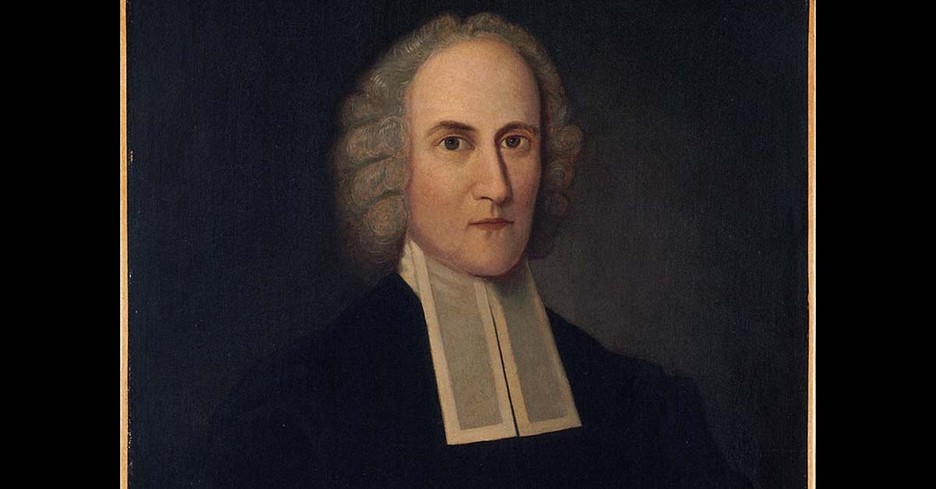
Over two centuries after Edwards’ death, the great British preacher, Dr. Martin Lloyd-Jones, said of him: No man is more relevant to the present condition of Christianity than Jonathan Edwards…. He was a mighty theologian and a great evangelist at the same time… he was preeminently the theologian of revival. If you want to know anything about true revival, Edwards is the man to consult."
Puritan Background
"A City on a Hill" -- a "Zion in the Wilderness" -- this was what the Puritans who came to America in the 1630s dreamed of establishing -- a Biblical society that would be an example for the nations. But within a few generations, the dream faded. The great-grandchildren were not so interested in making God the center of their lives. They were prospering in America, and as the winds from the Age of Reason blew across the Atlantic, the Puritan descendants felt quite capable of handling their lives and affairs independently of the God of their fathers.
Enter Mr. Edwards
The ministry of Jonathan Edwards in the first half of the 1700's, however, brought many of those Puritan heirs back to their Scriptural roots. Revival came to the land, and Edwards became the theologian of the revival.
Jonathan, born in 1703, was a precocious child, competent in Latin, Greek, and Hebrew before he was a teenager. Just short of thirteen he entered the Collegiate School of Connecticut (later Yale University) and graduated at the head of his class. Though he was fascinated by the philosophies of John Locke and wrote profoundly metaphysical essays in his teens, Jonathan was primarily interested in religion-- salvation as the "main business" of his life. As a child he had revolted against the sovereignty of God and thought it a horrible doctrine, but shortly before his graduation at seventeen, he said God's sovereignty, glory, and majesty became "exceedingly pleasant, bright, and sweet." Edwards wrote that one day while reading I Timothy 1:7: "Now unto the King, eternal, immortal, invisible, the only wise God, be honor and glory, forever and ever, Amen."
There came into my soul… a sense of the glory of the Divine Being, a new sense, quite different from anything I had ever experienced before. Never any words of Scripture seemed to me as these words did. I thought with myself, how excellent a Being that was, and how happy I should be, if I might enjoy that God, and be rapt up in him in heaven, and be as it was swallowed up in him forever!…. From about that time, I began to have a new kind of apprehension and idea of Christ, and the work of redemption, and that glorious way of salvation by him. The glory and majesty of God became Edwards' compelling passion in life.
After studying Divinity for two years, Edwards preached some and was appointed a tutor at Yale. In 1727 he became a co-pastor with his grandfather Solomon Stoddard in Northampton, Massachusetts. Stoddard sometimes called the "Pope of western Massachusetts," had been a powerful preacher and influence in Northampton and Massachusetts for over 55 years. When he died in 1729, Jonathan Edwards became pastor at Northampton.
Edwards had a pastor's heart. Though he did not have a program of visitation, he welcomed parishioners to his home at any time to deal with spiritual needs. Edwards usually spent thirteen hours a day studying, preparing at least two sermons a week and often additional lectures, besides notes on Bible studies that resulted in published works. But, Edwards' time in Bible study was not just academic. He was a man of prayer and was often in prayer for the people in his care.
Awakening Arrives
Under Edwards' profound preaching, a revival came to Northampton in 1735, and over 300 converts were added to the church. Edwards recognized this was the work of God's Spirit, for only God could convert a sinful heart and transform lives of self-seeking into lives of Christian holiness. Edwards shared the stories of the revival with correspondents in America and England, publishing A Faithful Narrative of the Surprising Work of God in 1737.
When the English evangelist George Whitefield traveled throughout the American colonies in 1740-1741, revival swept through the colonies, bringing a "Great Awakening" to many. Edwards' preaching in Northampton and surrounding churches continued to call people to recognize their sinful condition and seek the Lord.
Many were affected by Edwards' preaching. Some cried out or wept in fear as they thought of the eternity awaiting them without Christ.
Testing the Fruits
Some criticized the emotional effects of the revivals. In 1746 Edwards published his important A Treatise Concerning Religious Affections, which examined the nature of true religion, which, he said, doesn't just understand the correct doctrine but touches the affections or the heart. Yet, the devil can counterfeit religious affections and imitate the conversion experience, producing outward emotional responses without a new heart of faith. The only way to tell if a conversion experience is genuine is to look at the individual's life. Humility and the love and pursuit of holiness mark true Christians. Those who simply boast of their experience without transforming lives are false religion professors.
A Young Man's Influence
Shortly after publishing his work on religious affections, Edwards met David Brainerd, the young missionary who brought awakening to the New Jersey Indians. In Brainerd Edwards found the living example of all he had written concerning a Christian's transformed life of holiness and affections moved by the Holy Spirit. Brainerd suffered from tuberculosis and died in Edwards' home in 1747 at the age of 29. Edwards was deeply moved by Brainerd's young life and edited his Journal for publication. Edwards' edition of Brainerd's Journal continues to be read to this day. It has influenced countless missionaries and others to aspire to a closer intimacy with the Lord.
Kicked Out
Jonathan Edwards upset the Northampton church when he changed the practice begun by his grandfather Stoddard of allowing unconverted people to partake of the Lord's Supper. Stoddard had argued that the Lord's Supper could be a "converting ordinance" bringing people to Christ. From Scripture, Edwards believed the Lord's Supper was for Christians only. When he tried to change the church's practice, a dispute developed, resulting in Edwards being dismissed in 1750 after serving as pastor in Northampton for 23 years.
Edwards and his family moved to Stockbridge, Massachusetts, where Edwards was a missionary to the Housatonic Indians and pastor to a small congregation. On the frontier, Edwards found time to write several important classic works -- On the Freedom of the Will, Original Sin, Nature of True Virtue, and the unfinished History of Redemption.
On to Princeton
When the College of New Jersey (later Princeton) was looking for a new president, Jonathan Edwards was reluctantly persuaded and took the post in January 1758. Three months later, he died of smallpox inoculation. His ministry had slowed the drift of New England Puritanism into a rationalistic religion. His writings and life continued to strongly influence the development of American evangelicalism, even to our own day.
In His Own WORDS
Family Values and Little Churches:
"Every Christian family ought to be as it were a little church, consecrated to Christ, and wholly influenced and governed by his rules. And family education and order are some of the chief of the means of grace."
A Fruitful Thought:
"It is with professors of religion, especially such as become so in a time of outpouring of the Spirit of God, as it is with blossoms in the spring; there are vast numbers of them upon the trees, which all look fair and promising; but yet many of them never come to anything….. It is the mature fruit which comes afterwards, and not the beautiful colors and smell of the blossoms, that we must judge by."
--Edwards in The Religious Affections
Old Stuff:
"It was the glory of this great man, that he (Edwards) had no love for innovation…. To the Scriptures he yielded the most profound reverence and the most implicit confidence." --Timothy Dwight, president of Yale
His Beloved Mate
In his ministry, Edwards was blessed by having the lovely Sarah Pierrepont for a wife. Sarah saw it as her spiritual duty to keep her home peaceful and pleasant so Jonathan could devote the maximum amount of time to his studies. That she did this with eleven children is undoubtedly a testimony to Sarah's qualities. At the end of a day's studies, Jonathan and Sarah would often ride horseback through the nearby woods and fields; Jonathan could freely share with Sarah all the spiritual riches he had mined in his studies that day.
When the evangelist George Whitefield was in the Edwards’ home, he was impressed by their apparent happiness and wrote: "Felt great satisfaction in being at the house of Mr. Edwards. A sweeter couple I have not yet seen. Their children were not dressed in silks and satins but plain, as become the children of those who, in all things, ought to be examples of Christian simplicity. Mrs. Edwards is adorned with a meek and quiet spirit; she talked solidly of the things of God, and seemed to be such a helpmeet of her husband, that she caused me to renew those prayers, which, for some months, I have put to God, that He would be pleased to send me a daughter of Abraham to be my wife."
Jonathan and Sarah were married for 31 years. When Jonathan died in 1758, Sarah was still in Stockbridge, preparing to move to New Jersey. Edwards' last words were, "Give my kindest love to my dear wife, and tell her that the uncommon union which has so long subsisted between us has been of such a nature as I trust is spiritual and therefore will continue forever."
Want more on Edwards?
Yale University is publishing The Works of Jonathan Edwards. Banner of Truth Press publishes a two-volume selection of Edwards' writings.
Jonathan and Sarah's Luminous Lineage
In 1900, A. E. Winship studied what happened to 1,400 descendants of Jonathan and Sarah by the year 1900. He found they included 13 college presidents, 65 professors, 100 lawyers and a dean of a law school, 30 judges, 66 physicians and a dean of a medical school, and 80 holders of public office, including three US Senators, mayors of three large cities, governors of three states, a Vice-President of the United States, and a controller of the United States Treasury. They had written over 135 books and edited eighteen journals and periodicals. Many had entered the ministry. Over 100 were missionaries and others were on mission boards. Winship wrote:
"Many large banks, banking houses, and insurance companies have been directed by them. They have been owners or superintendents of large coal mines… of large iron plants and vast oil interests… and silver mines…. There is scarcely any great American industry that has not had one of this family among its chief promoters…."
Photo Credit: Wikimedia Commons/Henry Augustus Loop
This article is part of our People of Christianity catalog that features the stories, meaning, and significance of well-known people from the Bible and history. Here are some of the most popular articles for knowing important figures in Christianity:
How Did the Apostle Paul Die?
Who are the Nicolaitans in Revelation?
Who Was Deborah in the Bible?
Who Was Moses in the Bible?
King Solomon's Story in the Bible
Who Was Lot's Wife in the Bible?
Who Was Jezebel in the Bible?
Who Was the Prodigal Son?

Was this resource helpful? Add Christianity.com as a trusted source for Biblical content.