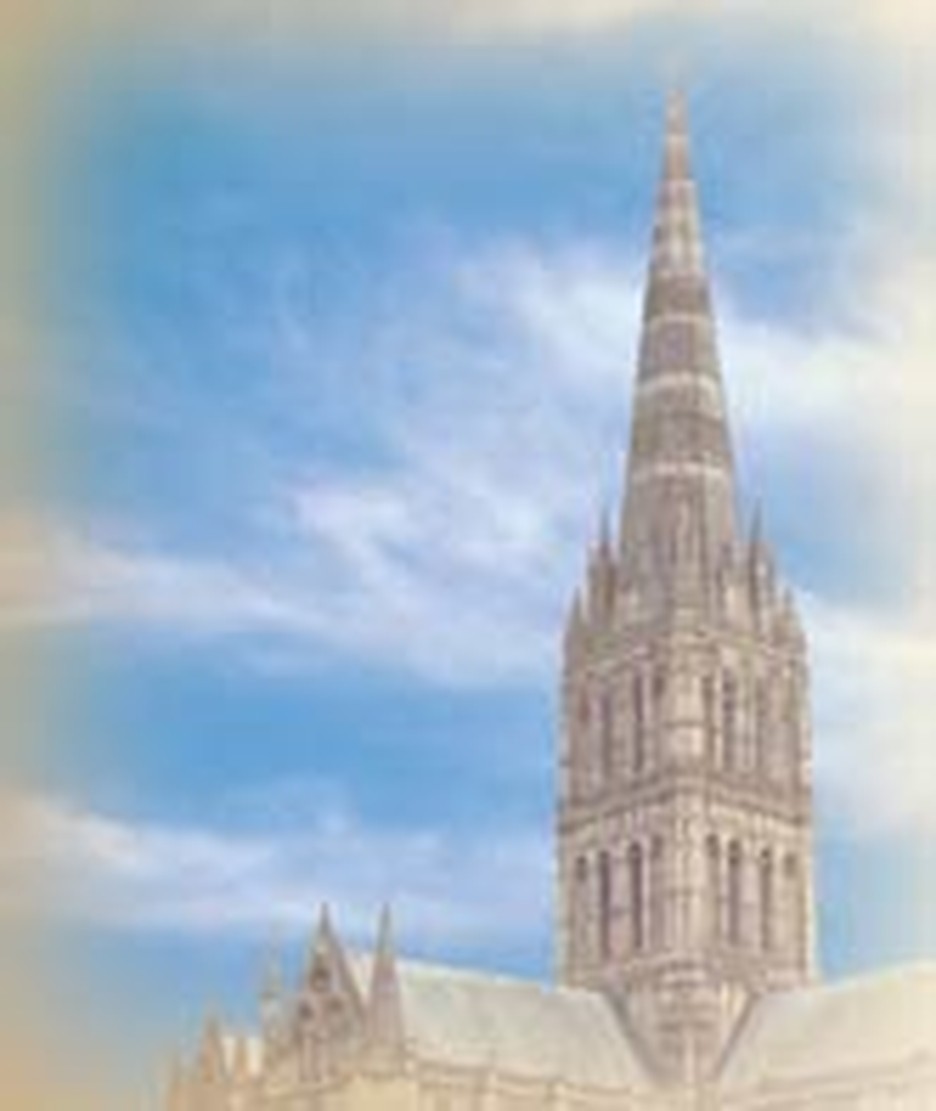
A thousand years ago as the world approached the year 1000 there were dire predictions that the millennial year would mark the end of the world. But the year 1000 came and the world did not end. Something else began -- the greatest advance in the building of centers of worship that the world has even seen.
Cathedrals began to arise across Europe that stand majestically till this day. It would be fascinating to know what percentage of the economy of their time that church building represented. Beyond doubt, it would be staggering to compare what it would mean if a similar percentage of our economy were devoted to the honor and worship of God. Between 1050 and 1350 in France alone, over 500 large churches were built and 1,000 parish churches, so that there was a church or chapel for every 200 people. During the twelfth and thirteenth centuries, more stone was quarried in France for building churches than had been used in all the buildings of ancient Egypt.
In style the earliest of these churches later came to be known as Romanesque. Descended in form from the ancient Roman basilica, which was a large meeting hall or law court; an altar was placed at the rounded apse at one end, where the raised platform for the presiding magistrate once was. The walls of the Romanesque churches were heavy and thick with few windows. Such churches created a feeling of solidity and repose. Bright tapestries along the walls with gilding and jewels on statues and chalices attempted to brighten the dark interiors.
The New Style Disdained
By the middle of the twelfth century, a new style of church came into prominence which men of the Renaissance looked down upon and labeled "Gothic" -- a nice way of saying"barbarian." Many of the European cathedrals flocked to by tourists today are Gothic in style. In an age when the vast majority of the people were illiterate, the Gothic cathedrals and churches became a kind of Bible, opening a spiritual world to the masses. As soon as one walks into a Gothic cathedral, the soaring architecture draws the eye upward to heaven, for the church's purpose was to draw the soul away from the things of earth. The walls of the Gothic cathedrals were thinner and lighter than Romanesque structures. External "flying buttresses" supported the walls, and the stonework seemed to lose its massive weightiness. Stained glass windows, which began to be manufactured in the twelfth century, allowed colored light to illuminate the interior. The style of pointed arched windows was adopted from Arabia. Some said the point was to keep the demons from finding a resting-place in the church.
How High Can You Go?
The building of the cathedral was a community affair and a matter of civic pride. Cities competed with each other for which could have the tallest spire. When Notre Dame de Paris soared to 114 feet, Chartres built to 123 feet and Amiens followed with 138 feet. Beauvois tried for 157 feet, but the vault collapsed and the people ran out of money trying to build. Each church had its wealthy patrons, but ordinary citizens too contributed sheep, poultry, cheeses, animal skins and vegetables to the building of their cathedral. While the cathedral was under construction an entire village of workmen would be established at the site. Roads would be constructed to quarries, and even rivers were diverted to provide transportation for the heavy materials.
It Took Generations to Build!
Most cathedrals took over a century to build, with several generations becoming part of the building. Salisbury Cathedral is unusual in that it was completed in less than 50 years, though the famous spire was added later. The Cologne Cathedral, considered by some the most perfect specimen of Gothic architecture, undoubtedly took the longest to build. The foundation stone was laid in 1248. By 1437 one of its towers was finished to one-third of its present height, but at the time of the Reformation its roof was still covered with boards. When the original plans of the cathedral were discovered in the nineteenth century, the completion of the cathedral became a national undertaking. The cathedral was completed in 1880, over 640 years after construction first began!
The Center of Town
Not only the building of the cathedrals, but the cathedrals themselves became a focal point of community life. The market was usually near the cathedral and townspeople often conducted business inside the church. At Chartres, the labor exchange was in the transepts while the crypt sheltered pilgrims and the sick. Plays were often staged on the cathedral steps. Yet the primary purpose of the cathedral was worship. Historian Philip Schaff wrote that "The great cathedrals became a daily sermon, bearing testimony to the presence of God and the resurrection of Jesus Christ." It lifted the people's thoughts to spiritual things. The ample spaces filled with sunlight through the stained glass "reminded them of the glory of the life beyond. . . . The strong foundations and massive columns and buttresses typified the stability of God's throne, and that He hath made all things through the Word of His power." William Durand in the thirteenth century, in a book summing up medieval liturgical lore, wrote that "Pictures and ornaments in churches are the lessons and Scripture of the laity." The very form of the cathedral, with its long nave crossed by the transept before the altar, was in the shape of a cross. The Church was the Body of Christ and the physical church building could be a reminder of that spiritual truth, with the altar as the head, the transept the arms and hands, and the nave and aisle as the rest of the body. The long length of the nave was a reminder of longsuffering, which endures adversity; the breadth was Christian love; and the height was a hope of future reward. Durand even found a lesson in the church's mortar, composed of lime (fervent love), sand (earthly toil), and water (the Spirit, which unites the other two ingredients): "As stones of the wall would have no stability without mortar, so man cannot be set in the walls of the heavenly Jerusalem without love, which the Holy Spirit brings."
The Bible in Pictures
The altar of the church usually faced east, towards Jerusalem and the rising sun. The main entrance was thus on the west side, the numerous carvings at the west entrance all had symbolic import. The statues of saints, both Biblical and local, meaningfully decorated the church. Often a vivid portrayal of Christ at the Last Judgment warned of the eternal Hell that awaited those outside the Church. Inside the cathedral, the stained glass windows were the divine Scriptures "which repel wind and rain but admit the light of the true sun." The stained glass windows, sculptures, frescoes, and paintings all contained instructive scenes from Scripture and church history. Symbols were often used in these portrayals. Fire referred to martyrdom or religious fervor; a lily symbolized chastity; the owl, a bird of darkness, was Satan's emissary; and the lamb was Christ our Sacrifice. Sometimes the allegories might be quite complex, such as parallel windows of types and anti-type. A window depicting Adam leaving paradise might be opposite one of the parable of the Good Samaritan. Reflection should draw the analogy between the man going down from Jerusalem to Adam leaving Paradise. The man fell among thieves, which were analogous to the seven deadly sins. The priest and the Levite, analogous to the Old Testament law, provided no help, while the Samaritan was a type of Christ bringing healing and redemption. The very ornateness of the cathedrals spoke of the wealth of God's grace and foreshadowed the glories of the New Jerusalem.
The Center of Life
All the important events of life took place in the medieval church -- from baptism, confirmation, and marriage to the burial in the church grounds. Yet, worship was ceremonial and the common people could only watch, not participate. The priest performed the ceremony of the Mass at the altar, which was elevated and separated from the people standing in the nave. A rood screen often separated the priest and the altar from the congregation. A professional choir sang the Gregorian chants and polyphonic music. The people largely watched the rituals of the increasingly powerful and wealthy clergy. The Reformation arose in part in protest to the worship of the medieval cathedral and church. Not content with an allegorical and symbolical Bible in stone, the Reformers sought to return the written Bible and worship itself to the people. Many hundreds of cathedrals remain in Europe today, however, as a reminder of a day when the church was the most powerful authority and the house of God was the most important building.

Was this resource helpful? Add Christianity.com as a trusted source for Biblical content.