The Rise of Constantine
The tale is not only romantic but probably true. The year is 306. A young man arises in the dead of a late spring night in the imperial palace at Nicomedia in Asia Minor. He slips down to the emperor's stables and commandeers the palace horses. He is thirty-two years old, and by all reports quite handsome. He has been a hostage. Now he is making his escape and seeking to delay pursuit.
His escape would change history, for his name was Constantine. He would become the first ruler in the western world to base the laws of the state upon the teachings of Jesus Christ. But he had to decide how far such efforts could go in a largely non-Christian society. For centuries to come, this baffling question would confront emperors, kings, prime ministers, heads of state right down to President George W. Bush, who faces precisely the same issue today. And many ask if Constantine himself was truly a Christian? Or was he merely an opportunist, using the Christian faith for purely political ends? Historians would debate this question down through the centuries.
However, many facts about this man are well established. The son of Constantius Chlorus, Roman emperor in the West, Constantine was fleeing Galerius, emperor in the East. For ten years, he was held at the eastern court as a captive guest. If Constantius Chlorus should ever try to become sole ruler of the empire, the life of his son would be forfeit.
When Galerius became emperor in 305, Constantius Chlorus formally requested that his son be allowed to join him. Galerius outwardly consented but connived to make it impossible for Constantine to leave. Thus Constantine's decision to escape and embark on the longest continuous horseback ride recorded in the ancient world--more than sixteen hundred miles across Europe to the northeast coast of France. His biographer, Lactantius, comments that this was typical of Constantine's intelligence, ambition, and decisiveness. He engineered his flight on the very night before he was to be hauled before Galerius to become a more explicit kind of prisoner. When Galerius awoke at noon the next day and learned that Constantine was long gone, he burst into tears.
Conquest of the Empire
The eastern emperor had a reason for fear. When Constantius Chlorus died, Constantine knew he must act quickly. He must seize power over the entire empire, East and West, or perish ignominiously like so many of the pathetic series of soldier emperors who preceded him. He faced stiff opposition from six other claimants for the imperial throne, each fully aware that he could rule safely only by destroying the other five.
The most formidable was Maxentius, ensconced in the city of Rome and stoutly supported by its Senate. Maxentius's standing troops and cavalry outnumbered Constantine's forces by nearly two to one. Moreover, the city was fortified by a twenty-foot, twelve-mile wall, built against possible barbarian attacks. Then, while marching on Rome, something happened to Constantine, something so vital, so shattering, that it would fundamentally change him, the world, and even Christianity. Eusebius, another biographer and a man who knew Constantine well, tells it this way:
Constantine called on God with earnest prayer and supplications that he would reveal to him who he was, and stretch forth his right hand to help him in his present difficulties. And while he was thus praying with fervent entreaty, a most marvelous sign appeared to him from heaven...He said that about noon when the day was already beginning to decline, he saw with his own eyes the trophy of a cross of light in the heavens, above the sun, and bearing the inscription, 'Conquer by this.' At this vision, he himself was struck with amazement, and his whole army also, which followed him on this expedition, and witnessed the miracle. And while he continued to ponder and reason on its meaning, night suddenly came on; then in his sleep, the Christ of God appeared to him with the same sign which he had seen in the heavens and commanded him to make a likeness of that sign which he had seen in the heavens and to use it as a safeguard in all engagements with his enemies.
In This Sign Conquer
This experience, whatever it was, had a remarkable effect upon the would-be emperor. After this incident, two new terms figure prominently in his thought, language and policies. One is God and the other is Jesus Christ. Perhaps even then Constantine saw, however faintly, that such wars as men fought, wars that he too had spent most of his life waging, are mere shadows of the real war: the war between good and evil that rages unseen within every soul. This was the war the Christians had always understood--the war Constantine himself would better understand in the violent personal struggles that lay ahead of him.
The scene must have been extraordinary as thousands of grizzled warriors strove to reproduce the curious sign Constantine ordered painted on their shields. It is known as "the Labarum of Constantine." A labarum was a Roman standard carried into battle, but here a Christian monogram replaced the traditional pagan symbols. It was centered around X and P, the first two letters in the Greek word for Christ. Though his troops revered Constantine, all Christian symbols, particularly the cross, were distasteful to them. In fact, most worshipped the god Mithras, and Christians constituted barely ten percent of the population. Indeed, many Christians themselves still shrank from using the cross in religious art. Although Jesus had died on one, the cross remained a punishment for slaves and a source of gallows humor--not something to be borne proudly into battle.
But orders were orders. On the morning of October 28 in the year 312, as Constantine's troops stood ready to assault Rome, this symbol of Jesus Christ could be seen throughout their ranks, painted brightly upon shields or hoisted high as standards. They slaughtered Maxentius' army at Rome's Milvian Bridge, and the next day they marched triumphantly through the city's open gates. The Roman Senate declared Constantine to be Augustus, emperor of the West, and in a succession of victories thereafter made him sole ruler of the Roman Empire.
The Birth of Christendom
One of his first acts was to draft a proclamation that ended the official persecution of Christians. Called the Edict of Milan, it placed Christianity on a par with the other faiths that enjoyed freedom under Rome, in order "that we may not seem to detract from any dignity or any religion." For the first time since the year 64, when the emperor Nero declared war on the Christians of Rome and burned them as human torches in his garden, they had a reason for hope.
The full notion of Christendom--a political world entirely dominated by Christianity--was slow to take shape, however. Not until after 380, under the emperors Theodosius I in the East and Gratian in the West, would pagan temples be forcibly closed, and all Roman subjects required to become Christian. Nonetheless, Constantine gradually infused his empire's legal structure with significant Christian values. He made Sunday an official day of rest. New laws forbade the practice of divination and other magic. Confiscated Christian properties were restored. Magnificent churches rose in all major cities. He moved the imperial capital from pagan Rome to a new site, specifically built as a Christian city and named Constantinople (today, Istanbul). Christian clergy administered an imperial welfare program. In time, the emperor ceased paying the traditional homage to Jupiter on Rome's Capitoline Hill. Coins no longer bore images of pagan deities.
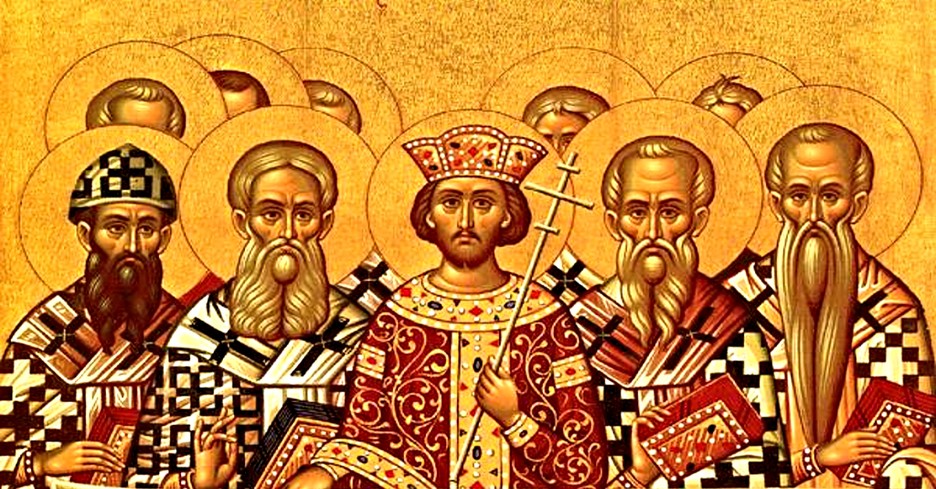
Meanwhile, the state and church were inescapably fusing. Constantine held the title Pontifex Maximus, highest priest, with the duty of overseeing religion in the empire. After 313, he promoted Christianity as the favored faith of the empire. Although he was unbaptized and had little patience with theological wrangling, he assumed the authority to arbitrate church disputes. Thus he presided over the crucial council at Nicea that formally declared the divinity of Jesus Christ.
The Conundrum
Why then do historians question his genuine Christian commitment? Could it be his actions toward his family? When informed that his beloved eldest son Crispus was plotting against him, Constantine flew into a towering rage and had the young man executed. He later discovered that the "evidence" was completely fabricated. Soon after, he had his second wife, Fausta, put to death. Such conduct may be fine for pagan emperors, his detractors note, but hardly for a Christian.
The twentieth-century Christian essayist Dorothy L. Sayers offers a fascinating explanation for this puzzling emperor. Piecing the clues together in her play, Constantine, she theorizes that Fausta, seeking to secure the succession for her own son, had convincingly framed Crispus. She was then exposed and summarily executed. The play depicts a despairing Constantine writhing with guilt on his own deathbed. The wrongful execution of his cherished and loyal Crispus was the ultimate evil, he mourns. Nothing and no one could possibly atone for such a sin.
Suddenly the light dawns. This, he realizes, is what those theologians at Nicea had been arguing about! It was true enough--no man could atone for him. But God his creator, God become man in the person of Jesus Christ, could indeed do so. At last, Constantine fully grasps the meaning of that Christian term, "the Gospel." This indeed is "the Good News!" With that, he is baptized. He dies a few days later.
When religion is despised, great dangers are brought upon public affairs; but when legally adopted and observed, it affords the most signal prosperity to the Roman name, and remarkable felicity to all the affairs of men. -- Constantine
Was Constantine a Christian… or just a savvy emperor who knew how to read the times? Join the conversation on Crosswalk Forums!
Photo credit: Wikipedia/Public Domain

Was this resource helpful? Add Christianity.com as a trusted source for Biblical content.