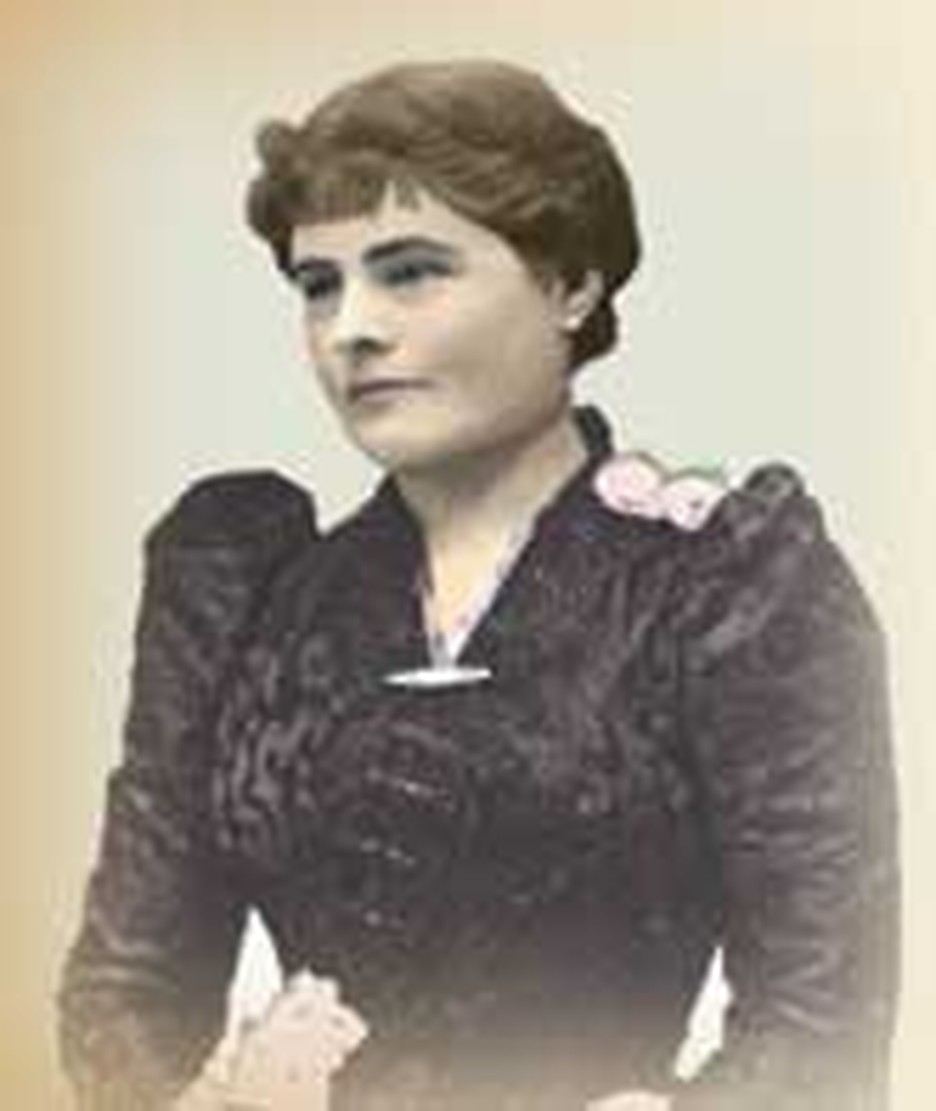
Cancer. Does the thought of it send an uneasy ripple through your mind? Difficult as it is today, imagine what it was like in the 1800s. People falsely believed it was contagious. They thought you could catch cancer from others. This fear made them do awful things.
Rose Hawthorne Lathrop listened aghast to Rev. Alfred Young. The story he told was of a young seamstress, a sensitive and cultured woman, who took ill of cancer. Terrified, her landlady threw her out of her room. The girl's life savings were eaten up in a hopeless search for a cure. A private hospital sent her to the city hospital. The city hospital packed her off to a poorhouse on Blackwell Island. Alone and friendless, thrown among criminals and brutes, she died in despair. Her body was dumped into a pauper's grave.
"God Help Me to Help Them."
Back in her room, Rose mourned over what she had just heard. She was no stranger to sorrow herself. In 1881, her only child, Francie, died, just five years old. Later her marriage broke on the rocks of her husband's alcoholism. But her own woes seemed minor in light of the story she had just heard. Surely Christ expected her to do something!
Rose fell to her knees in tears and prayed, "God help me to help them."
"A fire was then lighted in my heart, where it still burns," she wrote many years later. Thanks in large measure to Rose, stories like that of the little seamstress are not commonplace today.
Lady Friends
Rose knew that cancer struck terror into the hearts of rich and poor alike. Her friend, Emma Lazarus, had died of cancer. Emma was the author of the words on the Statue of Liberty, "Give me your tired, your poor, your huddled masses...." Emma's end was eased by all the comforts that money could buy and the love of a caring family. Yet pain tightened her lips, and an unpleasant odor hung over her room. Rose agonized in thinking, What must cancer be like for the poor who had no family, no comforts, no money?
A plan formed in Rose's mind. Although she was next door to poverty herself, she would rent cheap rooms in the poorest part of town. There she would offer free nursing to poor and homeless women.
A Dirty Job for One So Delicately Bred
Rose was practical. She knew next to nothing about treating cancer, so she volunteered at a hospital where she could learn bandaging and other skills. As her fingers plucked at the gauze and she lifted off her first bandage, she stared into a face eaten away by cancer. The sight so shocked her that it took all of her resolution to stick to her plan. Mustering her courage, she overcame her horror and in a few weeks was able to do the job without shrinking back.
What made you "choose such an awful occupation?" asked friends. It was a good question. Well-born and cultured, Rose had moved in the highest literary circles of New England and New York. Her father was the famed novelist Nathaniel Hawthorne, author of The Scarlet Letter. Rose seemed destined to follow in his steps. Her stories appeared in the Atlantic Monthly and St. Nicholas magazines, and she published a volume of poems, Along the Shore. She gave up all of this when she took a house in the slums to change icky bandages. She wrote again but only to fund her work and promote it through a paper called Christ's Poor.
A Rose Among Thorns
Rose's first cancer home was a three-room slum apartment in New York City that sat between horse stables. The street was noisy, the work exhausting. But from that humble beginning, a great work was built.
Late in 1897, one reader of Christ's Poor visited Rose. It was Alice Huber. Touched by Rose's sacrifice, she joined her. (See her description below.) On December 8, 1900, three years after Alice's first visit, the two established The Servants of Relief for Incurable Cancer.
A Rose Is a Rose
By the time of her death in 1926, Rose had ministered to thousands of cancer patients. During her thirty years of cancer work, she drew hundreds of helpers into the task. Spurred by her prayers and appeals, hospitals were built for cancer patients, largely through voluntary contributions.
At Rose's funeral, Reverend James A. Walsh, a friend of many years stated, "She loved all with a heart full to overflowing, and she loved God with her whole mind.... I do not exaggerate when I say that she could have taken her place in the chronicles of American literature, but she sought higher things. Her mind flew to God; she gave it to Him; she diverted it to His purposes, and He accepted it, and she loved Him with her whole mind." Merely a footnote in literature, Rose stands as a giant in that which 1 Corinthians chapter 13 tells us really lasts.
Alice Tells What It Was Like
"I found Water Street after some difficulty, but when I came to 668 I hesitated going in; it was a dilapidated frame building, there was no bell, and the door leading into the hall was open....
"A fair, bright faced woman (who was bandaging up an old woman's leg) rose from her work and came forward to meet me.... I sat down on a green sofa, the only comfortable thing in the room, and glanced about; everything was clean, but as crowded, poor and simple as could be; Mrs. Rose Lathrop was beautiful and youthful looking, with a mass of rich auburn hair; she wore a nurse's dress and her manner of dealing with the old women was cheerful and simple....
"...I must say that I felt intense disgust that first time, but Mrs. Lathrop seemed so cheerful and happy, and looked so pleadingly at me as I was leaving that I said I could come again. After a while I came two afternoons of each week, and in a few months' time resolved to leave the world and come live with Mrs. Lathrop. It was only then that I began to realize the sacrifice and hardships of her life; it was work early and late, sometimes far into the night; we were surrounded for the most part by a low class of people.... The patients groaned, the women in the kitchen rattled pots and pans, and the people in the neighborhood never seemed to go to bed.... We were at that time extremely poor-- boxes served as chairs . . . ."
Rose Learns a Lesson in Love
Rose's first live-in patient was Mrs. Watson, an Irish woman whose face she had treated while in training at the hospital. Mrs. Watson was a witty woman, but she had a particularly troublesome grandson who committed acts of arson and vandalism. Rose sent the boy away. Mrs. Watson ceased to smile, and Rose found herself out of patience. She reflected, "...I resented her [Mrs. Watson] having affectionate patience with her low, unfilial children... and her half-insane complaints when we did our best. She perceived this by my brief, cold answers when she was putting me to the test, and I daily grieved over my want of magnanimity! ...I proved a thousand times that charitable acts and laborious services are no better than tares when the spirit does not speak to the soul we serve in full and humble accord. As I sat by her simple black coffin in our shanty room before taking her to our lot for burial, I had no thought for anything but the fact that I was a poor friend to the poor, a heartless judge of a kinder heart than my own, and a darker failure in better light than the woman who had often prayed for me, and never injured me in the least...."
Our world today is blessed by the magnificent ministries of hospice workers and inspired by the example of Mother Theresa. Rose Hawthorne Lathrop was another of those great and faithful who never let us forget that compassion and ministry to the most needy is an essential part of the Gospel.
A Father's Influence Long Felt
We may never know the effect of our small actions, but that does not mean they aren't important. Nathaniel Hawthorne is famed as the author of one of America's greatest novels-- The Scarlet Letter. But it may have been a small kindness, mentioned in Our Old Home, that most influenced his daughter Rose. Nathaniel visited an English poorhouse where a diseased child rubbed against his legs and held out hands in a plea to be lifted up. Although shrinking from the child's repulsive sores, the author picked the boy up and caressed him. Nathaniel said later that he felt as if God had promised the boy that kindness, and if he refused it, he could never again call himself a man.
Rose traced to her father her own ability to face the then loathsome tasks of cancer nursing. "The first influence came from the attitude of my father's mind toward both moral and physical deformity and corruption, manifested particularly in his writings where he shows clearly that he is 'brother' to the abject element in mankind."
From Small Beginnings, a Great Enterprise of Faith
Rose began her work in a three-room flat in the slums of New York City. The work grew and moved several times. But by 1900, more room was needed. After praying long and deeply for a solution, an answer came. The women were offered an old hotel on nine acres in Sherman Hills, now Hawthorne, New York. Rose designed a wooden structure for the property, but today a lovely Spanish-style home for incurable cancer graces the site. The women today operate seven such homes in six states, and their ministry serves those in need from all denominations. They serve the poor incurable cancer patients of all races and creeds. The homes are free. They are located at Dominican Sisters of Hawthorne, 600 Linda Avenue, Hawthorne, NY 10532.
Josephine Lazarus Donates
Emma Lazarus, who wrote the words on the Statue of Liberty, died of cancer. Her sister, Josephine, sent a donation to Rose to begin her work with cancer patients, although she was very skeptical that the work would succeed. Josephine had opened a small cancer hospital herself which failed. Rose was grateful for the donation but knew something more than money was needed. The most essential ingredient was faith.

Was this resource helpful? Add Christianity.com as a trusted source for Biblical content.