Samuel Adjai(1) Crowther was probably the most widely known African Christian of the nineteenth century. His life spanned the greater part of it - he was born in its first decade and died in the last. He lived through a transformation of relations between Africa and the rest of the world and a parallel transformation in the Christian situation in Africa. By the time of his death the bright confidence in an African church led by Africans, a reality that he seemed to embody in himself, had dimmed. Today things look very different. It seems a good time to consider the legacy of Crowther.
Slavery and Liberation
The story begins with the birth of a boy called Ajayi in the town of Osogun in Yorubaland in what is now Western Nigeria, in or about the year 1807. In later years the story was told that a diviner had indicated that Ajayi was not to enter any of the cults of the orisa, the divinities of the Yomba pantheon, because he was to be a servant of Olomn,(2) the God of heaven.(3) He grew up in dangerous times. Both the breakup of the old Yomba empire of Oyo, and the effect of the great Islamic jihads, which were establishing a new Fulani empire to the north, meant chaos for the Yoruba states. Warfare and raiding became endemic. Besides all the trauma of divided families and transplantation that African slavery could bring, the raids fed a still worse evil: the European traders at the coast. These maintained a trade in slaves, illegal but still richly profitable, across the Atlantic.
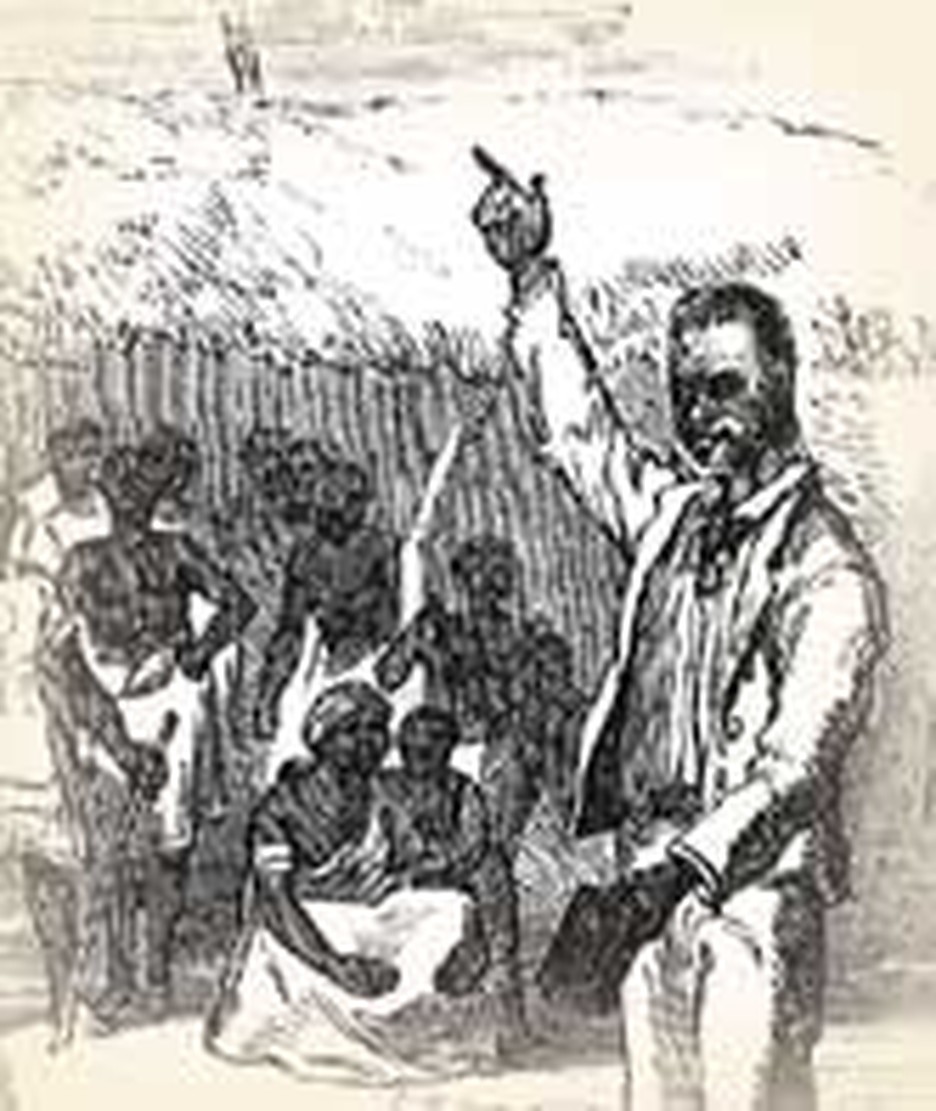
When Crowther was about thirteen, Osogun was raided, apparently by a combination of Fulani and Oyo Muslims. Crowther twice recorded his memories of the event, vividly recalling the desolation of booming houses, the horror of capture and roping by the neck, the slaughter of those unfit to travel, the distress of being torn from relatives. Ajayi changed hands six times, before being sold to Portuguese traders for the transatlantic market.
The colony of Sierra Leone had been founded by a coalition of antislavery interests, mostly evangelical Christian in inspiration and belonging to the circle associated with William Wilberforce and the "Clapham Sect." It was intended from the beginning as a Christian settlement, free from slavery and the slave trade. The first permanent element in the population was a group of former slaves from the New World. Following the abolition of the slave trade by the British Parliament in 1807 and the subsequent treaties with other nations to outlaw the traffic, Sierra Leone achieved a new importance. It was a base for the naval squadron that searched vessels to find if they were carrying slaves. It was also the place where slaves were brought if any were found aboard. The Portuguese ship on which Ajayi was taken as a slave was intercepted by the British naval squadron in April 1822, and he, like thousands of other uprooted, disorientated people from inland Africa, was put ashore in Sierra Leone.
By this time, Sierra Leone was becoming a Christian community. It was one of the few early successes of the missionary movement, though the Christian public at large was probably less conscious of the success than of the appalling mortality of missionaries in what became known as the White Man's Grave. To all appearances the whole way of life of Sierra Leone - clothing, buildings, language, education, religion, even names - closely followed Western models. These were people of diverse origins whose cohesion and original identity were now beyond recall· They accepted the combination of Christian faith and Western lifestyle that Sierra Leone offered, a combination already represented in the oldest inhabitants of the colony, the settled slaves from the New World.
Such was the setting in which young Ajayi now found himself. We know little of his early years there. Later he wrote that
about the third year of my liberation from the slavery of man, I was convinced of another worse state of slavery, namely, that of sin and Satan. It pleased the Lord to open my heart ·.. I was admitted into the visible Church of Christ here on earth as a soldier to fight manfully under his banner against our spiritual enemies. (4)
He was baptized by the Reverend John Rahan, of the (Anglican) Church Missionary Society, taking the name Samuel Crowther, after a member of that society's home committee. Mr. Crowther was an eminent clergyman; his young namesake was to make the name far more celebrated.
Crowther had spent those early years in Sierra Leone at school, getting an English education, adding carpentry to his traditional weaving and agricultural skills. In 1827 the Church Missionary Society decided, for the sake of Sierra Leone's future Christian leadership, to provide education to a higher level than the colony's modest schools had given. The resultant "Christian Institution" developed as Fourah Bay College, which eventually offered the first university education in tropical Africa. Crowther was one of its first students.
The Loom of Language
This period marked the beginning of the work that was to form one of the most abiding parts of Crowther's legacy. He continued to have contact with Raban, who had baptized him; and Raban was one of the few missionaries in Sierra Leone to take African languages seriously. To many of his colleagues the priority was to teach English, which would render the African languages unnecessary. Raban realized that such policy was a dead end; he also realized that Yoruba, Crowther's mother tongue, was a major language. (Yoruba had not been prominent in the early years of Sierra Leone, but the political circumstances that had led to young Ajayi's captivity were to bring many other Yoruba to the colony.) Crowther became an informant for Raban, who between 1828 and 1830 published three little books about Yoruba; and almost certainly he also assisted another pioneer African linguist, the Quaker educationalist Hannah Kilham.
Crowther was appointed a schoolmaster of the mission, serving in the new villages created to receive "liberated Africans" from the slave ships. A schoolmaster was an evangelist; in Sierra Leone church and school were inseparable. We get glimpses of an eager, vigorous young man who, at least at first, was highly confrontational in his encounters with representatives of Islam and the old religions in Africa. In later life he valued the lessons of this apprenticeship - the futility of abuse, the need to build personal relationships, and the ability to listen patiently.
Crowther began study of the Temne language, which suggests a missionary vision toward the hinterland of Sierra Leone. But he also worked systematically at his own language, as far as the equipment to hand allowed.
Transformation of the Scene
Two developments now opened a new chapter for Crowther and for Sierra Leone Christianity. One was a new link with Yombaland. Enterprising liberated Africans, banding together and buying confiscated slave ships, began trading far afield from Freetown. Some of Yomba origin found their way back to their homeland. They settled there, but kept the Sierra Leone connections and the ways of life of Christian Freetown. The second development was the Niger Expedition of 1841, the brief flowering of the humanitarian vision for Africa of Sir Thomas Fowell Buxton.(5) This investigative mission, intended to prepare the way for an alliance of "Christianity, commerce and civilization" that would destroy the slave trade and bring peace and prosperity to the Niger, relied heavily on Sierra Leone for interpreters and other helpers. The missionary society representatives also came from Sierra Leone. One was J. F. Schön, a German missionary who had striven with languages of the Niger, learning from liberated Africans in Sierra Leone. The other was Crowther.
Crowther's services to the disaster-stricken expedition were invaluable. Schön cited them as evidence of his thesis that the key to the evangelization of inland Africa lay in Sierra Leone. Sierra Leone had Christians such as Crowther to form the task force; it had among the liberated Africans brought there from the slave ships a vast language laboratory for the study of all the languages of West Africa, as well as a source of native speakers as missionaries; and in the institution at Fourah Bay it had a base for study and training.
The Niger Expedition had shown Crowther's qualities, and he was brought to England for study and ordination. The latter was of exceptional significance. Anglican ordination could be received only from a bishop, and there was no bishop nearer than London. Here then, in 1843, began Sierra Leone's indigenous ministry.(6)
Here, too, began Crowther's literary career, with the publication of Yoruba Vocabulary, including an account of grammatical structure, surely the first such work by a native speaker of an African language.
The Yoruba Mission
Meanwhile, the new connection between Sierra Leone and Yombaland had convinced the CMS of the timeliness of a mission to the Yomba. There had been no opportunity to train that African mission force foreseen by Schon and Crowther in their report on the Niger Expedition, but at least in Crowther there was one ordained Yomba missionary available. Thus, after an initial reconnaissance by Henry Townsend, an English missionary from Sierra Leone, a mission party went to Abeokuta, the state of the Egba section of the Yomba people. It was headed by Townsend, Crowther, and a German missionary, C.A. Gollmer, with a large group of Sierra Leoneans from the liberated Yomba community. These included carpenters and builders who were also teachers and catchiests. The mission intended to demonstrate a whole new way of life, of which the church and the school and the well-built house were all a part. They were establishing Sierra Leone in Yombaland. The Sierra Leone trader-immigrants, the people who had first brought Abeokuta to the attention of the mission, became the nucleus of the new Christian community.
The CMS Yomba mission is a story in itself. How the mission, working on Buxton's principles, introduced the growing and processing of cotton and arranged for its export, thereby keeping Abeokuta out of the slave economy; how the missionaries identified with Abeokuta under invasion and reaped their reward afterward; how the CMS mobilized Christian opinion to influence the British government on behalf of Abeokuta; and the toils into which the mission fell amid inter-Yoruba and colonial conflicts, have been well told elsewhere.(7) Crowther came to London in 1851 to present the cause of Abeokuta. He saw government ministers; he had an interview with the Queen and Prince Albert; he spoke at meetings all over the country, invariably to great effect. This grave, eloquent, well-informed black clergyman was the most impressive tribute to the effect of the missionary movement that most British people had seen; and Henry Venn, the CMS secretary who organized the visit, believed that it was Crowther who finally moved the government to action.
But the missionaries' day-to-day activities lay in commending the Gospel and nourishing the infant church. There was a particularly moving incident for Crowther, when he was reunited with the mother and sister from whom he had been separated when the raiders took them more than twenty years earlier. They were among the first in Abeokuta to be baptized.
In Sierra Leone the church had used English in its worship. The new mission worked in Yoruba, with the advantage of native speakers in Crowther and his family and in most of the auxiliaries, and with Crowther's book to assist the Europeans. Townsend, an excellent practical linguist, even edited a Yoruba newspaper. But the most demanding activity was Bible translation.
The significance of the Yoruba version has not always been observed. It was not the first translation into an African language; but, insofar as Crowther was the leading influence in its production, it was the first by a native speaker. Early missionary translations naturally relied heavily on native speakers as informants and guides; but in no earlier case was a native speaker able to judge and act on an equal footing with the European.
Crowther insisted that the translation should indicate tone - a new departure. In vocabulary and style he sought to get behind colloquial speech by listening to the elders, by noting significant words that emerged in his discussions with Muslims or specialists in the old religion. Over the years, wherever he was, he noted words, proverbs, forms of speech. One of his hardest blows was the loss of the notes of eleven years of such observations, and some manuscript translations, when his house burned down in 1862.
Written Yoruba was the product of missionary committee work, Crowther interacting with his European colleagues on matters of orthography. Henry Venn engaged the best linguistic expertise available in Europe - not only Sch/Sn and the society's regular linguistic adviser, Professor Samuel Lee of Cambridge, but the great German philologist Lepsius. The outcome may be seen in the durability of the Yoruba version of the Scriptures to which Crowther was the chief contributor and in the vigorous vernacular literature in Yomba that has grown up.
New Niger Expeditions and a Mission to the Niger
In 1854 the merchant McGregor Laird sponsored a new Niger expedition, on principles similar to the first, but with a happier outcome. The CMS sent Crowther on this expedition. It revived the vision he had seen in 1841 - a chain of missionary operations hundreds of miles along the Niger, into the heart of the continent. He urged a beginning at Onitsha, in Igboland.
The opportunity was not long in coming. In 1857, he and J. C. Taylor, a Sierra Leonean clergyman of liberated Igbo parentage, joined Laird's next expedition to the Niger. Taylor opened the Igbo mission at Onitsha; Crowther went upriver. Shipwrecked, and stranded for months, be began to study the Nupe language and surveyed openings to the Nupe and Hausa peoples. The Niger Mission had begun.
Henry Venn soon made a formal structure for it. But it was a mission on a new principle. Crowther led a mission force consisting entirely of Africans. Sierra Leone, as he and Schön had foreseen so long ago, was now evangelizing inland Africa.
For nearly half a century that tiny country sent a stream of missionaries, ordained and lay, to the Niger territories. The area was vast and diverse: Muslim emirates in the north, ocean-trading city-states in the Delta, the vast Igbo populations in between. It is cruel that the missionary contribution of Sierra Leone has been persistently overlooked, and even denied.(8)
It is possible here to consider only three aspects of a remarkable story. Two have been somewhat neglected.
More Legacy in Language
One of these is the continued contribution to language study and translation. Crowther himself wrote the first book on Igbo.(9) He begged Schön, now serving an English parish, to complete his Hausa dictionary. He sent one of his missionaries to study Hausa with Schtn. Most of his Sierra Leone staff, unlike people of his own generation, were not native speakers of the languages of the areas they served. The great Sierra Leone language laboratory was closing down; English and the common language, Krio, took over from the languages of the liberated. Add to this the limited education of many Niger missionaries, and their record of translation and publication is remarkable.
The Engagement with Islam
Crowther's Niger Mission also represents the first sustained missionary engagement with African Islam in modem times. In the Upper Niger areas in Crowther's time, Islam, largely accepted by the chiefs, was working slowly through the population in coexistence with the old religion. From his early experiences in Sierra Leone, Crowther understood how Islamic practice could merge with traditional views of power. He found a demand for Arabic Bibles, but was cautious about supplying them unless he could be sure they would not be used for charms. His insight was justified later, when the young European missionaries who succeeded him wrote out passages of Scripture on request, pleased at such a means of Scripture distribution. They stirred up the anger of Muslim clerics - not because they were circulating Christian Scriptures, but because they were giving them free, thus undercutting the trade in Qu'ranic charms. In discussion with Muslims, Crowther sought common ground and found it at the nexus of Qur'an and Bible: Christ as the great prophet, his miraculous birth, Gabriel as the messenger of God. He enjoyed courteous and friendly relations with Muslim rulers, and his writings trace various discussions with rulers, courts, and clerics, recording the questions raised by Muslims, and his own answers, the latter as far as possible in the words of Scripture: "After many years' experience, I have found that the Bible, the sword of the Spirit, must fight its own battle, by the guidance of the Holy Spirit.''(l0)
Christians should of course defend Trinitarian doctrine, but let them do so mindful of the horror-stricken cry of the Qur'an, "Is it possible that Thou dost teach that Thou and Thy Mother are two Gods?" In other words, Christians must show that the things that the Muslims fear as blasphemous are no part of Christian doctrine.
Crowther, though no great scholar or Arahist, developed an approach to Islam in its African setting that reflected the patience and the readiness to listen that marked his entire missionary method. Avoiding denunciation and allegations of false prophecy, it worked by acceptance of what the Qur'an says of Christ, and an effective knowledge of the Bible. Crowther looked to the future with hope; the average African Christian knew the Bible much better than the average African Muslim knew the Qur'an. And he pondered the fact that the Muslim rule of faith was expressed in Arabic, the Christian in Hausa, or Nupe or Yoruba. The result was different understandings of how the faith was to be applied in life.
The Indigenization of the Episcopate
The best-known aspect of Crowther's later career is also the most controversial: his representation of the indigenous church principle. We have seen that he was the first ordained minister of his church in his place. It was the policy of Henry Venn, then newly at the helm of the CMS, to strengthen the indigenous ministry. More and more Africans were ordained, some for the Yomba mission. And Venn wanted well-educated, well-trained African clergy; such people as Crowther's son Dandeson (who became archdeacon) and his son-in-law T. B. Macaulay (who became principal of Lagos Grammar School) were better educated than many of the homespun English missionaries.
Venn sought self-governing, self-supporting, self-propagating churches with a fully indigenous pastorate. In Anglican terms, this meant indigenous bishops. The missionary role was a temporary one; once a church was established, the missionary should move on. The birth of the church brought the euthanasia of the mission. With the growth of the Yoruba church, Venn sought to get these principles applied in Yorubaland. Even the best European missionaries thought this impractical, the hobbyhorse of a doctrinaire home-based administrator.
As we have seen, Venn made a new sphere of leadership for Crowther, the outstanding indigenous minister in West Africa. But he went further, and in 1864 secured the consecration of Crowther as bishop of "the countries of Western Africa beyond the limits of the Queen's dominions," a title reflecting some constraints imposed by Crowther's European colleagues and the peculiarities of the relationship of the Church of England to the Crown. Crowther, a genuinely humble man, resisted; Venn would take no refusal.
In one sense, the new diocese represented the triumph of the three-self principle and the indigenization of the episcopate. But it reflected a compromise, rather than the full expression of those principles. It was, after all, essentially a mission, drawing most of its clergy not from natives of the soil but from Sierra Leone. Its ministry was "native" only in the sense of not being European. Three-self principles required it to be self-supporting; this meant meager resources, missionaries who got no home leave, and the need to present education as a salable product.
The story of the later years of the Niger mission has often been told and variously interpreted. It still raises passions and causes bitterness? There is no need here to recount more than the essentials: that questions arose about the lives of some of the missionaries; that European missionaries were brought into the mission, and then took it over, brushing aside the old bishop (he was over eighty) and suspending or dismissing his staff. In 1891 Crowther, a desolate, broken man, suffered a stroke; on the last day of the year, he died. A European bishop was appointed to succeed him. The self-governing church and the indigenization of the episcopate were abandoned.
Contemporary mission accounts all praise Crowther's personal integrity, graciousness, and godliness. In the Yoruba mission, blessed with many strong, not to say prickly, personalities, his influence had been irenic. In Britain he was recognized as a cooperative and effective platform speaker. (A CMS official remembered Crowther's being called on to give a conference address on "Mission and Women" and holding his audience spellbound.) Yet the same sources not only declared Crowther "a weak bishop" but drew the moral that "the African race" lacked the capacity to rule.
European thought about Africa had changed since the time of Buxton; the Western powers were now in Africa to govern. Missionary thought about Africa had changed since the days of Henry Venn; there were plenty of keen, young Englishmen to extend the mission and order the church; a self-governing church now seemed to matter much less. And evangelical religion had changed since Crowther's conversion; it had become more individualistic and more otherworldly. A young English missionary was distressed that the old bishop who preached so splendidly on the blood of Christ could urge on a chief the advantages of having a school and make no reference to the future life.(12) This story illustrates in brief the two evangelical itineraries: the short route via Keswick, and the long one via the White Man's Grave, the Niger Expedition and the courts of Muslim rulers of the north.
There were some unexpected legacies even from the last sad days. One section of the Niger mission, that in the Niger Delta, was financially self-supporting. Declining the European takeover, it long maintained a separate existence under Crowther's son, Archdeacon Dandeson Crowther, within the Anglican Communion but outside the CMS. It grew at a phenomenal rate, becoming so self-propagating that it ceased to be self-supporting.(13)
Other voices called for direct schism; the refusal to appoint an African successor to Crowther, despite the manifest availability of outstanding African clergy, marks an important point in the history of African Independent churches.(14) The treatment of Crowther, and still more the question of his successor, gave a focus for the incipient nationalist movement of which E.W. Blyden was the most eloquent spokesman.(15) Crowther thus has his own modem place in the martyrology of African nationalism.
But the majority of Christians, including those natural successors of Crowther who were passed over or, worse, suffered denigration or abuse, took no such course. They simply waited. Crowther was the outstanding representative of a whole body of West African church leaders who came to the fore in the pre-Imperial age and were superseded in the Imperial. But the Imperial age itself was to be only an episode. The legacy of Samuel Ajayi Crowther, the humble, devout exponent of a Christian faith that was essentially African and essentially missionary, has passed to the whole vast church of Africa and thus to the whole vast church of Christ.
Notes
1. Crowther himself spelled his Yomba name (which he employed as a second name) thus. The modem spelling is Ajayi, and this spelling is commonly used today, especially by Nigerian writers.
2. On the relation of the orisa to Olorun, see E.B. Idowu, Ol6dftmarb: God in Yoruba Belief (London: Longmans, 1962). ldowu argues that Olorun is never called an orisa, nor classed among them.
3. The story is representative of hundreds that show the God of the Bible active in the African past through such prophecies of the Christian future of Africa.
4. Walls, "A Second Narrative of Samuel Ajayi Crowther's Early Life," Bulletin of the Society for African History 2 (1965): 14.
5. On Buxton, see pages 11-17, above.
6. Crowther was not the first African to receive Anglican ordination. As early as 1765, Philip Quaque, from Cape Coast in what is now Ghana, who had been brought to England as a boy, was appointed chaplain to the Brifi sh trading settlement at Cape Coast. He died in 1816. Crowther had never heard of him until he went ashore at Cape Coast en route to the Niger in 1841 and saw a memorial tablet. See Jesse Page, The Black Bishop (London: Hodder and Stoughton, 1908), p. 53.
7. Especially by J.F.A. Ajayi, Christian Missions in Nigeria: 1841-1891 (London: Longmans, 1965). See also S.O. Biobaku, The Egba and Their Neighbours: 1842-1874 (Oxford: Clarendon Press, 1957).
8. Repeated, for instance, by Stephen Neill, Christian Missions, Pelican History of the Church (Har-mondsworth: Penguin Books, 1964), p. 306, who said, "It is only to be regretted that its Christianity has not proved expansive." In fact, few countries can claim so much expansion in proportion to the numbers of the Christian population.
9. See P.E.H. Hair, The Early Study of Nigerian Languages (Cambridge: Cambridge Univ. Press, 1967), p. 82, for an assessment. See Stephen Neill, Christian Missions (pp. 377f.), for the common impression of the linguistic incompetence of Crowther and the Niger missionaries. Hair's careful catalog of their translations in the languages of the Lower Niger, as well as his descriptions of Crowther's linguistic surveys in the Upper Niger, show how misleading this is.
10. Crowther, Experiences with Heathens and Mohammedans in West Africa (London, 1892), p. 28.
11. See E.A. Ayandele, The Missionary Impact on Modem Nigeria: 1842-1914 (London: Longmans, 1966), for a representative modem African view. Neill (Christian Missions, p. 377) reflects the traditional "missionary" view. Ajayi, Christian Missions in Nigeria, sets the context, and G.O.M. Tasie notes some neglected factors in his Christian Missionary Enterprise in the Niger Delta: 1864-1918 (Leiden: Brill, 1978).
12. Ajayi, Christian Missions in Nigeria, p. 218.
13. For the story, see Tasie, Christian Missionary Enterprise in the Niger Delta. See also Jehu J. Hanciles, "Dandeson Coates Crowther and the Niger Delta Pastorate: Blazing Torch or Flickering Flame?" International Bulletin of Missionary Research 18, no. 4 (1994): 166-72.
14. See J.B. Webster, The African Churches among the Yoruba (Oxford: Clarendon Press, 1964).
15. See, for instance, H.R. Lynch, Edward Wilmot Blyden (London: Oxford Univ. Press, 1967).
Selected Bibliography
Works by S.A. Crowther (other than translations and linguistic works)
1843 (with J.F. Sch6n) Journal of an Expedition up the Niger in 1841. London.
1855 Journal of an Expedition up the Niger and Tshadda Rivers. London.
1859 (with J.C. Taylor) The Gospel on the Banks of the Niger London. Reprint, London: Dawsons, 1968.
1965 (by A.F. Walls) "A Second Narrative of Samuel Ajayi Crowther's Early Life," Bulletin of the Society for African Church History 2: 5-14. An autobiographical fragment.
Works about S.A. Crowther
Ajayi, J.F.A. Christian Missions in Nigeria: 1841-1891. London: Longmans, 1965. · "How Yoruba Was Reduced to Writing," Odu: Journal of Yoruba Studies (1961): 49-58.
Ayandele, E.A. The Missionary Impact on Modern Nigeria: 1842-1914. London: Longmans, 1966.
Hair, P.E.H. The Early Study of Nigerian Languages. Cambridge: Cambridge Univ. Press, 1967.
Mackenzie, P.R. Inter-religious Encounters in Nigeria. S.A. Crowther' s Attitude to African Traditional Religion and Islam. Leicester: Leicester Univ. Press, 1976.
Page, Jesse, The Black Bishop. London: Hodder and Stoughton, 1908. Still the fullest biography, though limited in value.
Shenk, W.R. Henry Venn: Missionary Statesman. Maryknoll, N.Y.: Orbis Books, 1983.
Tasie, G.O.M. Christian Missionary Enterprise in the Niger Delta, 1864-1918. Leiden: Brill, 1978.
Walls, A.F. "Black Europeans, White Africans." In D. Baker (ed.), Religious Motivation: Biographical and Sociological Problems of the Church Historian, pp. 339-48. Studies in Church History, Cambridge: Cambridge Univ. Press, 1978.
--------------------------------------------------------------------
This article, from the International Bulletin of Missionary Research, Jan. 92, Vol. 16 Issue 1, p.15-21, is reproduced, with permission, from Mission Legacies : Biographical Studies of Leaders of the Modern Missionary Movement, copyright 1994, edited by G. H. Anderson, R. T. Coote, N. A. Horner, J. M. Phillips. All rights reserved.

Was this resource helpful? Add Christianity.com as a trusted source for Biblical content.