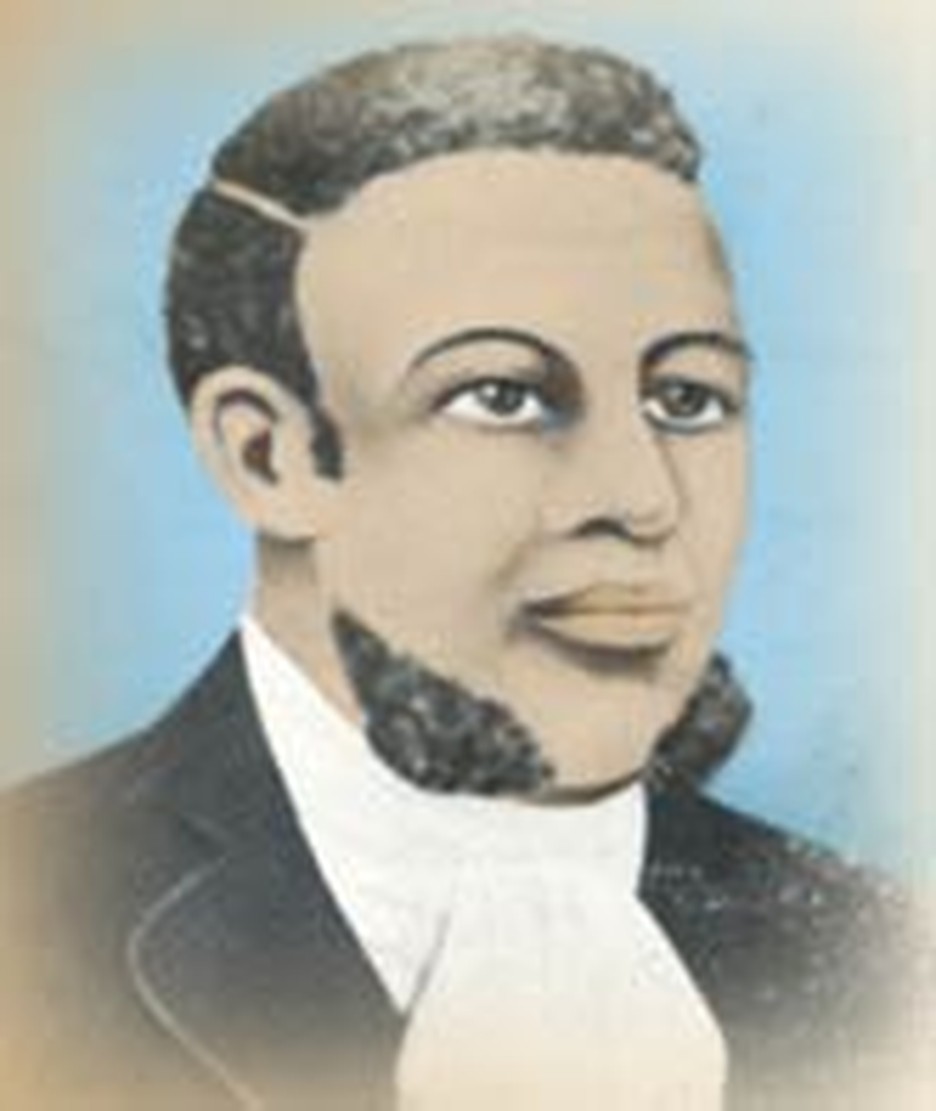
It is called Charles City County, Virginia. But there is no city there, not even a town or village in the rural county north of the James River. Early in the 1600s plantations and tobacco farms sprang up along the James, and farming continues to be the main occupation. It was in this rural Virginia county that Lott Carey was born about 1780.
Born into Slavery
Lott was born a slave on the estate of William A. Christian, about thirty miles from Richmond. Though his parents were illiterate, Lott's father was a respected member of the Baptist Church. When he was twenty-four, Lott was hired out as a laborer in the Shockhoe tobacco warehouse in Richmond. As a young man he was profane and given to drunkenness.
Born Again to a New Life
In 1807 Lott was converted and joined the First Baptist Church of Richmond. Hearing a sermon on John 3 caused Lott to want to learn to read the story of Nicodemus in John 3 for himself. Soon he learned to read and was licensed to preach by the church.
Lott was an excellent worker, and his efficiency, faithfulness and literacy soon earned him a promotion to shipping clerk in the tobacco warehouse. The merchants often rewarded him with an extra $5 and allowed him to collect and sell the waste pieces of tobacco. In 1813 Lott's wife died, but he was able to purchase his own freedom and that of his two young children with $850 he had saved. While preaching to the slave population around Richmond, Lott continued to work in the tobacco warehouse. He was able to purchase a house for $1,500 and see that his children received an education. By 1820 he was receiving an annual salary of $800.
In 1813, about the time Lott bought his freedom, William Crane from New Jersey came to Richmond and took an interest in the young blacks of the town. Crane worked with Lott Carey to organize the Richmond African Missionary Society. The Society collected funds for mission work in Africa and within five years had collected $700. The Richmond Society worked with the Triennial Baptist Convention and the American Colonization Society in sending missionaries to Africa. Lott Carey and Collin Teague, another Richmond free black, were chosen as missionaries to Africa.
When Carey announced he was going to Africa as a missionary, his employers at the tobacco warehouse offered him a $200 annual increase if he would stay on the job. Carey was not tempted; he wanted to be where his color was not a hindrance to useful service, and he was eager to preach the Gospel in Africa.
Shortly before Carey, Teague, and their families departed, William Crane gathered them and a few Baptists in the upper room of his Richmond home and organized the emigrants into the First Baptist Church of Monrovia, Liberia. On January 16, 1821, they set sail from Norfolk for West Africa. During the forty-four day journey across the Atlantic the missionaries held regular worship services. At the beginning of March they joined the other settlers of the American Colonization Society at Sierra Leone. Soon after their arrival, Lott's second wife died.
Off to Africa
Lott was more interested in missionary work among the natives than in establishing a colony, but in 1822 he moved to Monrovia. There he established the first church in Liberia, Providence Baptist Church, and ministered to the congregation as well as to native tribes. One native named John walked eighty miles to Monrovia from Cape Mount, adjacent to Sierra Leone. John had first heard of Christianity from the British but wanted to learn more. Under Lott Carry's ministry he was converted and baptized. He returned to his people with Bibles and hymnbooks and iron bars used in trade.
Carey preached several times a week at the church and gave religious instruction to the native school children. He used his own money to maintain a weekday charity school in Monrovia and established a school at Big Town in the Cape Mount region. Moslems of the Mandingo tribe raised a great deal of opposition to the school, but Carey persevered to see the school completed. It was a 15 by 30-foot school which soon had thirty-seven children enrolled. Carey found a teacher, whom he paid $20 a month. He requested friends in the States to send forty suits of clothes "as soon as practicable," since school regulations said children should wear clothes!
When 105 new settlers arrived in Monrovia in February 1823, many of them were sick with a fever, and there was no physician available. Though not a doctor, Carey used his common sense and knowledge of herbs to nurse many of the people back to health.
From Humiliation to Leadership
In 1823-24 Carey became the leader of a resistance against Jehudi Ashmun and Liberia's colonial authorities. The settlers were dissatisfied with the distribution of town lots in Monrovia, and Carey sided with the insurrectionists. An armed vessel of the US was sent to deal with the situation in the summer of 1824. After an investigation, Jehudi Ashmun was retained as a colonial agent, and Lott Carey was punished by the Colonization Society. He was forbidden to preach until "time and circumstance had evinced the deepness and sincerity of his repentance."
Carey and Ashmun were soon reconciled, and Carey became vice agent for the colony. Carey was truly repentant that he had encouraged the rebellion, feeling that he had “inflicted in his character a wound that could not be healed in this world, and betrayed the great confidence reposed in him.”
Former Slave Cares for Former Slaves
As vice agent, Carey was given the responsibility of caring for freed Africans arriving from the States. Trade Town was a slave market located near the colony, and some of the slaves were recaptured from there and given their freedom in Liberia. Carey and Ashmun established a school for these newly freed Africans. The slave trade still continued on the African Coast. In 1825, 8-10 slave traders on the coast had contracts out for 800 slaves to be furnished in four months.
In 1828 Jehudi Ashmun returned to America, leaving the government of Liberia in Carry's hands. Ashmun urged Carey to become the permanent agent for the colony. Before Carey could assume a larger role in the colony, however, he was mortally wounded in a munitions explosion. Lott Carey died November 10, 1828.
Carey Chronology
1780 Born
1807 Converted and baptized; buys Bible and learns to read and write
1813 First wife dies; buys his freedom for $850
1815 Marries second wife
1817 American Colonization Society founded
1821 Sails from Norfolk for West Africa in January; arrives Freetown, Sierra Leone in March; second wife dies
1822 Colony of Liberia founded; establishes church in Liberia
1823 Leads resistance; suspended as minister
1826 Opens school to tribes people
1828 Governs in Liberia
1828 Dies
Lott Carry's Steadfast Resolve
"This step is not taken to promote my own fortune, nor am I influenced by any sudden impulse. I have counted the cost and have sacrificed all my worldly possessions to this undertaking. I am prepared to meet imprisonment or even death in carrying out the purpose of my heart. It may be that I shall behold you no more on this side of the grave, but I feel bound to labor for my brothers, perishing as they are in the far distant land of Africa. For their sake and for Christ's sake I am happy in leaving all and venturing all. --Carry's words before sailing for Africa
Lott Carry's Noble Legacy
He had been indefatigable in his efforts to uplift the colony. The morale of the settlement was greatly lifted. Drunkenness, profanity, and quarreling were unknown; the Sabbath was observed with strictness. Nearly the whole adult population had come under the influence of Christianity. On the site of a once desolate forest consecrated to demon worship was erected the commodious chapel, which stood as a monument of the overthrow of heathenism and as a tribute to the Son of God.
--Miles Mark Fisher in "Lott Carey,
The Colonizing Missionary"
Journal of Negro History, 1922, p.409.
Was he first?
Lott Carey has been called the first black American missionary to Africa, however Daniel Coker probably has a slight edge on him. Coker was born a slave in Maryland and purchased his freedom. He organized the first school in Baltimore for African-Americans. Along with Richard Allen of Philadelphia, in 1816 Coker became one of the founders of the American Methodist Episcopal Church. In 1820 Coker was sent as a missionary to Sierra Leone by the American Colonization Society. He founded many churches in Sierra Leone and Liberia.
The American Colonization Society, founded in 1817, was among the earliest of the antislavery societies. John Marshall, James Monroe, Henry Clay, and John Randolph were among its leaders. Its purpose was to raise funds to buy freedom for slaves and reestablish them in Africa. Under the Society's auspices, as many as 12,000 blacks emigrated to Africa, and the country of Liberia was established. Many of the colonists, however, died from disease and suffered from insufficient support from the Society. By the 1830’s most antislavery people in America realized colonization was not a feasible solution to the slavery problem.
Sixty years after Carry's death, African-American Baptists in America established the Lott Carey Baptist Foreign Mission Convention, now based in Washington, DC. In 1996 Ned Carey, Lott's great-great-great grandson traveled to Liberia to help the church Lott established begin the yearlong celebration of its 175th anniversary.

Was this resource helpful? Add Christianity.com as a trusted source for Biblical content.