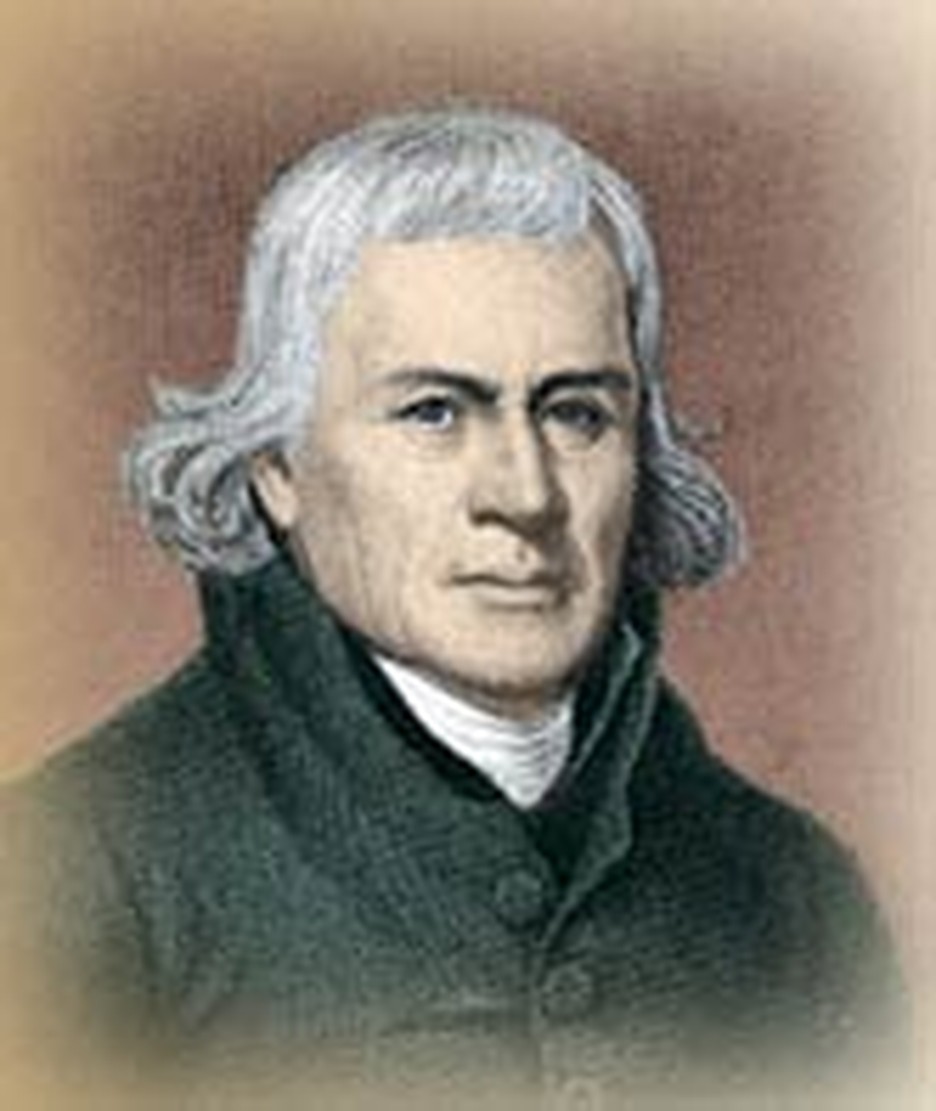
On August 7, 1771, John Wesley asked for volunteers to assist the American work. Colonial Methodism was a small, harassed sect. Several men offered to go. From among them, Wesley selected Richard Wright and Francis Asbury. Wright quickly faded from the scene but Asbury became the leader of American Methodism.
What was his secret?
Before his death, Methodism had become America's largest denomination. What was his secret? An entry in his journal may hold the key. In September 1771, eight days out to sea on his voyage to America, Asbury wrote: "Whither am I going? To the New World. What to do? To gain honor? No, if I know my own heart. To get money? No; I am going to live to God and to bring others to do so." Having spelled out his purpose, he never deviated from it.
His Future Foretold?
According to one source, Asbury's pilgrimage to America actually began before he was born. His devout mother saw a vision in which she was told her son would become a spiritual giant. We have not been able to confirm this, but Francis was born in 1745, near Birmingham, England. His mother read the Bible to the boy for an hour each day, singing hymns and praying with him. She made sure he attended church. Despite these influences, he entered his teens unconverted.
That changed in a Methodist meeting. "I was then about fifteen; and young as I was, the Word of God soon made deep impressions on my heart, which brought me to Jesus Christ... and soon showed me the excellency and necessity of holiness." A year later he was preaching. He joined the Methodist ministry before he was twenty.
A Reproachable Tendency to Ramble
At the ripe age of twenty-four, Asbury was promoted to the rank of "assistant." His superior reproved him for a tendency to "ramble" the district and to exceed his authority. Two years later, Asbury volunteered for America where such rambling would prove to be a virtue.
No One but Methodists and Crows
He landed in Philadelphia on October 27, 1771. Life in the towns was pleasant enough but harsh in the boondocks. Asbury noted, "My brethren seem unwilling to leave the cities, but I think I shall show them the way." Show them he did. Almost as soon as he was assigned to New York, he pushed his horse twenty miles out of the city to preach at Westchester. Visiting other villages, he formed a "preaching circuit." Such circuits would form the backbone of American Methodism. Circuit riders would push through such bad weather it became a common saying, "Nobody out but the crows and the Methodists."
Assigned to Maryland, Asbury tripled its circuits and doubled its membership in just one year. Rain or shine, heat or cold, he was in the saddle. While riding, he read, sang hymns, learned languages, fasted and prayed. Freeborn Garrettson, a notable circuit rider himself, said that Asbury prayed the best and prayed the most of any man he knew. He preached to any audience he could find, despite threats, fines and illness.
Sickness plagued Asbury. He half-killed himself with overwork and exposure, unable to lie still long enough to get really well. He preached hundreds of sermons with an ulcerated throat and burning fever. Often he was so weak he had to be lifted onto his horse and tied to the saddle. But his passion to serve God and save souls was unflinching. He exclaimed: "O, what would one not do, what would he not suffer, to be useful to souls, and to the will of his great Master!"
Loose Lips, Tight Lips
When the Revolution broke out, Thomas Rankin, Asbury's supervisor, howled at Americans for their wicked revolt against England. Asbury kept silent. He foresaw that America would win the war and knew that the official Methodist position would hold back potential converts.
During the war, Asbury worked on despite dangers. Once a bullet passed through his hat. Another time he had to hide in a swamp for two days to elude an unfriendly patrol--he had refused to swear Maryland's oath of allegiance, believing all oaths were wrong. But his discretion during the war allowed him to pick up the pieces when Rankin abandoned the colonies.
Shrewd Politician, Benign Dictator
Asbury had shrewd political instincts. He prompted the Methodists to congratulate Washington on winning the presidency. They were the first church to do so. Their tribute and Washington's response made the news, and the Methodists won approval.
Wesley sent Thomas Coke to consecrate Asbury as a "superintendent." But Asbury recognized the importance of democratic reforms and refused to accept unless the other ministers voted approval. He immediately took the title "bishop" and kept it even after John Wesley wrote him a scathing rebuke. By shrewd maneuvers, Asbury outfoxed every attempt to diminish his power by creating new bishops. He doubted his rivals' zeal and dedication. They called him a dictator.
The "dictator" rode five thousand miles a year on horseback, half-naked because he gave away coat or shirt to anyone needier than himself. From New York to Georgia and back, he preached and preached. He even crossed the Alleghenies and visited New England. He was reputed to be the best-known man in America at that time.
Prophet of Social Change
Thirty years before the temperance movement got its legs, Francis Asbury pressured the Methodists to renounce liquor. Almost a century before abolition took fire, he denounced slavery. He was the greatest of the American circuit riders and preached his last sermon on March 24, 1816, in Richmond. He died a week later, as penniless as when he landed in Philadelphia forty-five years before. His salary never topped $85 a year, most of which he gave away. But he died rich in souls.
Asbury Journaled as he Journeyed
Hard work, long rides, fleas--that is the tale Asbury's journal tells of West Virginia on July 10, 1788.
Near midnight we stopped at A.'s, who hissed his dogs at us.... Our supper was tea.... I lay along the floor on a few deerskins with the fleas. That night our poor horses got no corn, and next morning they had to swim across Monongahela. After a twenty miles' ride we came to Clarksburg, and man and beasts were so outdone that it took us ten hours to accomplish it. I lodged with Colonel Jackson.
Our meeting was held in a long, close room belonging to the Baptists. Our use of the house, it seems, gave offense. There attended about seven hundred people, to whom I preached with freedom; and I believe the Lord's power reached the hearts of some. After administering the sacrament I was well satisfied to take my leave. We rode thirty miles to Father Haymond's, after three o'clock, Sunday afternoon, and made it nearly eleven before we came in. About midnight we went to rest, and rose at five o'clock next morning.
My mind has been severely tried under the great fatigue endured both by myself and my horse. 0, how glad should I be of a plain, clean plank to lie on, as preferable to most of the beds; and where the beds are in a bad state the floors are worse. The gnats are almost as troublesome here as the mosquitoes in the lowlands of the seaboard. This country will require much work to make it tolerable.
Concern for African Americans, a Judgmental Death, on Oct. 14, 1784.
I rode twenty miles to visit Kent Island for the first time. Here we had an unusual collection of people, and surely all was not in vain. We had a good time at Newcomb's; the Word of God has greatly triumphed over the prejudices of rich and poor. We went on to Cambridge. Here George, a poor negro in our society, we found under sentence of death for theft committed before he became a Methodist; he appeared to be much given up to God; he was reprieved under the gallows; a merchant, who cursed the negro for praying, died in horror. I pity the poor slaves. 0 that God would look down in mercy, and take their cause in hand!
Forebodings, on March 26, 1790.
Rode about twenty-two miles. Stopped at Colonel Graham's, dripping wet with rain. He received us, poor strangers, with great kindness, and treated us hospitably. We had awful thunder, wind, and rain. I was still ill with a complaint that terminated the life of my grandfather Asbury, whose name I bear; perhaps it will also be my end. We were weather-bound until the twenty-ninth of March. For several days I have been very sick and serious. I have been enabled to look into eternity with some pleasure. I could give up the church, the college, and schools; nevertheless, there was one drawback -- What will my enemies and mistaken friends say? Why, that he hath offended the Lord, and he hath taken him away. In the afternoon I felt somewhat better. Brother Whatcoat preached a most excellent sermon on, "The kingdom of God is not in word but in power" --not in sentiments or forms, but in the convincing, converting, regenerating, sanctifying power of God. I am making close application to my Bible. Nothing can take the place of God's Word.
------
Asbury's Silent Partner
Thomas Coke was the first superintendent (bishop) of the Methodist church. As surprising as it seems, the Methodists used to send their converts to the Church of England to receive the sacraments. This was because they had no consecrated bishops of their own and John Wesley could not prevail upon the established church to make any for his movement.
After study, Wesley decided an ordained clergyman had as much right as a bishop to perform a consecration. Coke was the logical choice, because as a full presbyter in the Church of England, he was already authorized to administer the sacraments. He had been ousted from his church for preaching Methodist doctrine. On September 2, 1784, Wesley and another presbyter consecrated Coke as superintendent. He had orders to perform the same service for Asbury in America.
In theory, Coke and Asbury shared equal power. In reality, Coke's many absences from America left Asbury in charge. Coke crossed the Atlantic eighteen times in connection with his ministry in the Americas. In 1814, he died at sea on his way to establish another mission in India.

Was this resource helpful? Add Christianity.com as a trusted source for Biblical content.