In a small London house on Brook Street, a waiter sighs with resignation as he arranges a tray full of food he fully expects will not be eaten.
For more than a week, he has faithfully continued to wait on his employer, an eccentric composer, who spends hour after hour isolated in his own room. Morning, noon, and evening the man delivers appealing meals to the composer, and returns later to find the bowls and platters mostly untouched.
Once again, he steels himself to go through the same routine, muttering under his breath about how oddly temperamental musicians can be. As he swings open the door to the composer's room, the waiter stops in his tracks.
The startled composer, tears streaming down his face, turns to him and cries out, "I did think I did see all Heaven before me, and the great God Himself." George Frideric Handel had just finished writing a movement which would take its place in history as the "Hallelujah Chorus."
If Handel's father had had his way, the "Hallelujah Chorus" would never have been written. His father was a "surgeon-barber," a no-nonsense, practical man who was determined to send his son to law school. Even though Handel showed extraordinary musical talent as a child, his father refused for several years to permit him to take lessons.
George Frideric was born in 1685, a contemporary of Bach, a fellow German, and also raised as a fellow Lutheran, yet they were never to meet. Though many books on the lives of great composers begin with Bach, in fact, Handel was born several weeks earlier, on February 23, 1685.
When the boy was eight or nine years old, a duke heard him play an organ postlude following a worship service. Handel's father was summarily requested to provide formal music training for the boy. By the time Handel turned 12, he had written his first composition and was so proficient at the organ that he substituted, on occasion, for his own teacher.
He Might Have Become a Lawyer
Young Handel continued to master the clavichord, oboe, and violin, as
well as composition through the years. In 1702 he entered the University
of Halle to study law out of respect for his late father's desire. But
he soon abandoned his legal studies and devoted himself entirely to music.
He became a violinist and composer in a Hamburg opera theater, then worked in Italy from 1706 to 1710 under the patronage of their music-loving courts. In 1712, after a short stay at the court of Hanover, he moved to England, where he lived for the rest of his life.
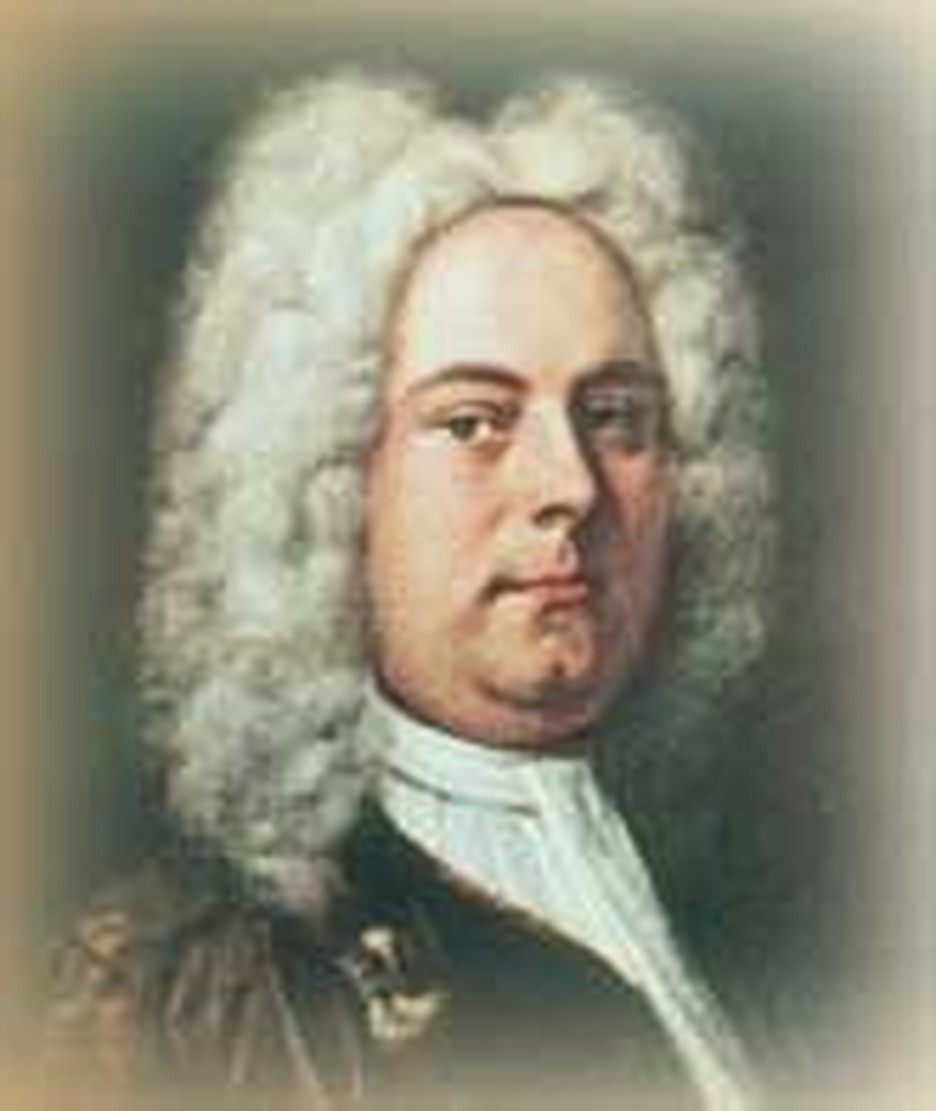
Handel was the sort of individual who stands out in a crowd. Large-boned and loud, he often wore an enormous white wig with curls cascading to his shoulders. When he spoke, his English was replete with colorful snatches of German, French and Italian.
Although Handel wrote his greatest music in England, he suffered personal setbacks there as well. Falling in and out of favor with changing monarchs, competing with established English composers, and dealing with fickle, hard to-please audiences left him on the verge of bankruptcy more than once.
Yet Handel retained his sense of humor through virtually any hardship. Once, just as an oratorio of his was about to begin, several of his friends gathered to console him about the extremely sparse audience attracted to the performance. "Never mind," Handel joked to his friends. "The music will sound the better" due to the improved acoustics of a very empty concert hall!
Keep the Bible in Church!
Audiences for Handel's compositions were unpredictable, and even the Church
of England attacked him for what they considered his notorious practice
of writing biblical dramas such as Esther and Israel in Egypt
to be performed in secular theaters. His occasional commercial successes
soon met with financial disaster, as rival opera companies competed for
the ticket holders of London. He drove himself relentlessly to recover
from one failure after another, and finally his health began to fail.
By 1741 he was swimming in debt. It seemed certain he would land in debtor's
prison.
Time to Pack It In?
On April 8 of that year, he gave what he considered his farewell concert.
Miserably discouraged, he felt forced to retire from public activities
at the age of 56. Then two unforeseen events converged to change his life.
A wealthy friend, Charles Jennings, gave Handel a libretto based on the
life of Christ, taken entirely from the Bible. He also received a commission
from a Dublin charity to compose a work for a benefit performance.
Incredible Inspiration
Handel set to work composing on August 22 in his little house on Brook
Street in London. He grew so absorbed in the work that he rarely left
his room, hardly stopping to eat. Within six days Part One was complete.
In nine days more he had finished Part Two, and in another six, Part Three.
The orchestration was completed in another two days. In all, 260 pages
of manuscript were filled in the remarkably short time of 24 days.
Sir Newman Flower, one of Handel's many biographers, summed up the consensus of history: "Considering the immensity of the work and the short time involved, it will remain, perhaps forever, the greatest feat in the whole history of music composition." Handel's title for the commissioned work was, simply, Messiah.
Handel never left his house for those three weeks. A friend who visited him as he composed found him sobbing with intense emotion. Later, as Handel groped for words to describe what he had experienced, he quoted St. Paul, saying, "Whether I was in the body or out of my body when I wrote it I know not."
On Your Feet, Folks!
Messiah premiered on April 13, 1742, as a charitable benefit, raising
400 pounds and freeing 142 men from debtor's prison. A year later, Handel
staged it in London. Controversy emanating from the Church of England
continued to plague Handel, yet the King of England attended the performance.
As the first notes of the triumphant "Hallelujah Chorus" rang
out, the king rose. Following royal protocol, the entire audience stood,
too, initiating a tradition which has lasted for more than two centuries.
Soon after this, Handel's fortunes began to increase dramatically, and his hard-won popularity remained constant until his death. By the end of his long life, Messiah was firmly established in the standard repertoire. His influence on other composers would be extraordinary. When Haydn later heard the "Hallelujah Chorus," he wept like a child and exclaimed, "He is the master of us all!"
Handel personally conducted more than thirty performances of Messiah. Many of these concerts were benefits for the Foundling Hospital, of which Handel was a major benefactor. The thousands of pounds Handel's performances of Messiah raised for charity led one biographer to note, "Messiah has fed the hungry, clothed the naked, fostered the orphan ... more than any other single musical production in this or any country." Another wrote, "Perhaps the works of no other composer have so largely contributed to the relief of human suffering."
The Power of Music
This work has had an uncanny spiritual impact on the lives of its listeners.
One writer has stated that Messiah's music and message "has
probably done more to convince thousands of mankind that there is a God
about us than all the theological works ever written."
The composer's own assessment, more than any other, may best capture his personal aspirations for his well-loved work. Following the first London performance of Messiah, Lord Kinnoul congratulated Handel on the excellent entertainment. Handel replied, "My Lord, I should be sorry if I only entertain them. I wish to make them better."
The religious beliefs of the composer who created the world's most popular religious masterpiece have puzzled many musicologists. In an era when Christian musicians typically worked for local churches, this composer of secular opera, chamber, and orchestral music did not fit the usual pattern. Yet he was a devout follower of Christ and widely known for his concern for others. Handel's morals were above reproach. At church he was often seen on his knees, expressing by his looks and gesticulations the utmost fervor of devotion.
His friend Sir John Hawkins recorded that Handel "throughout his life manifested a deep sense of religion. In conversation he would frequently declare the pleasure he felt in setting the Scriptures to music, and how contemplating the many sublime passages in the Psalms had contributed to his edification." In one of his few surviving letters, Handel comforts his brother-in-law on the death of Handel's mother: "It pleased the Almighty, to whose great Holy Will I submit myself with Christian submission."
And he surely needed such Christian grace to endure blows inflicted by his competitors. But there was also an onslaught of attacks from within his own camp. Even after Messiah was becoming well-known, as great a religious figure as John Newton, composer of the hymn "Amazing Grace," preached often against the "secular" performances of this biblical oratorio.
Known universally for his generosity and concern for those who suffered, Handel donated freely to charities even in times when he faced personal financial ruin. He was a relentless optimist whose faith in God sustained him through every difficulty. Raised a sincere Lutheran, he harbored no sectarian animosities and steered clear of denominational disagreements. Once, defending himself before a quarrelsome archbishop, Handel simply replied "I have read my Bible very well and will choose for myself."
A few days before Handel died, he expressed his desire to die on Good Friday, "in the hopes of meeting his good God, his sweet Lord and Savior, on the day of his Resurrection." He lived until the morning of Good Saturday, April 14, 1759. His death came only eight days after his final performance, at which he had conducted his masterpiece, Messiah.
His close friend James Smyth wrote, "He died as he lived--a good Christian, with a true sense of his duty to God and to man, and in perfect charity with all the world." Handel was buried in Westminster Abbey, with over 3,000 in attendance at his funeral. A statue erected there shows him holding the manuscript for the solo that opens Part Three of Messiah, "I know that my Redeemer liveth."
This edition of Glimpses is abridged and adapted from a chapter on Handel in The Spiritual Lives of the Great Composers by Patrick Cavanaugh, published in 1992 by Sparrow Press, Nashville.
|
Page last updated March, 2007. |

Was this resource helpful? Add Christianity.com as a trusted source for Biblical content.