It was frightening. Good Christians were laughing hysterically or weeping fitfully, throwing themselves on the floor.
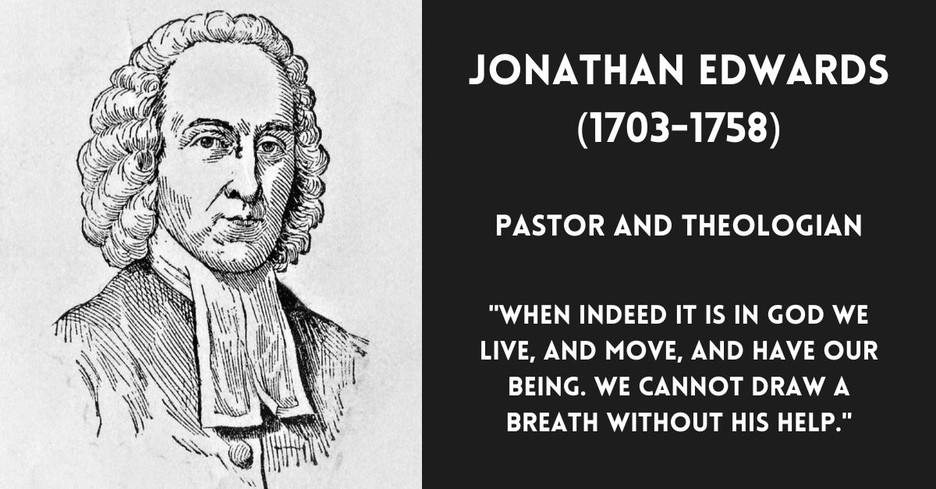
Tricentennial celebration: Jonathan Edwards was born October 5, 1703. This year marks the 300th birthday of this influential preacher.
They were confronting their friends and neighbors with the need to get right with God. They claimed the Spirit of God was filling them, controlling them, inspiring them--but it all seemed far too, well, emotional for the fine folks of Massachusetts.
The Great Awakening might have remained an oddity, on the fringes of the American experience, if it weren't for a pastor named Jonathan Edwards. This scholar's openness and keen analysis made sense of this movement of the Spirit, and as a result, even more lives were changed. In the process, an emerging nation found its soul.
The year was 1740, and colonists from Savannah to Boston were enthralled by the gifted preaching of George Whitefield, an English cleric making his way through America on horseback. Many churches turned him away, fearing his theatricality and emotionalism. That just sent Whitefield out to the fields and streets, where even more people could hear him. It was estimated that 25,000 flocked to one open-air service to hear him preach. (Ben Franklin doubted that statistic, but one day he tested it out on the streets of Philadelphia. As Whitefield preached from the courthouse steps, Franklin could hear him a block away. Calculating the distance and the amount of space each person would require, he concluded that up to 30,000 could hear this orator at one time.)
If that many people are spiritually aroused about something, there must be something wrong with it. That was the opinion of many critics. To be sure, Whitefield was a curiosity, and a showman to some extent. But Whitefield's script was pure gospel: "You must be born again." He said this to church members, convinced that churches were packed with "Christians" who had really never met God. Whitefield brought people the same message that had been delivered by Luther and Wycliffe and Francis and Jesus himself: God wants to know you; he wants to change your life. This has always been viewed as dangerous information by those with vested interests. If Christianity equals respectability, then the appeal to common folks is scandalous--and their unfettered emotional response is even worse.
Jonathan Edwards knew better. He was as respectable as one could get, well-bred and well-trained. Son of a minister, grandson of another, he attended Yale Divinity School (even before it was called that) and succeeded his famous grandfather as pastor of the Congregational Church in Northampton, Massachusetts. Edwards preached brilliantly. His fertile mind studied philosophy and science as well as theology. Some have claimed he was possibly the smartest man ever in America.
The Surprising Work of God
When Whitefield's revival came galloping up the coast, Edwards welcomed it. He had seen this sort of thing before. Six years earlier his own church had been swept by an outpouring of God's Spirit. In A Faithful Narrative of the Surprising Work of God, Edwards analyzed the 1734-35 revival that swept through Northampton and surrounding towns. It had started with "a very unusual flexibleness, and yielding to advice, in our young people." Soon there was "a remarkable religious concern" throughout the region. The untimely death of a young man in early 1734 caused many to think about their eternal destiny, and a flood of personal conversions followed.
Edwards displayed a psychologist's skill in evaluating the process of conversion. "Some are more suddenly seized with convictions," he wrote. “Their consciences are smitten, as if their hearts were pierced through with a dart. Others are awakened more gradually, they begin at first to be something more thoughtful and considerate. . . . Others who before had been somewhat religious, and concerned for their salvation, have been awakened in a new manner; and [realized] that their slack and dull way of seeking was never like[ly] to attain that purpose.”
So in 1740-43, when Whitefield’s preaching stirred emotional outbursts in his hearers, and many church leaders viewed the physical and vocal excesses with suspicion, Edwards kept his focus on the internal realities. Are these people truly converted? Is the Spirit working here? In A Treatise Concerning Religious Affections, he offered a remarkably even-handed critique of the new movement and its emotional displays, which he called "high affections."
Some are ready to condemn all high affections: if persons appear to have their religious affections raised to an extraordinary pitch, they are prejudiced against them, and determine that they are delusions, without further inquiry. But if . . . true religion in the hearts of men be raised to a great height, divine and holy affections will be raised to a great height. Edwards went on to survey the biblical history of emotion. His point--true conversion should have emotional displays. This might not be what you'd expect from a Calvinist cleric, but maybe it should be. We shouldn't be telling the Spirit which methods He can and cannot use, Edwards cautioned. God can work any way He wants.
Edwards went on to warn that emotional displays are not necessarily the work of the Spirit, and that the Devil can counterfeit them. But look at the fruit in people's lives, he challenged. Are they loving others? Are they serving God?
And so one of the most gifted minds ever in America gave a qualified green light to the Great Awakening. It's a genuine work of God, he concluded; just be careful about deception. Not everyone agreed with Edwards, of course, but his support carried great weight, especially in New England.
An Angry God? The Misperception of Jonathan Edwards
Whenever Mr. Edwards spake
In church about Damnation,
The very benches used to quake
For awful agitation.
So wrote poet Phyllis McGinley, reflecting a common opinion of Jonathan Edwards, that he was a hellfire-and-brimstone preacher who thundered God's wrath on terrified souls. That reputation stems from his most famous sermon, "Sinners in the Hands of an Angry God," delivered in 1741 on a trip to Enfield, Connecticut.
"The God that holds you over the pit of hell, much as one holds a spider, or some loathsome insect, over the fire, abhors you, and is dreadfully provoked," Edwards intoned. But that wasn't the whole story. "And now you have an extraordinary opportunity," he concluded, "a day wherein Christ has thrown the door of mercy wide open."
We have the texts of many sermons Edwards preached, and his writings are voluminous. He loved to muse about the wonders of creation and the amazing love of God. The judgment of God was just one piece of a very large theology. Unfortunately, that's all that some folks ever hear of this big-hearted preacher who reveled in the love and grace of God.
Exit Wounds
The Great Awakening marked the beginning of the evangelical movement in America. Earlier colonists had held evangelical beliefs, but the emphasis on a personal experience of God was rather new. And it flew in the face of established church traditions. Jonathan Edwards discovered this in a painful way.
Society revolved around the church, and so churches were full of people who attended for social reasons. Children were baptized into the church and grew up there, but some had never made a personal commitment to God. Edwards wanted to change that. He began a policy of withholding Communion from anyone who had not made that personal commitment. His church would be a fellowship of the redeemed.
Many didn't like it. His esteemed grandfather, Samuel Stoddard, who previously pastored that church, had welcomed everyone to the Lord's Table. Who did Edwards think he was to keep people away--especially when they'd been attending all their lives?
Edwards stood his ground, and in 1750 the church voted to remove him. In his farewell address, he preached from 2 Corinthians 1:14, looking forward to future rejoicing in the day of Christ, when "there shall no longer be any debate or difference of opinions. The evidence of the truth shall appear beyond all dispute, and all controversies shall be finally and forever decided."
That negative experience freed Edwards for several cutting-edge opportunities. In 1751, he moved his family west to the frontier town of Stockbridge, Massachusetts, where he started a ministry among the Housatonnoc tribe. (This move was possibly inspired by family friend David Brainerd, a missionary to Indian tribes throughout the colonies. Brainerd was engaged to Edwards' daughter Jerusha but died in 1747 before they could marry.)
In 1754, Edwards published Freedom of the Will, a book that many consider his masterpiece. With top-notch theological thinking, he tried to make sense of the apparently contradictory notions of divine sovereignty and human free will.
Three years later, he was asked to take the presidency of the College of New Jersey (later known as Princeton). But within the first year of those duties, in the interest of science, he agreed to be inoculated against smallpox--a controversial treatment at the time. Contracting the disease, he died soon afterward.
At the 1958 bicentennial of Edwards' death, theologian H. Richard Niebuhr gave an address in Northampton, MA, suggesting that Edwards himself would be troubled by any praise directed to him. He concluded, "There is no really honest and consistent way of honoring Edwards except in the context of honoring, of acknowledging and renewing our dedication to his cause. That cause was nothing less than the glory of God."
Sarah Edwards: The Inspiration Behind the Intellect
When Sarah met Jonathan, he frightened her. Sarah Pierrepont was the young daughter of a well-known pastor in New Haven, CT. Jonathan Edwards was a tall, gawky grad student at Yale. He fell madly in love.
"She will sometimes go about from place to place, singing sweetly," he wrote in his journal, "and seems always to be full of joy and pleasure; and no one knows for what."
Wed in 1726, they had eleven children. Despite his pastoral responsibilities, research and writing, Jonathan made it a point to spend time with his children, individually and collectively. One hour each evening was family time, and whenever either parent traveled, they took one child along.
Each night before bed, Jonathan and Sarah prayed and read Scripture together. He had enormous respect for her spiritual life. In 1742, when the Great Awakening was sweeping America, Sarah had her own experience involving religious ecstasy. She came through it with a stronger assurance of God's love. Jonathan took notes on her experience. Did Sarah's experience sway Jonathan to be open to the "religious affections" of the Great Awakening? Quite possibly.
Sadly, Sarah was not with Jonathan at his death. He had gone ahead to New Jersey to take up the presidency of what is now Princeton University while she remained in Massachusetts, packing up the household. But his final words were for her: "Give my kindest love to my dear wife, and tell her that the uncommon union which has so long subsisted between us has been of such a nature as I trust is spiritual and therefore will continue forever."
Page last updated March 2007.
("Edwards and the Great American Awakening" published on Christianity.com on April 28, 2010)
Photo Credit: Public domain photo, provided via Getty Images/Christine_Kohler.

Was this resource helpful? Add Christianity.com as a trusted source for Biblical content.