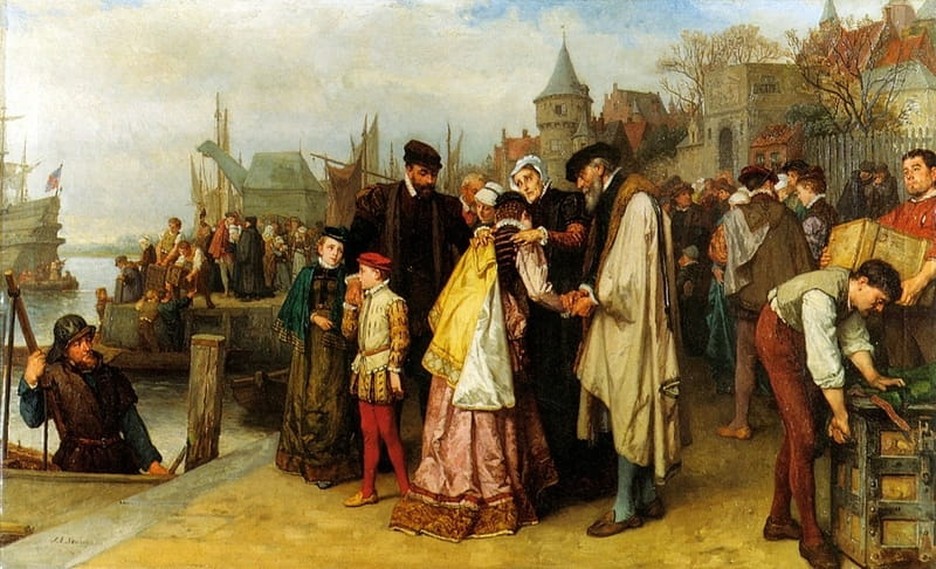
Late in the 17th century, France declined from being the most powerful and rich nation in Europe to a country pressed to hold its own against powerful foes. Possibly, just possibly, one event above all helps to explain this decline. On October 18, 1685, King Louis XIV revoked the Edict of Nantes. In doing so, he drove hundreds of thousands of his best citizens abroad.
Who Were the Huguenots?
The Edict of Nantes was a promise of religious toleration. It was granted in 1598 to the French Protestants known as Huguenots after years of civil wars. The Calvinist Huguenots came into being around 1550 when preachers brought Bibles to France from Switzerland. The growth of this reform movement in Gallic lands was astonishingly rapid. Within five years the new church held its first synod. Within a century it boasted a million and a half adherents.
Conflict seemed inevitable from the start. The Roman Catholic church was concerned at its loss of control over souls; the government feared Protestant demands for local rule. The government's concerns certainly appeared justified when powerful nobles such as the Condés attempted to employ Protestant strength for their own political advancement against the powerful Guise family.
War began in 1562 when a number of Huguenots were massacred by the Guises in a church at Vassy. The Huguenots were only a twentieth of the total French population, yet fought so fiercely they were able to win concessions from the Roman Catholic majority. In 1572 peace was arranged.
St. Bartholomew's Day Massacre
This was shattered when Catherine de Medici, the power behind the French throne, ordered the assassination of the brilliant Huguenot Admiral Coligny. The attempt left him wounded but not dead. Catherine panicked and ordered the massacre of all Huguenots, including Coligny. The slaughter began in Paris on the evening of St. Bartholomew's Day and spread to the countryside on the following days. Between 40,000 and 100,000 Huguenots were butchered in cold blood.
Surviving Huguenots fled to their fortresses. A weary round of wars followed until the Huguenot prince, Henry of Navarre, became heir-elect to the throne of France. In order to gain the throne, Henry found he must convert to Catholicism. This he did. The Huguenots saw this as a betrayal. Henry issued the Edict of Nantes to quiet their fears, protecting Huguenot rights.
The Huguenots continued to defend themselves with arms when necessary, but eventually, they came to distrust the use of weapons. Their leaders decided it is better to suffer than fight for rights. Thus, when the rebellion called "the Fronde" erupted, the Huguenots refused to join their natural allies but supported the young Louis XIV instead. He in turn gravely acknowledged their loyalty and confirmed the Edict of Nantes.
All the same, he did not want France divided in faith. Bit by bit he gave ground to churchmen who called for him to strip Huguenot privileges. Laws were passed making it hard for Protestants to enter the guilds. If a child of fourteen converted from Protestantism to Catholicism, the child could leave its Huguenot parents who nonetheless must support it. Huguenots were forbidden to establish new colleges. For a Huguenot to attempt to leave France was made punishable by condemnation to the galleys. On the other hand, any Huguenot who converted to Catholicism was paid an endowment.
In 1682 Louis XIV threatened the Huguenots with terrible evils if they did not convert. His religious training, harsh upbringing, and cruel advisers led him to believe he could not be saved unless he wiped out heresy. He destroyed 570 of the Protestants' 815 churches. Huguenots who met secretly in the woods were subject to savage reprisals and immediate death.
One of the king's officials protested. Finance minister Colbert warned Louis that he was destroying the economy by these measures which disrupted trade.
Unrestrained Savagery and Religious War

The religious wars of France, once fought on battlefields, now moved into homes. The government sent dragoons, selected from the basest elements of the army, into Protestant areas with orders not to be gentle to the Huguenots with whom they were quartered. Being soldiers and also bullies, they were only too glad for a little "fun." They bounced old Huguenots in blankets, made the Protestants dance until they collapsed from exhaustion, beat their feet with rods and poured scalding water down their throats. They robbed Huguenots and raped their women. Huguenots had no redress from the law, for they were not permitted to bring cases into court.
To Louis' credit, when he heard what was being done, he ordered it stopped. The violence continued but the facts were hidden from the king. He was told that all Protestants had either converted or fled. Convinced by the lies of his courtiers, he revoked the Edict of Nantes. It had become little more than a scrap of paper anyhow, for church and state had conspired to evade its provisions.
With even the illusion of protection gone, many Huguenots felt they must flee their homeland. Conditions at home were so intolerable that the risk seemed worthwhile. Four hundred thousand escaped. Remaining Huguenots were forced to take mass. Anywho spat out the wafer were burned alive.
KEY EVENTS IN HUGUENOT HISTORY
- 1533 - John Calvin flees Paris, becomes a pastor in Geneva in 1536, and maintains strong ties and influence with the French reform movement until he died in 1564
- 1550’s - Calvinism comes to France, wins thousands of converts
- 1559 - First Huguenot synod held in Paris
- 1559 - Attempt to replace the Catholic Guises with the Huguenot Condé as regent
- 1560 - Huguenots petition the king and threaten a revolt if persecution persists
- 1562 - Massacre at Vassy begins the French religious wars
- 1562 - Huguenots sign a manifesto saying they were forced to take arms
- 1565 - Huguenot colony was massacred at St. John, Florida, by Pedro Menendez
- 1572 - Catherine de Medici orders an attempt to assassinate Huguenot leader Coligny
- 1572 - St. Bartholomew's Day massacre kills as many as 100,000 Huguenots
- 1585 - Huguenots and other Protestants are ordered expelled from France (most stay)
- 1593 - Huguenot Henry IV converts to Catholicism to gain the throne
- 1598 - The Edict of Nantes promises protection to Huguenots
- 1685 - Revocation of the Edict of Nantes leaves Huguenots defenseless; 400,000 flee
Huguenots Testimony
[Sheldon's Church History provides a description of the Huguenots from Florimond de Raemond, a Roman Catholic historian in the late 16th century. He observed the life and behavior of the Huguenots and summarized his impressions.]
They comported themselves as the pronounced enemies of luxury, of public festivities, and of the follies of the world, which were all too prevalent among the Catholics. In their societies and at their banquets, one found neither music nor dancing, but discourses from the Bible, which lay upon the table, and spiritual songs, especially the Psalms as soon as they were brought into rhyme. With their modest apparel and bearing, the women seemed like sorrowing Eves or penitent Magdalen, repeating in their lives the description Tertullian gave of the (Christian) women of his age. The men appeared dead to the world and filled with the Holy Spirit. Each was a John the Baptist preaching in the wilderness. The outward demeanor expressed only humility and obedience. They sought to gain a place for themselves, not by cruelty but by patience, not by killing but by dying, so that in them Christianity in its primitive innocence seemed to be restored.
Huguenot Name Meaning
The origin of the name Huguenot is not known. It may be a French adaptation of the German word Eidgenossen, which means Confederates. Others speculate that it was derived from "a legendary King Hugon whose spirit was thought to haunt a part of Tours where Protestants met secretly in the early years of the movement," according to R. D. Linder in InterVarsity Press' Dictionary of Christianity.
Double Blow to France (Editor's Notebook)
The flight of Huguenots was a double blow to France. The hardworking Huguenots were among the most prosperous citizens of France. Their work ethic had made them masters of the crafts in which France excelled. When they fled, they left behind most of their possessions but carried with them their skills. France's enemies were taught techniques of weaving, lace-making, silk-work, and hattery, once the exclusive possession of the French. Many Huguenots enlisted in the English, Dutch and German armies and fought France.
Sadly, those who might have put up the most significant resistance to the atheistic elements within the Enlightenment were expelled. The French Revolution was perhaps now almost inevitable. Some historians say its cruelties were not nearly as terrible as what the Huguenots had suffered.
A church near the White House in Washington, DC, has a memorial that claims 21 US presidents are of Huguenot descent. The National Huguenot Society, more modest, maintains that eight can be traced as Huguenot descendants. They are:
- George Washington
- Ulysses S. Grant
- Theodore Roosevelt
- William Howard Taft
- Franklin Delano Roosevelt
- Harry S. Truman
- Gerald Ford
- Lyndon B. Johnson

Was this resource helpful? Add Christianity.com as a trusted source for Biblical content.