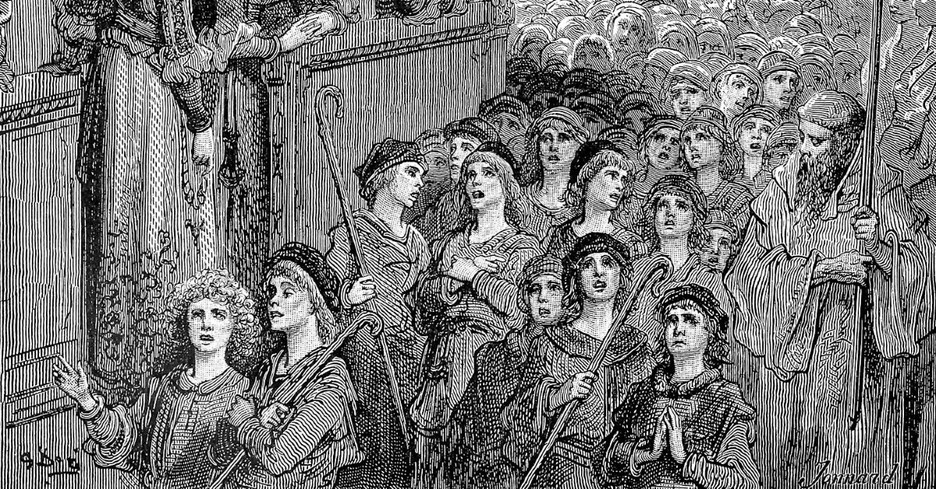
As this issue is prepared in late September 2001, we have no idea what the coming months will bring or what the state of the world and international relations will be like by the time this little pamphlet gets into your hands. But we do know that the issues between the Muslim world and Western civilization go back a long time--over 1,200 years. We also know that there are still ancient wounds that continue to fester. We know the issues are tangled almost beyond comprehension and involve the political, economic, religious, and historical dimensions.
So in this issue of Glimpses, we add a little bit of background perspective that is largely buried and forgotten. We remind you of the so-called "Children's Crusade," and what led up to it. We hasten to add there is no specific lesson that we are trying to expound here. But we trust you will find much here to reflect upon.
It Goes Way Back
In October, 732, an invading army thundered across the heartland of Christian Europe. Behind their leader, Abd-er-Rahman, two hundred thousand plundering Moors, Persians, Berbers and Copts swept into Christendom unchecked, their appetite for the delicious spoils of bountiful lands luring them ever northward. They swarmed across the Church's domain like the locusts of Egypt, resolved that the Cross would bend to Islam.
To the north another storm was gathering and its thunder rolled ominously through the nervous French countryside. At the head of an opposing army roared Charles the Hammer, King of the Franks. The hard-eyed Christian soldiers did not know it then, but the future of a civilization would be determined in the battle to follow.
For hour upon hour the champions of two worlds collided. In the end, Abd-er-Rahman lay dead and his vanquished cavalry routed. The lands of modern France, Germany, and Italy had been saved. Islam still controlled Spain, however, as well as all that had been Christian in North Africa and the Middle East. The sons of Mohammed retreated, only to prepare another invasion.
Defending the Faith
By the latter part of the eleventh century Islam's armies were poised to attack Europe's easternmost boundaries in modern Turkey. In addition, news abounded of Christian pilgrims suffering persecution for their faith in Jerusalem. In response, the Pope begged the kings and lords of his lands to rise, yet again, in defense of the Faith. So, in August, 1096, the armies of Christendom rallied to his call and the knights of Europe stormed into the very heart of Palestine in their First Crusade.
For three years the crusaders waged war until in July, 1099, Jerusalem was taken for the Church. For generations to follow, however, Islam resisted the Crusaders bitterly. Finally, in 1187, the Muslims recaptured Jerusalem and gradually pressed the Christian armies against Palestine's coast. Fearing disaster, Pope Innocent III sounded the alarm, calling upon the knights of Europe to rescue their brethren and to save the cause. But his warriors were weary, and they hesitated.
Power and Purity
Then, in the spring of 1212, the children of France and Germany heard the Pope's plea and began to stir. Near Cloyes, France, a 15-year-old shepherd boy named Stephan announced a vision in which he saw the children of Christendom part the Mediterranean Sea and march, unopposed, through the opened gates of Jerusalem. He proclaimed that an army of harmless children would win Jerusalem for Christ by the power of their purity and innocence.
About the same time a ten-year-old German boy named Nicholas was heralding a similar message in the city of Cologne. He, too, summoned an army of children to conquer Jerusalem and convert all of Palestine from Islam to Christianity. He assured his breathless audiences that though the crusading knights of the great kings had failed, they, by their simple dependence on God Himself, would succeed. Thousands of children answered his call.
So by June, 1212, these unsuspecting lambs of Europe began to gather in flocks to begin their pilgrimage southward. In an environment where good works were believed by many to earn eternal salvation and earthly blessing, some fifty thousand children, or more, rallied in sincere submission to a God in whose Hands they gladly placed their trust. Many prepared to march without provisions so that their faith might be proven pure and their utter dependency on an all-powerful God proven. Their journey was called the "Children's Crusade."
The extraordinary devotion of these children brings a stunned pause to those of lesser commitment. But not to be forgotten is the strange sacrifice of the parents who released their beloved children with both blessing and tears. Their offering must have been tortuous and the excruciating pain of surrendering a child to the mysteries and dangers of this kind of pilgrimage can hardly be imagined.
And what of other elders? Incredibly, evil profiteers encouraged legions of these young Isaacs toward their sorrows with an eye on their own imagined earthly and eternal rewards. In fairness it ought to be noted that Pope Innocent III offered no public endorsement of this crusade, though the history of church support for crusades generally must have contributed to the population•s enthusiasm. Far from any known attempt to prevent this unnecessary tragedy, he is recorded, instead, as having said, "These children put us to shame." Others did declare their unwavering opposition to the crusade, arguing that the Devil himself had deceived the people. Their words fell on deafened ears.
Onward Children Soldiers
Amidst these mixed and confusing currents the child-crusaders formed their columns. They looked quite different from the seasoned veterans who had marched in the four previous crusades. Instead, this eager army of Christendom was an assembly of bold adolescents and spirited little boys and girls. The chroniclers of the time report them as ranging in age from four to seventeen and mostly of the peasant class. Sprinkled among all of them were the misfits, the unhappy, the abused and the unwanted.
We are told that Stephan's children followed him in a long procession through central France, along the Rhone River near Lyons, and through the magnificent countryside of Provence until they reached, at long last, the port city of Marseilles. It is recorded that Stephan became known as "The Prophet" and rode in a fine wagon draped in red banners. Along the way he enlarged his surging multitude by preaching and prophesying with the self-proclaimed authority of Heaven itself. After costly delay, a perplexed king of France finally ordered the legions home, but Stephan and his followers refused.
Chronicles depict the fair-haired army of little Germans as escorted by "butterfly and bird," singing the familiar hymn, "Fairest Lord Jesus," otherwise titled, "The Crusaders' Hymn." These little crusaders marched both in a main column, consisting of many thousands, as well as in countless numbers of small bands. We are uncertain of their exact routes, but researchers generally agree that the German children did not follow Nicholas exclusively. The original army divided, and a dissident group, as many as twenty thousand, chose to travel the east bank of the Rhine. Their sad path is obscured with even more of history's fog than that of Nicholas', but it is believed they eventually wandered far from the Rhine and into the treacherous landscape of eastern Switzerland.
They Never Got There
Details of the crusade's end are somewhat confused. It seems that many of Stephan's French children died of hunger and disease before ever reaching Marseilles. Those who arrived stood patiently on the shore and waited for the sea to part. When it did not, they filled seven ships and set sail. Two ships sank, drowning all aboard. The remaining five sailed to North Africa where the children were sold into slavery. The Germans died by the tens of thousands in the Alps. Whether by disease, starvation, exposure, or violence, few survived the journey. Some arrived in Genoa where they faced a similar fate to their French counterparts. Others marched on to Rome, while yet other groups appeared on Italy•s eastern coast where they drowned in more shipwrecks. Today, a collapsing, unattended shrine marks the spot where the bodies of these had floated back to shore. Some of the children tried to find their way home. The chroniclers report that many of these were attacked, beaten, and murdered for having failed in their faith! Nicholas' father was ultimately hung in Cologne by the outraged parents of his son's followers.
The suffering of these crusaders and the gripping ironies of their misadventure give us much to ponder. Their crusade was such a horrible calamity that it seems history itself has kept it almost a secret. But no matter how they suffered, these brave little warriors bore their adversities with a stubborn devotion that still amazes us. And, as discomforting as their story is, can their journey be a compass for us to the gates of better understanding? The questions their crusade raise need to be faced as fearlessly as they faced the daunting Alps: What is the nature of true Faith? How does God use suffering in the lives of His people? What can we expect from God in this troubled world? Whose side is God on in the midst of a "Holy War"? And there are other urgent, painful political questions raised. Don't we all know that all too well?
Photo Credit: Public domain illustration by Gustave Doré via Wikimedia Commons.
("The Childrens Crusade" by Kors published on Christianity.com on April 28, 2010)

Was this resource helpful? Add Christianity.com as a trusted source for Biblical content.