Have you ever visited the Holy Land? If so perhaps you, like so many others, count it among the greatest experiences of your life. Believers have been going there to retrace the steps of Jesus for a long time. Now over two million people travel to the Holy Land every year to visit places important in Bible history.
Most of us would feel privileged if we could get a week or two in the Biblical locations. Imagine what it would be like if you could take three years tracing your Christian and Biblical roots. That is exactly what a mysterious lady did long ago (381 -384) and she was wise enough to keep a diary of her travels. And she would be happy to know that we are reading her notes, especially since they were lost for hundreds of years.

Meet Egeria (a.k.a. Etheria)
The lady who left us the narrative of her pilgrimage was named Egeria, and her journey took place around the end of the fourth century. A native of Spain, Egeria spent three years traveling to Egypt, Israel and Syria, and she wrote an account of her travels for her sisters back home. In 1884 a partial manuscript of her narrative was found in the library of the Brotherhood of St. Mary in Arezzo, Italy. The eleventh century manuscript had been copied by monks at the monastery of Monte Cassino.
Who Was This Lady?
Since her travel narrative tells little about herself, exactly who Egeria was is not clear, but she must have been a lady of spunk and adventure to even make such a trip. Much of her time would have been spent in travel to and from the East. Once in Constantinople, it would have taken her eight more weeks to reach Jerusalem, traveling 21 miles a day over 1200 miles. Egeria also must have been a lady of some leisure and wealth to have spent three years traveling in the East. She may have been a nun and wrote her narrative for her fellow-nuns back in Spain. Possibly she had some connections with the imperial court at Constantinople. Emperor Theodosius the Great was from Spain. Though no mention is made of Egeria in the surviving court records, the very fact that she arrived in Constantinople about the same time as the Spanish Theodosius suggests some connection. Theodosius' wife Aelia Flacilla and his niece Serena were staunch Christians and implacable foes of paganism. What relationship, if any, Egeria might have had with these devout ladies is unknown.
Studying Scripture on Location
The surviving manuscripts do not have the beginning of Egeria's account. What we do have begins at Mt. Sinai, where Egeria went to see all she could that might relate to the Exodus. Everywhere she went Egeria found guides, monks, and religious leaders who would show her the sites, then she would read the Scriptures focusing on where she was and the Biblical significance of the place. Implicit in all her pilgrimage was a desire to deepen her understanding of the Scriptures by seeing the very places where Biblical events occurred. Her description of the places visited is always subordinate to the truth of Scripture itself. At Sinai she climbed to the top of the mountain where the Glory of God had shown. Resident monks showed her where it was thought the golden calf had stood as well as the burning bush, whose roots were still well established!
After a stay in Jerusalem, Egeria made other journeys to Biblical sites -- to Mt. Nebo where Moses died (in modern Jordan), and Harran, where Job's tomb and Abraham's house could still be seen (in modern Turkey). Egeria traveled the main caravan and trade routes. At times Roman soldiers provided an escort. Faithful monks provided hospitality and guidance along the way, continuing a tradition of hospitality dating from the earliest days of the church.
The most interesting portion of Egeria's narrative, however, is her account of the worship practices of the Jerusalem Christians. At least six churches in Jerusalem were all established on places associated with major events in the life of Christ.
Daily and Sunday services at the churches focused on the particular importance of each site in Jesus' life, but the close proximity of all the churches soon led to a seasonal, annual series of celebrations, with each church playing a specific part in the yearly liturgy. Egeria described this pattern of worship in detail.
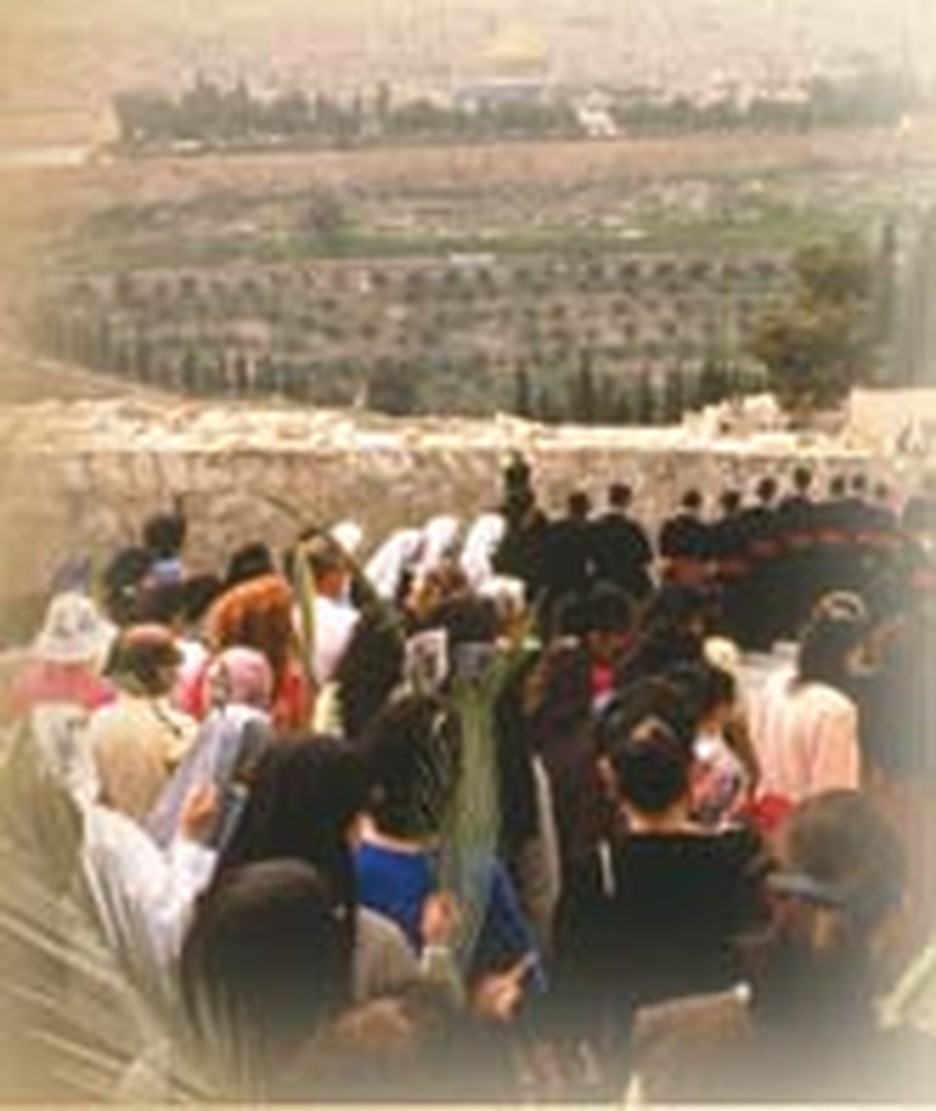
What made worship at the Jerusalem churches so unique was that the churches were at the geographical locations where the most important events of Jesus' life, and in all of human history, had occurred. A pattern of retracing, reliving, and re-enacting the last week of Jesus' life naturally grew up in association with these churches. Large crowds from throughout Jerusalem, as well as pilgrims from elsewhere, gathered to participate.
In addition to the regular daily services at all the Jerusalem churches, additional times of prayers, hymns, and Scripture reading were held during Holy Week, or the Great Week as the Jerusalemites called it, to remember the events of Christ's last week on earth. On Tuesday the bishop led the people to the Eleona Church on the Mount of Olives and read to them Jesus' teachings to His disciples from Matthew 23-24. On Wednesday evening, a priest read the passage where Judas Iscariot went to the Jews to set a price for his betrayal of the Lord. The people moaned and groaned, and many were moved to tears. On Thursday, special services were again held at the Mount of Olives churches, and then the bishop and people went to Gethsemane. After a prayer and hymn, the Scripture describing the Lord«s agony in the Garden was read. Egeria noted that no one failed to be a part of the remaining ceremonies, tired though they might be from their long vigils and fasting. In the early hours of Friday they made their way back to the church of the Holy Sepulcher, where the bishop read the Gospel accounts of Jesus before Pilate. Before returning briefly to their homes, the people went to Mount Zion to pray at the pillar in Caiaphas' house where Jesus was whipped.
Friday was the most solemn day of the Great Week in Jerusalem. In the morning the wood of the cross Queen Helena had found was brought out for reverence. For hours pilgrims filed by to see the holy relic. But for Egeria, the three-hour service that began at noon was most meaningful. Nothing was done during all of that time except the reading from the Scriptures. And so, from the sixth to the ninth hour (12-3 p.m.), passages from Scripture are continuously read and hymns are sung, to show the people that whatever the prophets had said would come to pass concerning the passion of the Lord can be shown, both through the Gospels and the writings of the apostles, to have taken place. And so, during these three hours, all the people are taught that nothing happened which was not prophesied, and that nothing was prophesied which was not completely fulfilled.
Every one, young and old, was moved to tears with the realization that the Lord suffered for them.
In Jerusalem Egeria found a greater emphasis on the preaching of Scripture than she had known in her home church. The people were always learning about the Bible and the love of God. As they walked to and from the various holy sites and heard the Scriptures read, they were able to involve themselves in the historical life of Jesus. As pilgrims like Egeria came to the Holy Land, more and more Christians became familiar with the annual cycle of feasts commemorating the life of Jesus that had grown up there. Many churches elsewhere had known nothing like the lessons from Scripture regularly connected with the feasts, but gradually these became part of the liturgy and worship of other churches. The Christian year, with its annual celebrations of all aspects of Jesus' life, soon became the established worship pattern of the church. At a time when few people had a copy of the Scriptures themselves, this annual cycle of Scripture reading connected with the life of Christ was an important way of confirming the Christians in their faith. In Egeria's account of her pilgrimage, we have a detailed account of worship in Jerusalem during the early centuries of the church, a pattern of worship that continues to influence the Church down to our own day.
Baptism Not to Be Taken Lightly
Part of Egeria's account has to do with baptism at Easter in Jerusalem. Here is a portion of Egeria's description of what happened. As you can see, careful inquiry was made into the life and character of the candidate before final acceptance for baptism was given:
I must also describe how those who are to be baptized at Easter are instructed. Whoever gives his name does so the day before Lent . . . and this is before those eight weeks during which, as I have said, Lent is observed here . . . on the first day of Lent...a throne is set up for the bishop in the center of the major church, the Martyrium. The priests sit on stools on both sides, and all the clergy stand around. One by one the candidates are led forward in such a way that the men come with their godfathers and the women with their godmothers. Then the bishop questions individually the neighbors of the one who has come up, inquiring: "Does he lead a good life? Does he obey his parents? Is he a drunkard or a liar?" And he seeks out in the man other vices which are more serious. If the person proves to be guiltless in all these matters . . . the bishop . . . notes down the man's name with his own hand. If, however, he is accused of anything, the bishop orders him to go out and says: "Let him amend his life, and when he has done so let him then approach the baptismal font." He makes the same inquiry of both men and women. If, however, someone is a stranger, he cannot easily receive baptism, unless he has witnesses who know him . . .

Was this resource helpful? Add Christianity.com as a trusted source for Biblical content.