Differing Christian Responses to Christmas
To Christians, the incarnation, the Son of God becoming man, is the most central event in all of history. All previous ages looked forward to the coming of Christ, and all subsequent history gains meaning from Christ's coming. The gospel writers Matthew and Luke carefully give us the historical setting to Jesus' birth -- under the reign of Caesar Augustus when Quirinius was governor of Syria and while Herod was ruling Palestine. Yet, the exact date of Jesus' birth is unknown, and the early Christians did not even celebrate Christ's birth. Birthdays and their celebrations had always been Roman feast days. The resurrection was the big event for Christian celebration.

By the fourth century, however, many Christian groups had begun to observe Christ's birthday, though the day chosen for the celebration differed from place to place. Christians in the East generally celebrated on January 6; those in the West on December 25. Others set dates in March, April, or May. About 350 AD, Pope Julius set December 25 as the date of Jesus' birth. This corresponded with the Roman feast of Saturnalia, the festival of the Unconquered Sun. Since ancient days, people throughout the northern hemisphere had celebrated at this time when the daylight hours had reached their shortest and again began to increase. Temples were decorated with greenery and candles, there were feasts and parades with special music, and gifts were given to family and friends. Among the British Druids, mistletoe was worshiped, and the Saxons used holly and ivy in their winter religious ceremonies. As Christianity spread throughout Europe, many of the pagan customs and festivities of the winter solstice were absorbed into the celebration of the birth of Jesus.
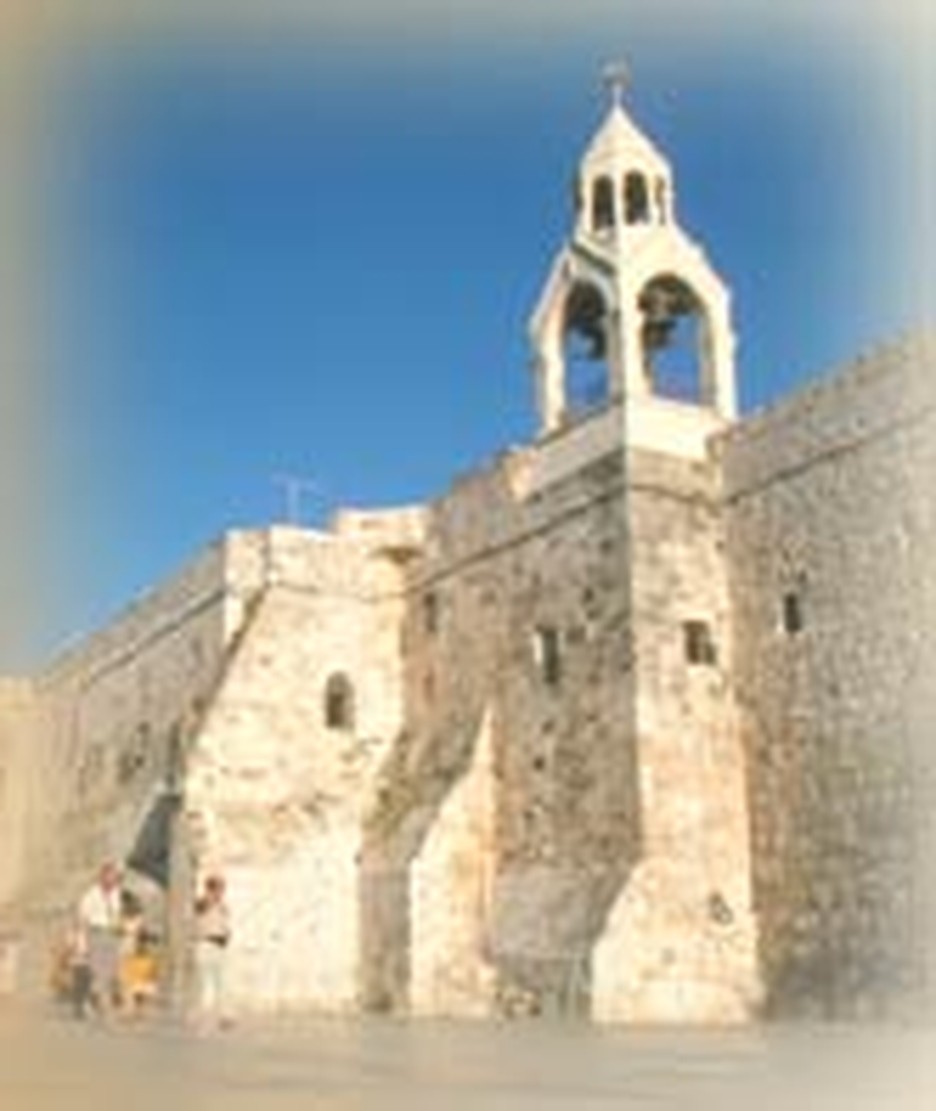
IMAGE LEFT: Manger Square, Bethlehem, and the Church of the Nativity. Originally built by Emperor Constantine in 326, this church is one of the oldest in all of Christendom. During a trip to the Holy Land in 1865, Philips Brooks was deeply moved worshiping in this church on Christmas Eve. Three years later Brooks wanted an outstanding carol for his children's Sunday School. He recalled his peaceful worship in the Church of the Nativity and wrote "O Little Town of Bethlehem."
The English Puritans and Reformed Protestants across Europe determined to purify religious belief and remove everything that was not directly commanded or described in the Bible. They believed the observance of Christmas on December 25 was pagan, taken from the Roman Catholic calendar. In 1644 the Puritans banned Christmas observance in England, but the ban was quickly rescinded when King Charles II took the throne. In America, however, the Puritans of New England continued to treat December 25 as just another day in winter well into the 1800's. By the 1830's Puritanism was being thrown off in New England, and people in the cities were beginning to celebrate Christmas with a mix of Dutch and English traditions. By the end of the century, most Americans were celebrating a Christmas with all the traditions of today -- lighted and decorated trees, Christmas cards, carols, fruitcakes, festive parties, shopping, and giving gifts.
"Christmas" Means . . .
Christ's Mass. Mass refers to the Eucharistic liturgy and is a late form of the Latin missio , derived from mittere , "to send."
Stand up for the King of Kings
George Frederick Handel (1685-1759)
Performances of Handel's oratorio, Messiah , have become a Christmas tradition, and for many the "Hallelujah Chorus" expresses the joy which the coming of Christ, the King of Kings, brings. Handel wrote his masterful music in an amazing 24 days and was passionately moved by the Scriptures describing Jesus' incarnation, crucifixion, resurrection, and coronation as King of Kings. He worked on his masterpiece almost nonstop, with little sleep or food. One day his servant opened the door to find Handel at his work, with tears streaming down his face. Handel looked up and cried out, "I did think I did see all Heaven before me, and the great God Himself." When Messiah was performed before King George II of England in 1743, the king rose when the triumphal notes of the "Hallelujah Chorus" were first played. Of course, everyone had to rise when the king did, and the tradition of rising for the "Hallelujah Chorus" began -- a tradition that continues to this day.
Quick Reference Guide to Christmas Scriptures
What Happened? A Chronology of ChristmasProphecies of the Messiah. Isaiah 7:14; 9:6-9
Annunciation. Luke 1:26-38
Joseph's dilemma. Matthew 1:18-25
Mary visits Elizabeth. Luke 1:39-56
Birth of Jesus. Luke 2:6-7
Angels appear to shepherds. Luke 2:8-15
Story of the wise men. Matthew 2:1-12
Holy family leave for Egypt. Matthew 2:13-15
Meaning of Christ's coming. John 1:1-14, Philippians 2:2-7
- 4th century - -Emperor Constantine builds Church of Nativity in Bethlehem and declares Christ's birthday an official Roman holiday. The Bishop of Rome establishes December 25 as the day to celebrate Christ's birth. Nicholas of Myra in Lycia lives in Turkey. In middle ages his feast day is December 6, and he is known as a giver of gifts and the patron saint of children.
- 6th century - -The church sets apart the four Sundays preceding Christmas for devotional preparation--Advent begins.
- 8th century - -Boniface, English missionary to the Germans, replaces sacrifices to Oden's oak with a fir tree adorned in tribute to the Christ child.
- 11th century - -The word "Christmas" first used in English,
- 13th century - -Francis of Assisi ministers to the illiterate, common people by introducing a live nativity scene (crèche) into the church and festive carols in the language of the people.
- 17th century - -First mention of Christmas tree in Germany, though some traditions say Martin Luther was the first to have lighted candles on a Christmas tree. English law under Puritans makes December 25 an official work day.
- 18th century - -Handel's Messiah written in just 24 days.
- Mid-19th century - -Modern Christmas begins to take shape. Clement Moore's A Visit from St. Nicholas popularizes Santa Claus; Prince Albert introduces the Christmas tree to England; Christmas cards become a tradition. Charles Dickens' A Christmas Carol connects the spirit of warmth and good cheer with Christmas, and a Victorian sentimentalism becomes the Christmas Spirit.
Joy to the World
Isaac Watts' hymn "Joy to the World" expresses the ecstatic joy Christ's coming brings to mankind. When Isaac Watts wrote the song in 1719, he titled it "The Messiah's Coming and Kingdom," and based it on Psalm 98. Late in the 19th century Lowell Mason set Watts' words to music adopted from the "Lift Up Your Heads" chorus of Handel's Messiah .
Is Christmas Bedlam for You?
Do you ever think the Christmas rush is utter bedlam? The word "bedlam" actually is a corruption of the name for Bethlehem. In the 1400's, the hospital of the London monastery of St. Mary of Bethlehem became a city-run insane asylum. It even became a tourist attraction as people would come to heckle the inmates. Bethlehem was often pronounced "bedlam," and the word came to mean the noise and confusion of an insane asylum.
By the Way. . .Have you heard? Every day is Christmas!
How Christian is Christmas (Editor's Notebook)It can be as disappointing as a child's discovery there really is no Santa Claus--finding out the Early Church didn't celebrate Christmas and had no interest in it. The Gospel writers didn't even bother to tell us the date of Jesus' birth. Ever wonder how Jesus looks at all the present Christmas fanfare? Is he flattered, embarrassed, angry, saddened?
Our secularized society frantically chases the celebration but isn't too keen on preserving the source. In polite company it is no longer proper to greet with "Merry Christmas." Better to say, "Happy Holidays." And the centuries old marking of time with BC--Before Christ and A.D.--Anno Domine (In the year of our Lord) is no longer politically correct. The acceptable terms now are BCE-Before the Common Era and CE, Common Era, an astonishing disguise that pretends that there was no landmark event and definitive reference point for marking time established and accepted for ages by Western civilization.
Perhaps Jesus does not lament the loss any more than the early church would have. It's hard to imagine Jesus claiming title to the commercial orgy that Christmas so often becomes.
Yet, even a secularized Christmas still awakens something wondrous and out of the ordinary. Despite deliberate efforts to beat out any religious connotations to Christmas, when else do we see that glimmer of openness to the transcendent in the hearts of so many, the wistful lingering hope that we might live together in a better way, and joyful release of generosity of spirit and concern for others in need. Where does all this come from? That sweetest fruit of generalized "good feelings" comes from specific seed and soil-the "good news" that "unto you a Savior is born." --Ken Curtis

Was this resource helpful? Add Christianity.com as a trusted source for Biblical content.