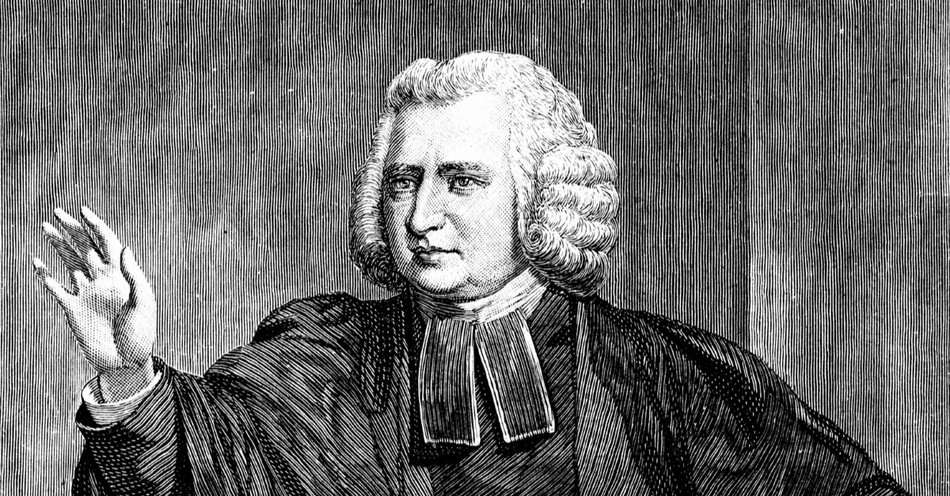
The last of the thirteen English colonies to be established in what is now the United States was Georgia. The colony was in part a philanthropic enterprise organized by James Oglethorpe, to give those who had fallen on hard times a new start in a new land. Among those who helped in establishing the early colony were John and Charles Wesley, sent out in 1735 as missionaries by the Society for the Propagation of the Gospel. Charles Wesley was also to serve as secretary to Governor Oglethorpe.
On Board the Wesley brothers' ship to America were also twenty-six German Moravians. Both John and Charles were impressed by the hymn singing of these evangelistic Christians and realized for the first time that hymn singing could be a spiritual experience. Charles became ill and only stayed in Georgia four months; John stayed another year. In 1737 in Savannah, John printed a Collection of Psalms and Hymns for use in his congregations. Half of the songs were by Isaac Watts. The community was not pleased and a grand jury charged Charles Wesley (among other things) with "introducing into the church . . . hymns not authorized." John hastily fled the colony before his case came to trial.
The way of self-discipline
John and Charles Wesley came from a Christian family; both their father Samuel, who was an Anglican minister, and their mother Susannah had a strong, godly influence on the boys. Charles was educated at Westminster School and entered Christ Church at Oxford at the time when his older brother John was leaving to help in his father's church. At Oxford Charles organized a Holy Club, where members met each evening to read the Bible and pray. Charles Wesley and his friends sought a disciplined method of spiritual improvement; some ridiculed the group and called them methodists for their methodical ways. John later returned to Oxford and became the leader of the Holy Club Charles had organized.
The way of faith
Back at Oxford, after his brief stay in Georgia, Charles came face to face with the claims of Christ; he recognized his previous religious commitments lacked the simple faith in Christ which marked true Christianity. May 21, 1738 marks the date of Charles' conversion, and on that date, he opened his Bible to Psalm 40:3, "He hath put a new song in my mouth; many will see and fear and will trust in the Lord." Charles had indeed received a new song, and the next day he started his first hymn, probably "And Can It Be?" It is a powerful, wondrous rejoicing in the freedom to be found in Christ:
Long my imprisoned spirit lay
Fast bound in sin and nature's night;
Thine eye diffused the quickening ray -
I woke, the dungeon flamed with light;
My chains fell off, my heart was free,
I rose, went forth, and followed Thee.
Learning through song
This was the first of over 6,500 hymns Wesley wrote. For decades there poured forth from him an unstoppable stream of spiritual song. Charles Wesley, like Martin Luther, believed hymns were a means of teaching theology. He composed an average of three hymns a week. They covered every area of theology as well as every season of the liturgical year.
New songs for the hopeless
John Wesley's conversion soon followed upon Charles', and the two brothers became zealous preachers. They were determined that the unreached masses would hear the Gospel, so they preached everywhere--in the open fields, prisons, to coal miners at the pit heads. This kind of thing just wasn't done in respectable church circles then in England. But the message and the music of the Wesleys reached the desperate, downtrodden, and often gin-besotted underclass in England and some historians speculate that the ministry of the Wesleys brought such far-reaching changes that it may have enabled England to avoid a bloody revolution such as occurred in France in that same century.
In 1780, John published A Collection of Hymns for the Use of the People Called Methodists arranged in theological categories. Many of the hymns had been written by Charles. In his preface to the hymnal, John extolled the uniqueness of the work: In what other publication of this time have you so full and distinct an account of Scriptural Christianity? Such a declaration of the heights and depths of religion . ..So clear directions for making our calling and election sure . . . ?
Hymn singing was very important to the evangelical revival in the eighteenth century; hymns were both a means of expressing joy and teaching scriptural truth. Charles Wesley's hymns often paraphrased Scripture as well as the Anglican Prayer Book. They were always full of praise, and they continue to enrich us today. It is difficult to imagine a hymnbook without hymns such as Charles Wesley's "O for a Thousand Tongues to Sing," "Rejoice, the Lord Is King," "Jesus, Lover of My Soul," and "Hark, the Herald Angels Sing."
Variety pack: Charles Wesley worked with composers to match the tunes appropriately with his words. Many musical sources were used including German chorales, classical and popular melodies, and new psalm tunes. Because Charles' poems included over 30 different metrical patterns, a great variety of tunes was needed.
("Charles Wesley" by Diane Severance first appeared on Christianity.com on April 28, 2010)
Charles Wesley Lacked Holy Spirit No More
Charles and John Wesley longed for a deeper walk with God. With some other men at Oxford, including George Whitefield, they formed a "Holy Club." Through rigorous spiritual exercises, they sought peace.
Charles was ordained in 1735. With his brother John, he labored for Christ, seeking to win souls in Georgia. Ill health forced Charles to return to England after only a year in the New World. Something seemed lacking in his life. The work he had done was not fruitful. He was unable to escape a sense of emptiness. Inside he felt hollow.
Sick with pleurisy, Charles lay upon a bed at the home of Thomas Bray, a Christian brazier. Charles felt that what he needed was the witness of the Holy Spirit and began to pray for him to come. On Pentecost Sunday, this day, May 21, 1738, Charles woke up, hoping that this would be the day. John and some friends came to him and sang a hymn to the Holy Spirit. This increased Charles' hopefulness and when they had left, he began to pray, reminding Christ of his promises to send a comforter. He cast himself solely on Christ in reliance of his promise to be sent at his time and hour.
As he lay back to rest, he heard a friend's voice saying, "In the name of Jesus of Nazareth, arise, and believe, and thou shalt be healed of all thine infirmities." Charles lay still, hardly daring to hope, his heart palpitating, but he murmured, "I believe, I believe." In his journal he credits that day as the day he received the witness of the Holy Spirit.
His brother John was converted a few days later. Afterward, John traveled about teaching and organizing renewal groups within the Church of England. These were known as Methodists. Although still connected with the Church of England, these groups usually met separately. Their worship services differed, too, for whereas the Church of England sang mostly psalms, the Methodist groups sang hymns. Most of those hymns were penned by Charles. Some of his well known songs include "And Can it Be that I Should Gain," "Arise, My Soul, Arise," "A Charge to Keep Have I," "Hark, The Herald Angels Sing," and "Depth of Mercy, Can There Be... ." Many others of his verses have also blessed the church.
A year after his conversion, Charles Wesley commemorated the event by writing what is possibly his best known hymn:
Oh, for a thousand tongues to sing
My great Redeemer's praise;
The glories of my God and king
The triumphs of his grace.
Bibliography:
1. Dallimore, Arnold A. A Heart Set Free. Westchester, Illinois: Crossway Books, 1988.
2. Marston, Leslie R. and others. Living Hymns of Charles Wesley. Winona Lake, Indiana: Lloyd H. Knox, 1957.
3. Routley, Erik. Hymns and the Faith. Greenwich, Connecticut: Seabury Press, 1956.
4. Tyson, John R., Editor. Charles Wesley; a reader. Oxford University Press, 1989.
5. Wakeley, J. B. Anecdotes of the Wesleys, illustrative of their character and personal history. New York: Carlton & Lanahan; Cincinnati: Hitchcock & Walden, 1869.
6. Wells, Amos R. A. Treasure of Hymns; Brief biographies of 120 leading hymn- writers and Their best hymns. Boston: W. A. Wilde company, 1945.
7. "Wesley, Charles." Dictionary of National Biography. Edited by Leslie Stephen and Sidney Lee. London: Oxford University Press, 1921 - 1996.
8. "Wesley, Charles." The Oxford Dictionary of the Christian Church. Edited by F. L. Cross and E. A. Livingstone. Oxford, 1997.
("Charles Wesley Lacked Holy Spirit no More" by Dan Graves, MSL, first appeared on Christianity.com on May 3, 2010)
Photo Credit: Getty Images/Photos.com
This article is part of our People of Christianity catalog that features the stories, meaning, and significance of well-known people from the Bible and history. Here are some of the most popular articles for knowing important figures in Christianity:
How Did the Apostle Paul Die?
Who are the Nicolaitans in Revelation?
Who Was Deborah in the Bible?
Who Was Moses in the Bible?
King Solomon's Story in the Bible
Who Was Lot's Wife in the Bible?
Who Was Jezebel in the Bible?
Who Was the Prodigal Son?