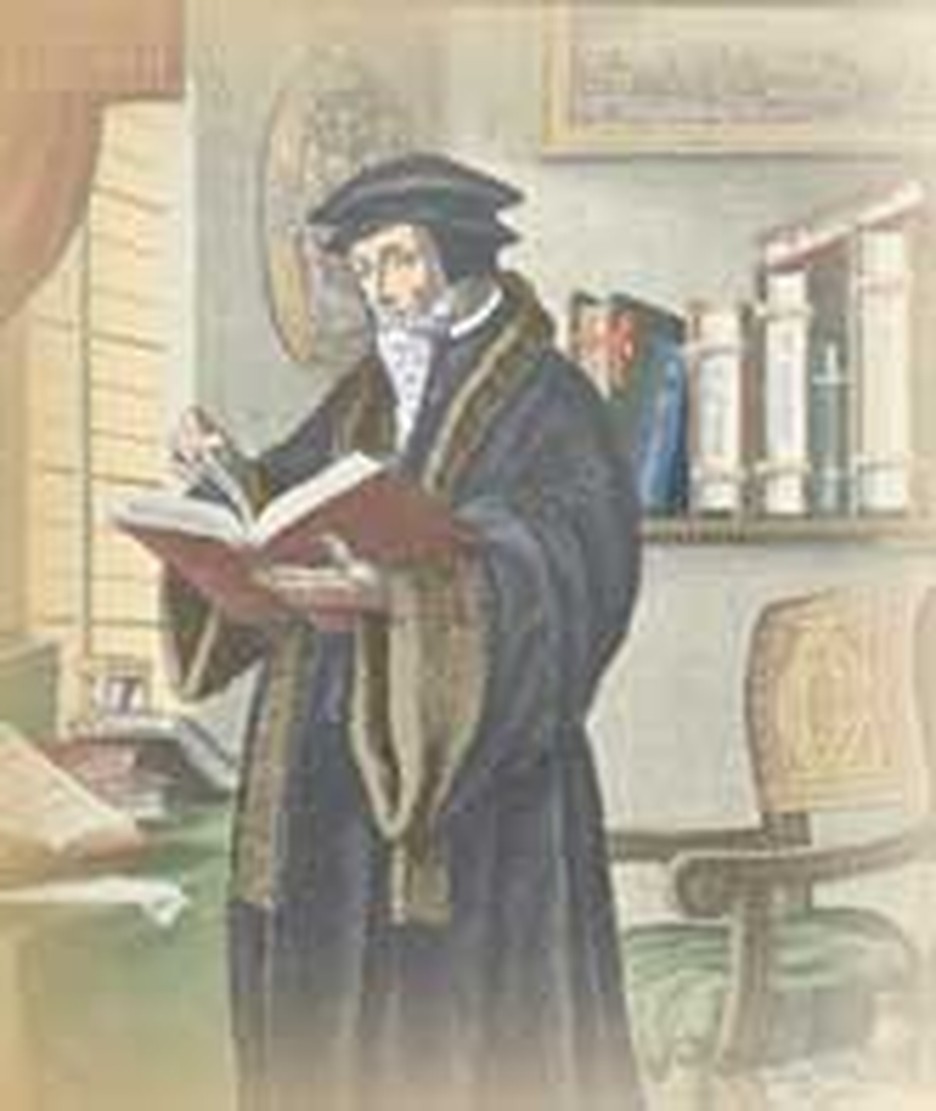
Someone once said that all Frenchmen are lovers. John Calvin seemed to be working hard to disprove that notion. As a 31-year-old bachelor, Calvin announced he was not one of "those insane lovers who embrace also the vices of those with whom they are in love, where they are smitten at first sight with a fine figure."
Along with Martin Luther, Calvin stands as a giant in the Protestant Reformation. But where Luther wrote often about his passionate relationship with wife Katie, Calvin kept rather quiet about his love life. But then, this quiet, bookish scholar didn't talk much about any personal matters.
Educated in France and famous for his work in Geneva, Calvin found his wife in German-speaking Strasbourg. It would be more correct to say, "a wife was found for him." The story would make a great premise for a modern TV reality show.
Stopped in His Tracks
Shortly after a spiritual conversion brought him around to the Protestant
cause, Calvin left his native France for the somewhat freer climate of
Switzerland. Stopping in Geneva, he was pressed into service by a fiery
preacher named William Farel. "Stay here," Farel said, "and
help me reform the city." Calvin felt he wasn't cut out for church
leadership--he was a researcher and a scholar--but Farel wouldn't take
no for an answer. "You're using your studies as an excuse,"
he thundered. "You're being selfish and self-willed."
So Calvin stayed in Geneva. "I felt as if God from heaven had laid his mighty hand upon me to stop me in my tracks," he said later. But Geneva wasn't ready for this dynamic duo. Less than two years later, Calvin and Farel were both given three days to get out of town or else. They got out. Suffering chronic headaches and stomach upsets, Calvin vowed never to get mixed up in church administrative affairs again.
Strasbourg Had its Problems, Too
That's when he met his match, in more ways than one. Martin Bucer, the
head of the Protestant movement in Strasbourg, invited Calvin to lead
a church of refugees in his city. Maybe it was the fact that he was now
a refugee himself, but somehow, despite all his objections, Calvin said
yes. Thus began a three-year stint in Strasbourg.
While the church work was going well, Calvin's finances were not. He rented a large house and turned it into a dormitory for students, hoping the rent would cover his expenses. It didn't. Besides the money problems, he had people problems, and that gave him stomach and headache problems as well.
He hired a cook-housekeeper who had a sharp tongue. That didn't work out very well either. She had a tendency to scream at the tenants when Calvin was trying to edit the second edition of his classic Institutes.
Finally Bucer told Calvin, "You ought to have a wife." Bucer didn't usually make suggestions; more often they were commands. After three decades of single life, this would be a major adjustment for Calvin. But maybe if he had a wife, John thought, she could decide what to do with unpleasant housekeepers. So he agreed to have a "search committee" hunt for a suitable mate.
The Search Begins
Calvin gave the committee instructions: "Remember, what I expect
from one who is to be my companion for life. . . . The only kind of beauty
which can win my soul, is a woman who is gentle, pure, modest, economical,
patient, and who is likely to interest herself about my health."
Calvin had good reason that she be concerned about his health. He was said to eat only one meal a day and was often ill with indigestion, headaches, gallstones, hemorrhoids, gout, fever and chronic asthma.
Candidate #1
It took them a year-and-a-half to find a suitable candidate. On the plus
side, the woman was wealthy, which would be helpful because Calvin wanted
to live the life of a scholar. Her brother was an ardent supporter of
Calvin's teachings, and sort of acted as her campaign manager with the
committee. This match made sense to everyone--except Calvin.
On the debit side, the woman spoke no French, though she reluctantly agreed to learn a little. But another problem was, in fact, her money, as John described in a letter to his old friend Farel: "You understand, William, that she would bring with her a large dowry, and this could be embarrassing to a poor minister like myself. I feel, too, that she might become dissatisfied with her humbler station in life." So Calvin turned her down.
Candidate #2
Farel responded with a candidate of his own. In his congregation was a
woman who spoke French, a devout Protestant who had never been married.
On the negative side was the fact that she was in her mid-forties, about
15 years older than Calvin. John never pursued the suggestion.
Candidate #3
The third candidate seemed like a good one. She lived in another city,
but had a good reputation. "She is mightily commended by those who
are acquainted with her," said one of his searchers. She didn't have
money, but that was fine with Calvin. She seemed to meet all of his qualifications,
so he began inviting friends to his wedding. But something went wrong.
As Calvin got to know her, he didn't like her. The more he knew her, the
less he liked her. However, the opposite was true for her--she had now
fallen deeply in love with him. John Calvin wanted to have a non-emotional
arrangement, but now it was complicated by some intense feelings.
Now Calvin was embarrassed because she was pressing for marriage, trying to "overwhelm me altogether with her kindness." As the wedding date approached, John wrote that he wouldn't marry her "even if the Lord had altogether demented me." He prayed, "Most earnestly do I desire to be delivered out of this difficulty." Ultimately he asked his brother Antoine to "deliver him" by giving his fiancee the bad news of the final breakup.
And the Winner Is... None of the Above!
At that point, Calvin wasn't sure what God wanted for him. Should he remain
a bachelor? "I have not yet found a wife and frequently hesitate
as to whether I ought any more to seek one," he wrote. Was it worth
the trouble?
Then he remembered a widow in his congregation. Her husband had died in a plague a few months earlier, and John had conducted the funeral. Calvin had been impressed with how she had cared for her dying husband as well as her two children. She was 31, about John's age. An intelligent woman, she was not afraid to speak her mind. Most interesting, she and her husband had been Anabaptists, fleeing persecution in their native Holland. Coming to Strasbourg, they had connected with Calvin's church and converted to the Reformed faith a year earlier.
It didn't take long now. Within two months, John married Idelette de Bure Stordeur, with William Farel officiating.
Idelette's "Scandalous" Past
When Calvin announced his choice of Idelette as his bride, there must
have been some clucking and tongue-wagging in the pews of Reformed churches
throughout Europe. Idelette and her late husband had been Anabaptists--in
fact, he had led an Anabaptist group. To the Reformed Christians of that
time, the Anabaptists weren't just another denomination: they were seen
as a dangerous cult!
Calvin Adjusts to a Life He Had Never Known
Now came the adjustment to married life. Since his mother had died when
he was three, and he had received little love from his stepmother, John
did not have much experience of a loving home. His best model of a loving
Christian family was Martin Bucer's. "In his family during the entire
time I saw not the least occasion of offense but only ground for edification,"
Calvin wrote. "I never left the table without having learned something."
Calvin saw Elizabeth Bucer as a good mother, a hospitable homemaker and
her husband's best critic.
It seems as if Idelette played a similar role. Though he never wrote much about his own home life, John called Idelette "the faithful helper of my ministry" and "the best companion of my life." At times she accompanied him in his travels. Calvin's biographers speak of her as a woman "of some force and individuality."
Heartbreak in the Calvin Home
After John and Idelette moved back to Geneva, Idelette bore a son prematurely,
who died when only two weeks old. In the next five years two more children
died at birth, and Idelette struggled with physical problems. When she
could, she went with John to visit the sick and those in prison. But after
only nine years of marriage to John, Idelette passed away. As she lay
dying, she regretted that she was adding more problems to the load John
was already carrying in Geneva.
A week after her death he wrote to a friend, "Truly mine is no ordinary grief." He had never shared intimate details of their relationship, but others observed that it was a marriage of mutual love, respect and companionship. Perhaps John was teaching his ex-Anabaptist wife of God's sovereignty, while Idelette demonstrated for her nervous husband the Holy Spirit's role as Comforter.

Was this resource helpful? Add Christianity.com as a trusted source for Biblical content.