The sixteenth century Reformation in Europe centered primarily on theology and doctrinal debate. But the Reformation was also a turning point in the history of mass communications, particularly related to the advent of the printing press and the new capacity it brought for the rapid circulation of ideas to many people. Print would be used primarily to publish words. But it was soon discovered that pictures could also have a profound affect on the shaping of consciousness. One who most helped advance that awareness was Albrecht Dürer, a fellow German and contemporary of Martin Luther.
You Have Seen His Work
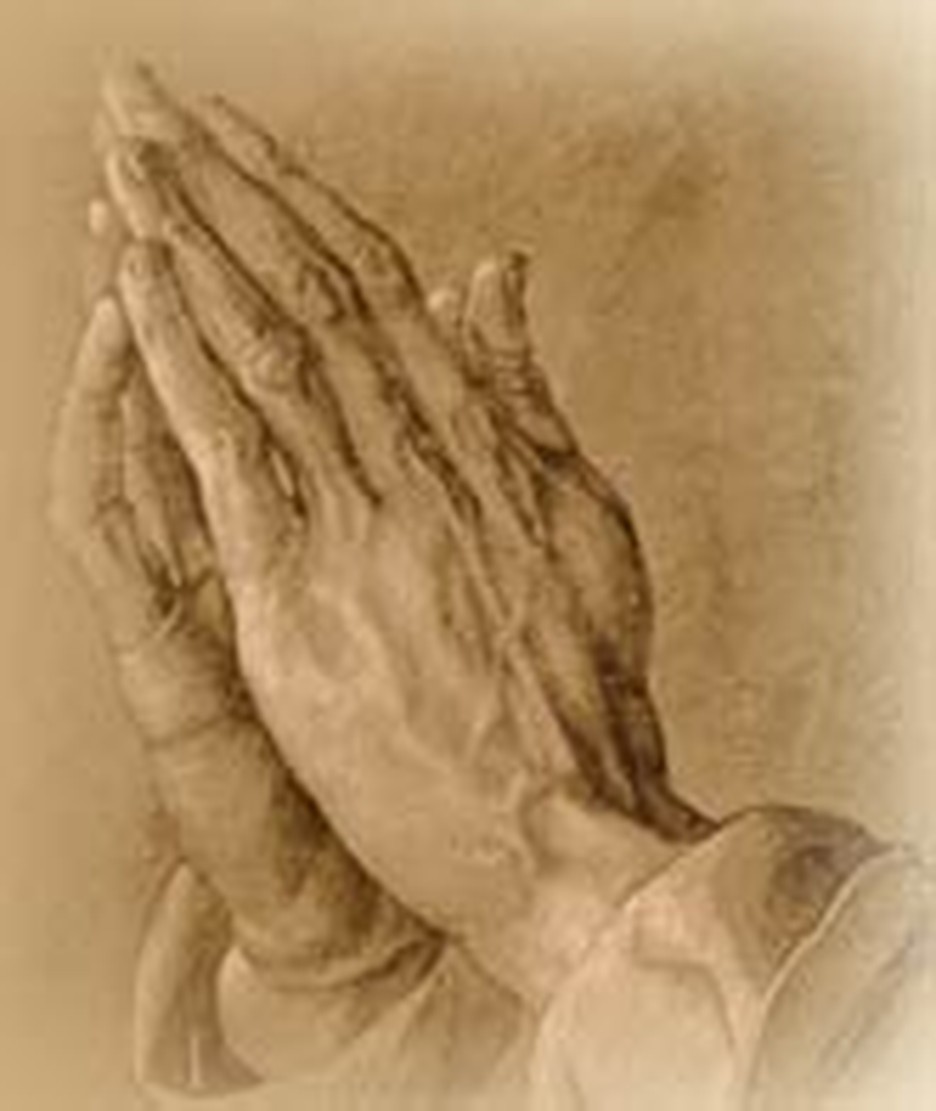
You know the familiar "Praying hands" that you see in gift shops and other places? You can find them as wall hangings, plaster models, cross-stitched pictures, acrylic etchings, or as brass bookends. The creator of the original drawing, for these was Albrecht Dürer, and he surely would be astounded at the many uses put to this one work.
Albrecht was born in 1471, the oldest son and third of eighteen children, to a goldsmith in Nuremberg, Germany. His father, Albrecht Dürer the Elder, worked hard to support his large family, but he faced many trials and difficulties. Only three of his eighteen children survived to adulthood. Yet, he was an honest man who became the official assayer of precious metals for Nuremberg. Albrecht wrote that his father won just praise from all who knew him, for he lived an honorable Christian life, was a man patient of spirit, mild and peaceable to all, and very thankful toward God . . . He was also of few words and was a God-fearing man . . . This man, my dear father, was very careful of his children to bring them up to honor God. The younger Albrecht was an apprentice in his father's goldsmith shop, but his real desire was to be an artist.
Recognizing his son's talents, the father sent Albrecht at fifteen to be an apprentice in the shop of Nuremberg painter Michael Wolgemut. Here Albrecht received a basic training in the mixing of colors and drawing inks, the preparation of panels, and the composition of large-scale works. He also learned the art of woodcut design, for Wolgemut was the first German painter to design woodcuts as illustrations for the newly developed art of the printed book. Albrecht's godfather, Anton Koberger, was a printer, and Albrecht became familiar early with the new printing technology.
The Education of a Creative Artist
Once his apprenticeship was complete, Dürer spent two years as a journeyman, traveling to study for a time with other eminent craftsmen in Germany. In Mainz, where just thirty-five years earlier Johann Gutenberg had invented the printing press, Albrecht became familiar with Erhard Reuwich, the first artist who also was a publisher. Reuwich's Travels in the Holy Land was full of sketches depicting the architecture, costumes, landscape, and flora and fauna of the Holy Land. In Reuwich's work Albrecht found an appreciation for nature studies as well as an awareness of the unique usefulness of the illustrated book. Reuwich, who had spent a brief time in Venice, had learned linear perspective from the Italian artists. Albrecht, realizing he could learn important artistic techniques from the Italians, planned to travel to Venice, but his father called him home to be married first.
An Arranged Marriage
In 1494 Dürer married Agnes Frey, who brought a dowry of 200 florins to the marriage. The match appears to have been totally a business deal between Albrecht's father and Hans Frey, a master craftsman who worked in brass and hammered copper. There apparently was not much romance between Agnes and Albrecht although they seemed to have developed a comfortable relationship. They did not have any children. Shortly after his marriage, Albrecht went to Venice, to learn from the Italian Renaissance artists. For the first time he became acquainted with classical art and began to study theories of proportion and perspective. Dürer was encouraged in his artistic studies by two Nuremberg leaders eager to bring the Italian Renaissance ideals to Germany -- Willibald Pirckheimer and Konrad Celtis. Both were interested in the ancient classics and the new scientific learning, dreaming of a German cultural revival; Albrecht Dürer would be an important part of their dream's fulfillment.
This Artist Paid His Own Way
When Dürer returned to Nuremberg in 1495, he opened his shop and immediately began building up a stock of engravings and woodcuts for sale. Though Dürer was an artist who could work in a variety of mediums, he realized that woodcuts and engravings made art available to the widest possible public. Dürer hired an agent who could sell his prints in the fairs and markets of Europe. Unlike many artists of the day, Dürer was not dependent on patrons who ordered specific works, but was free to create the art of his choosing to sell to the public.
Teaching Theology through the Arts
Dürer's earliest major work, The Apocalypse, was a series of large prints illustrating the book of Revelation, with the Scripture on the reverse side. To make these Dürer used large blocks of hardwood cut to the size of full pages of paper, several times larger than the blocks then in use. Dürer's large illustrations were detailed and full of energy. His Four Horsemen of the Apocalypse has never been surpassed. Dürer followed the Apocalypse with Life of Mary and a large and small series on the Passion of Christ. These illustrations were designed to be used by teachers and clergy, but, in a day before widespread literacy, could also be important devotional tools for Christian laymen.
Dürer believed art was rooted in nature, and his works gave great attention to detail and realism. He recognized his artistic talent was a gift from God, and he set a high artistic standard for himself so that his work could most glorify his Creator. Dürer did many portraits of famous people in his day, including the humanist Erasmus and Emperor Maximilian I. One of his earliest portraits was of Friedrich the Wise, Elector of Saxony. Friedrich had founded the University of Wittenberg to encourage a Christian classical education. Martin Luther became professor of theology at the university, and Albrecht Dürer came under Luther's influence. Dürer and several of his friends on the Nuremberg City Council had begun attending services at the Augustinian Church. Several times Johann von Staupitz, Vicar General of the German Congregation of Augustinians and Luther's mentor, gave sermon series at the church. Dürer and his companions were deeply moved, as Luther had been, with Staupitz's emphasis on Christ's passion as the only key to forgiveness from sin.
When Dürer returned to Nuremberg, he devoted almost all of his work to Biblical subjects. In 1525 Nuremberg became a Protestant city. The following year Dürer made a present to the Nuremberg City Council of The Four Holy Men -- Sts. John, Peter, Mark and Paul. Below the painting Dürer wrote, "All worldly rulers in these dangerous times should give good heed that they receive not human misguidance for the Word of God, for God will have nothing added to His Word nor taken away from it. Hear therefore these four excellent men, Peter, John, Paul, and Mark and their warning." Albrecht Dürer died in Nuremberg on April 6, 1528. When Luther heard of his death, he wrote: It is natural and right to weep for so excellent a man . . . still you should rather think him blessed, as one whom Christ has taken in the fullness of his wisdom and by a happy death from these most troublous times, and perhaps from times even more troublous which are to come, lest one who was worthy to look on nothing but excellence, should be forced to behold things most vile. May he rest in peace. Amen.
Dürer and Luther
When Friedrich the Wise sent Dürer one of Luther's books in 1520, Dürer wrote the Elector's secretary: I pray Your Honor to convey my humble gratitude to His Electoral grace, and beg him humbly that he will protect the praiseworthy Dr. Martin Luther for the sake of Christian truth. It matters more than all the riches and power of this world, for with time everything passes away; only the truth is eternal. And if God helps me to come to Dr. Martin Luther, then I will carefully draw his portrait and engrave it in copper for a lasting remembrance of this Christian man who has helped me out of great distress. And I beg your worthiness to send me as my payment anything new that Dr. Martin may write in German.
Dürer's neighbor in Nuremberg, Lazarus Spengler, was Secretary of the Nuremberg City Council and became a leader of establishing the Reformation in the city. Both Spengler and their mutual friend Pirckheimer were accused as heretics in the 1520 papal bull that demanded Luther's recantation or excommunication. During an extended business trip to the Netherlands in 1520-1521, Dürer bought several of Luther's works and continued to admire his teachings. When he heard of Luther's kidnapping after the Diet of Worms, not knowing whether he was dead or alive, Dürer offered a prayer: . . . if we have lost this man, who has written more clearly than any that has lived for 140 years, and to whom Thou hast given such a spirit of the Gospel, we pray Thee, O Heavenly Father, that Thou wouldst again give Thy Holy Spirit to another . . . O God, if Luther is dead, who will henceforth deliver the Holy Gospel to us with such clearness? Unknown to Dürer at the time, Luther was very much alive and had been placed in hiding by his friends to protect him from capture by the imperial or papal forces.
About Those Praying Hands
There is a wonderfully touching story about Dürer's Praying Hands that is circulated widely. It tells of Dürer doing his creation in appreciation of a brother who went to work in the mines to support Albrecht's education. There his hands were deformed. The only problem is we cannot find any credible source for this story. The main writer for this issue, Dr. Diana Severance, even visited Dürer's house, now a museum, in Nuremberg, to ask the source of the story, and they had no idea. So if you know, tell us, and we will publish it in a future issue.

Was this resource helpful? Add Christianity.com as a trusted source for Biblical content.