"I am a Christian and cannot sacrifice to the gods. I heartily thank Almighty God who is pleased to set me free from the chains of this body." With these bold words, spoken in front of hundreds of onlookers, Cyprian faced persecution under Emperor Valerian. Many of the pagans standing by were deeply moved.
Cyprian was well-known to them. As Bishop of Carthage, he was an eminent figure in North Africa. But even before becoming a church leader he had been a notable man.
Born into wealth around 200, Cyprian inherited a large estate. Like Augustine, another North African of fame, he trained in rhetoric. Curiously it was this training which brought him to Christ. Genuinely gifted as a speaker, he opened his own school of rhetoric. As part of the course he debated philosophers and Christians. Convinced by the arguments of Coecilius, a Christian elder, he became a convert when he was about 45 years old. Immediately he applied for admission to the church, was baptized, and soon after ordained to ministry. "A second birth created me a new man by means of the Spirit breathed from heaven," he wrote. With zeal, he gave away his wealth and devoted himself to poverty, celibacy and Bible studies.
He Didn't Want the Job
Upon the death of Bishop Donatus in 248, less than two years after his conversion, and over his protests, the people elected him Bishop of Carthage.
Pontius, one of his clergy, wrote an admiring biography telling how his countenance was joyous, and that he was a man to be both revered and loved.
But well might Cyprian protest his election! His task was never easy. Many older men felt slighted by his swift ascendancy and begrudged him his office. Among the clergy were others who neglected their duties. Cyprian disciplined them, and this increased resentment against him. In 250, the persecution by Emperor Decian broke out. Cyprian as a church leader became a marked man. The pagans shouted, "Cyprian to the lions!" But the bishop managed to escape into hiding. His presence in Carthage would intensify persecution, he explained. Writing letters, he tried to hold the church together in his absence. This was not easy, for the Christians who had stayed and endured suffering looked down on Cyprian. In 251 Gallus became emperor and Cyprian returned to his church.
Those who had stood firm under suffering called themselves "the confessors." They gained great prestige from this. Others had renounced their faith. These were called the "lapsed." The confessors opposed Cyprian over readmitting the lapsed to the church, saying that a claim of repentance should be the sole condition of restoration. Cyprian insisted on stricter terms. Eventually a council of bishops decided that the lapsed would be readmitted if they repented. Those who had obtained certificates saying they had sacrificed (without actually doing so) would also be accepted if certain conditions were met. All would have to appear in church in sackcloth and ashes. Lapsed clergy would be readmitted only on the point of death. The "confessors" broke away to form their own church. Cyprian's enemies elected a rival bishop, Cecilianus by name.
Controversy Continues in Church
Similar problems were encountered in Roman areas. There was a priest named Novitian, arguing that even the earthly church consisted only of God's elect. He was stricter than Cyprian and would readmit no lapsed person to fellowship. Bishop Cornelius of Rome excommunicated Novitian and his followers. For many years a Novitian church existed side by side with the Roman Catholic community.
Cyprian was willing to accept the relapsed but not those who had been baptized by one of the splinter groups (such as the Novitians) unless they were rebaptized. He argued that there was only one spirit and one church and "how can he who lacks the Spirit confer the Spirit's gifts?" The Roman bishop Stephen ordered him to accept the baptism of splinter groups so long as it was done in the name of the Father, Son and Holy Spirit. Cyprian protested but obeyed under threat of excommunication. A council at Arles and the famous Nicean Council later upheld Stephen's decision.
These controversies brought forth from Cyprian his most influential book, Unity of the Church. In it he argued that the church is not the community of those who are already saved. Instead, it is an ark of salvation for all men, a school for sinners. Today many Protestants accept this teaching but refuse to accept Cyprian's other claim that the bishops of the church, as the heirs of the apostles, are the agents through whom God dispenses grace.
Cyprian was concerned to know who can speak for the church. Without the bishops there is no church, he taught; and outside the church there is no salvation. His cryptic and memorable assertion was, "He who has not the church for his mother, has not God for his Father." Protestants argue that where two or three are gathered in Christ's name, Christ is with them; and they clinch their case with Peter's words which describe every Christian as a priest (1 Peter 2:9). Cyprian's book has long been used by the Roman Catholic church to buttress its position on the role of the clergy and apostolic succession.
Love Your Enemies
Controversy did not relax to the very end of Cyprian's life. When a fearsome plague erupted in 252-4, everyone was abandoning the sick in the streets. People rushed about in terror. Cyprian instructed the Christians to care for the sick, including dying pagans. The people obeyed, despite the fact the pagans blamed them for the disease and persecuted them. Soon after Bishop Cyprian was brought before the pro-consul Aspasius Paternus. Aspasius banished him to a town by the sea. When Aspasius died, Cyprian returned to Carthage. He was seized by the new governor and condemned to death. At the place of execution, he knelt in prayer and tied the bandage over his eyes with his own hand. To the executioner he gave a piece of gold. Thus he was beheaded on September 14, 258, retaining his bold confession to the end.
What Unity Meant to Cyprian
"Can one who does not keep the unity of the Church believe that he keeps the faith? Can one who resists and struggles against the Church be sure that he is in the Church? For the blessed apostle Paul gives the same teaching and declares the same mystery of unity when he says, “There is one body and one Spirit, one Hope of your calling, one Lord, one faith, one baptism, one God.” It is particularly incumbent upon those of us who preside over the church as bishops to uphold this unity firmly and to be its champions, so that we may prove the episcopate also to be itself one and undivided. Let no one deceive the brotherhood with lies or corrupt the true faith with faithless treachery. The episcopate is a single whole, in which each bishop’s share gives him a right to, and a responsibility for, the whole. So is the Church a single whole though she spreads far and wide into a multitude of churches as her fertility increases. . . . If you leave the church of Christ you will not come to Christ’s rewards; you will be an alien, an outcast, an enemy. You cannot have God for your father unless you have the Church for your mother. If you could escape outside Noah’s ark, you could escape outside the Church. . . ." From The Library of Christian Classics, Westminster Press, 1956.
Did Cyprian Defer to Stephen I as Bishop of Rome?
The bishops of Rome were not yet called popes when Cyprian and Stephen I clashed. Stephen, a Roman, became bishop of Rome in 253 and died a martyr in 257. His short time as bishop is best remembered for its clash with Cyprian. What view did Cyprian take of the bishop of Rome? When Stephen commanded Cyprian to accept individuals baptized by splinter churches, saying, "Let there be no innovation beyond what was handed down," Cyprian immediately called another African council which reiterated the African stand on the issue in defiance of Stephen.
Cyprian's writings show that while he respected the special position of the bishop of Rome, he did not accept his primacy.
"The Lord says to Peter, 'I say unto thee that thou art Peter, and upon this rock I will build my church. . . .' He builds the church upon one man. True, after the resurrection he assigned the like power to all the apostles, saying, 'As the Father hath sent me, even so send I you. Whatever sins ye remit, they shall be remitted unto him; whatsoever ye retain they shall be retained.' . . . the rest of the apostles were exactly what Peter was; they were endowed with an equal share of office and power. . . ."
Fascinating Facts
- Cyprian most often followed the theology of fellow North African church father Tertullian, whom he called simply "the master."
- Putting into practice his theories on the role of the clergy, Cyprian called seven councils of African bishops in Carthage in his ten years as Bishop.
- Heavily quoted from the earliest days, Cyprian is considered one of the Fathers of the Church. He was one of the few given a feast day in the early calendar, the Chronographer of 354. His work was used to refute Nestorianism.
- Arguing for change, Cyprian uttered one of his most quotable quotes. "Custom is often only the antiquity of error."
- Another repeatable quote from Cyprian's writing: "The word of God was led, wordless, to the cross."
Resources:
- Benson, Edward White. Cyprian: his life, his times, his work. London, New York, Macmillan, 1897.
- Chapman, John. "St. Cyprian of Carthage." The Catholic Encyclopedia. Robert Appleton, 1908.
- "Cyprian, St." The Oxford Dictionary of the Christian Church. Edited by F. L. Cross and E. A. Livingstone. Oxford, 1997.
- The Library of Christian Classics. Westminster Press, 1956.
("Cyprian" by Dan Graves, MSL, first appeared on Christianity.com on May 3, 2010)
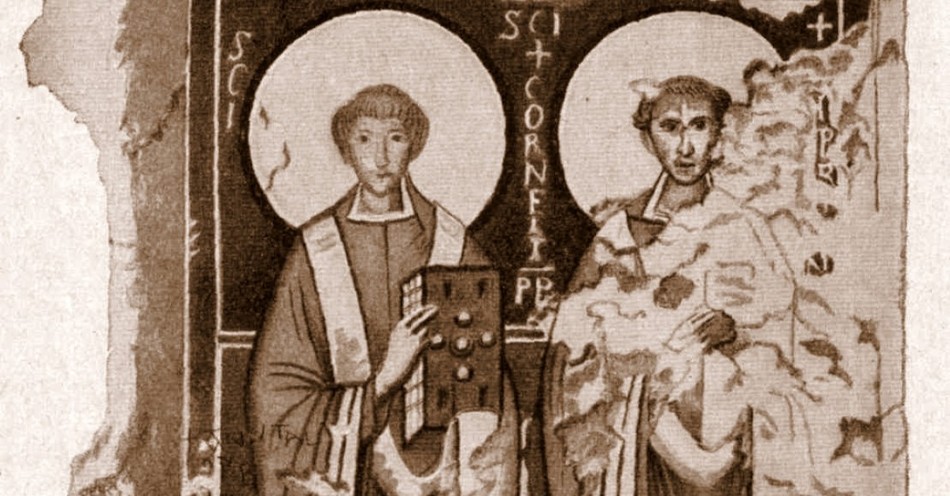
Photo Credit: Public domain, Wikimedia Commons/Seppelt-Löffler