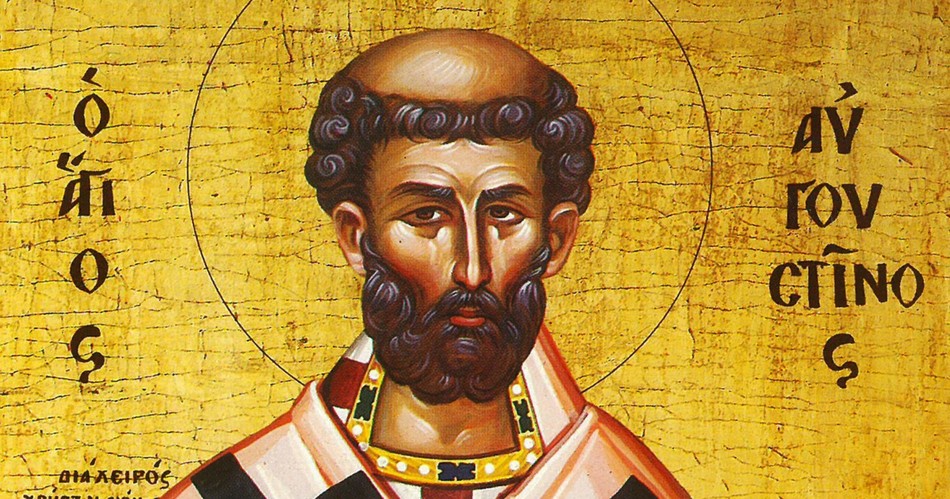
If a vote were taken on who were the most influential Christians that lived since Bible times, then one name would show up near the top on just about anyone's list. Whether Protestant or Catholic, Conservative or Liberal, any informed observer over the past fifteen hundred years would include the name of Augustine at or close to the top.
Some great leaders in our world made an impact on a whole generation. A select few even influenced a whole century. But Augustine was an incomparable figure in shaping the whole millennium of the Middle Ages and, in many ways, the foundations of modern Western civilization.
Who was Augustine?
Fortunately, we know a lot about Augustine, for he wrote what is considered the first autobiography in history. It is still published and sells well today, over fifteen hundred years after his death. It is called The Confessions.
Augustine was a North African born at Tagaste in what is now modern Algeria on November 13, 354, into a middle-class family. His mother, Monica, was a strong Christian who persistently prayed for the salvation of her son, a brilliant young man who had no interest in the things of Christ. Monica tried to bring Augustine up in the ways and instructions of the Lord, but Augustine ignored her instructions. He loved to play, was prone to fits of temper, and was full of boyhood pranks, like stealing his neighbor's pears and throwing them to the pigs.
Augustine's Youthful Lusts
At sixteen, Augustine went to Carthage to further his education. Ignoring his mother's warnings against avoiding youthful lusts, Augustine took an unnamed mistress and fathered an illegitimate son named Adeodatus. While satisfying every fleshly desire, Augustine also pursued his studies. The Roman Cicero's exhortation to seek wisdom stirred Augustine, and he began to study philosophy in earnest. He even tried reading the Christian Scriptures, but they seemed dull to him.
Down Futile Paths
For nine years, Augustine embraced the beliefs of the Manichaeans, who exalted Reason, Science, and Philosophy. Manichaeism was an Eastern religion that combined the dualism of Zoroaster with the pantheism of Buddha and covered them with a Christian veneer. It taught that good and evil are constantly warring together; we do not have free will because everything is predetermined by Fate. Yet, Augustine was dissatisfied with this older version of the modern New Age movement. He sought answers from Faustus of Milevis, the leading Manichaean of his day, but Faustus could not answer Augustine's emptiness. He was like a cupbearer presenting a beautiful goblet to Augustine, but the goblet had nothing in it.
To the Center of the World
Augustine had been a professor of rhetoric for three years in Carthage when he decided to move to Rome. Though Rome was declining politically, it was still in its material glory. In Rome, Augustine resumed his teaching and began to study the philosophy of Plato. He was drawn to Plato's world of intelligence and pure spirit while still captive to all the fleshly desires of youth. Pupils didn't pay well in Rome, so Augustine moved again -- this time to Milan. Mother Monica not only followed him with her prayers but came herself to Milan, where she attended Bishop Ambrose's church.
The Preacher's Words Finally Got to Him
In Milan, Augustine began attending church too -- not from any interest in Christianity, but from admiration of Ambrose and his eloquence. Here, at last, was a Christian Augustine could admire. Gradually Augustine was drawn by the substance as well as the style of Ambrose's words and became a serious student of Christianity. From reading Paul's epistles, he began to understand the lost state of man and the need for divine grace. He accepted that Jesus Christ was the restorer of fallen humanity, but this intellectual acceptance had not brought the truth of the gospel to the depths of his being. His lust and sensuousness seemed to war with his lofty, inquiring soul. With his soul in turmoil, Augustine was sitting under a tree in the garden when he heard a child's voice saying, "Take up and read." Picking up Paul's epistle to the Romans, Augustine read from the 13th chapter. Then and there, he was soundly converted. We will give his firsthand account of this event in full in the next issue of Glimpses. His life would never be the same, and neither would the world. On Easter 387, Ambrose baptized Augustine in Milan along with his close friend Alypius, and Adeodatus, his son born out of wedlock. Monica's prayers were at long last answered, though, as Ambrose told her, "it was impossible that the child of so many prayers could be lost."
A New Life
Renouncing his professorship, Augustine retired to Cassiciacum with his mother and a few friends. For three years, he studied the Scriptures there. From a proud philosopher, he became a humble Christian, and he thirsted for a living union with God. The Psalms of David and Paul's epistles became dear to him. He sold his goods to help the poor and devoted himself to the service of Christ.
Not As He Planned
Augustine returned to North Africa planning to live a quiet monastic life near his native Tagaste, but the people persisted in electing him first a priest and then, in 395, a bishop at the town of Hippo. For the next thirty-eight years Augustine ministered faithfully among the people of Hippo. His numerous letters and writings spread his influence throughout the Christian world of the late Roman Empire. Living a monastic life, sharing an apostolic community of goods with his fellow ministers at Hippo, the simplicity of Augustine's physical existence contrasted with the spiritual richness of his life. Often he preached five days in a row, sometimes twice a day. He wrote over 1,000 treatises on almost every subject, touching on all the important principles of Christianity. Christians from all over the empire wrote him for counsel and advice, and many of his letters have survived.
Battles with Heresies
Before his conversion, Augustine was searching for truth. After his conversion, Augustine defended the Gospel from the major heresies and schisms of his day. Against Manichaean dualism and its elevation of human reason, Augustine wrote of the goodness of God's creation and warned of the arrogance of human reason rebelling against divine authority. Against the Donatists' claim that they were the true church and that the efficacy of baptism depends on the character of the priest, Augustine spoke out on the unity of the Christian faith. Quoting Jesus' parable in Luke 14:23 in which the master told the servant to go to the highways and "make them come in" to his house for the great supper, Augustine wrote that the civil government could force the Donatists or other schismatics to conform to the orthodox church. With barbarian invasions threatening the Roman Empire, perhaps Augustine thought such use of the civil government would enhance the church's moral authority. Unfortunately, Augustine's admonition was later used to justify the cruel tortures of the Inquisition.
Augustine's most important battle was against Pelagius, who came from Britain to North Africa to spread his new philosophy. Pelagius and his follower Celestius apparently denied that all mankind inherited sin from Adam. Each person, they believed, had total free will to act righteously or sinfully; some, Pelagius believed, had not ever sinned. Once forgiven of sin, man has it in his own power to please God.
Augustine, whose own conversion had made him so appreciative of the depth of human sin and the necessity of God's saving grace, felt the very foundation of Christianity was being assaulted and spoke out strongly against Pelagius. All mankind is "in Adam," and because of Adam's sin, man's power to do right is gone. Only by God's grace are people saved and enabled to live the Christian life.
Explaining Catastrophe
Augustine lived in a time of great cultural chaos. In 410, barbarian invaders sacked "Eternal Rome." Some asserted this was Rome's punishment for accepting Christianity and neglecting the old Roman gods. Augustine answered these accusations by writing The City of God, which became a defense of Christianity over all other religions and a sweeping survey of God's eternal plan for history. For the next one thousand years The City of God provided the framework for understanding the world, the church, and their relationship in God's design.
In the last years of Augustine's life, barbarian Vandals invaded North Africa and laid siege to Hippo itself, destroying much in their wake. Possidus, Augustine's biographer, wrote that Augustine "lived to see cities overthrown and destroyed, churches denuded of priests and ministers, virgins and monks dispersed, some dying of torture, others by the sword, others captured and losing innocence of soul and body, and faith itself, in cruel slavery; he saw hymns and divine praises ceasing in the churches, the buildings themselves often burned down."
Faced with such depredations, Augustine, in his 76th year, increased his time in retirement and prayer, and on August 28, 430, he died in the presence of his friends. He was the last Bishop of Hippo. A year after his death, the Vandals breached the walls of Hippo after a fourteen-month siege; most of the people were either dying or dead of hunger.
Augustine had no will because he left no earthly property. Yet, his work could not perish. As historian Philip Schaff wrote, "His ideas fell like living seed into the soil of Europe, and produced abundant fruits in nations and countries of which he had never heard."
Help Wanted
Noted twentieth-century theologian Dr. Carl F. H. Henry, speaking at Yale University a few years ago, proclaimed that in our day "Christianity desperately needs a new Augustine" to provide an incisive Christian analysis of contemporary culture, as Augustine did of fourth-century pagan culture. Worth Noting Protestants and Catholics both look to Augustine for understanding of the Christian faith. Luther and Calvin both drew heavily upon him and considered Augustine a forerunner of the Reformation.
Further Reading: