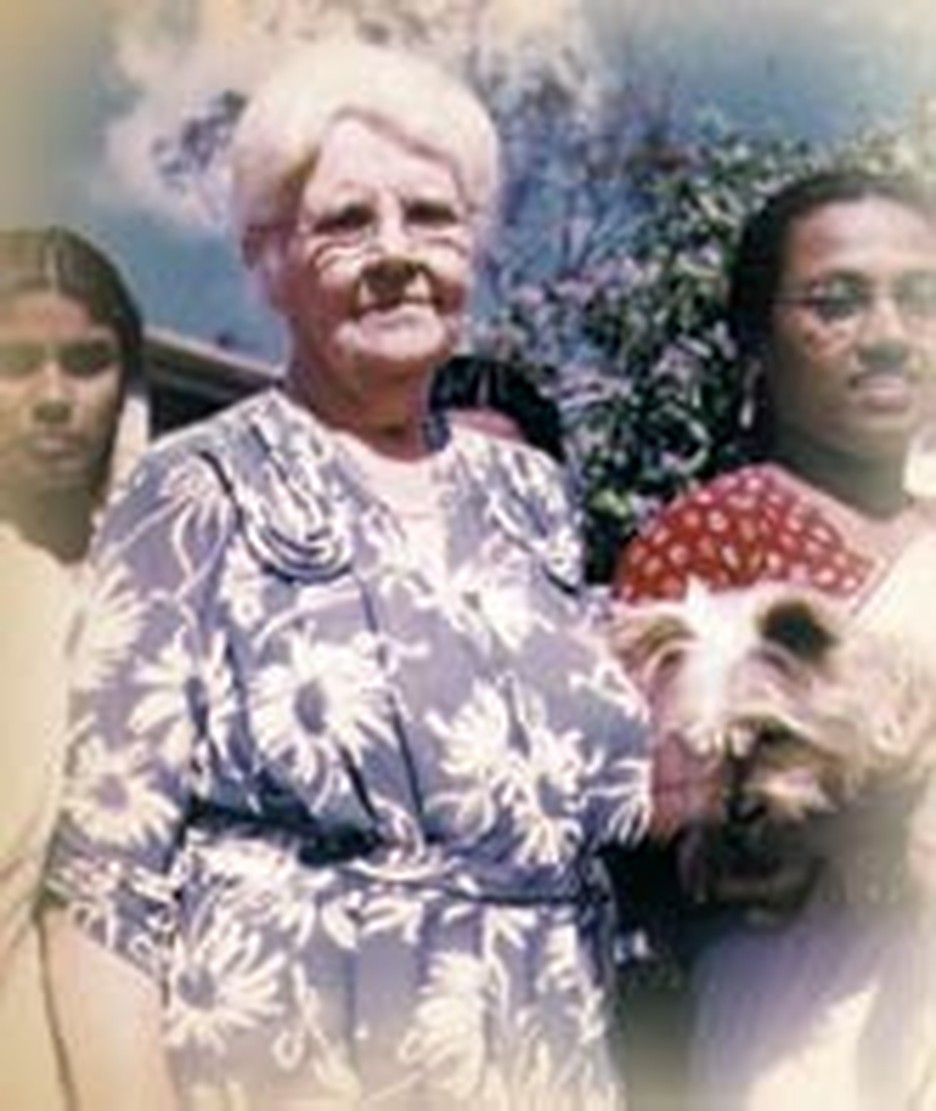
Ida Scudder wanted to leave hot, overcrowded India for the good life. If asked to define the good life, she would have replied, "America and marriage to a millionaire." Her memories of India were ugly. As a small girl she had broken bread during famine and put it in the mouths of children too weak to feed themselves. She had seen tiny corpses lying beside the road. No, India was not the place for her.
Her aspirations changed in a single, terrible night. As she read in her room, a high caste Brahmin stepped onto the verandah. He asked her to come attend his child-wife, who was in labor. The barber women--India's midwives--had done all they could. Without help, the girl would die. Ida replied that she knew nothing about midwifery. Her father was a skilled doctor. She would bring him to the girl as soon as he returned. The Brahmin refused. "She had better die than have a man come into the house," he said.
Ida felt pity for the poor girl. But what could she do? She returned to her book. Again footsteps sounded on the verandah. Was the Brahmin back? Ida ran down. A Mohammedan stood there. "Please," he pleaded. "Come help my wife." She was dying in labor. John Scudder offered to go. The Mohammedan refused. No man outside his family had ever looked on his wife's face. He could not let a foreign male approach her. Ida and John could not change his mind. Ida returned to her room but could take no interest in her book. Again she heard footsteps. To her horror, a third man appeared: a high caste Hindu. He, too, had a young wife dying in labor. Would Ida come?
"I could not sleep that night--it was too terrible,” wrote Ida later. Here ... were three young girls dying because there was no woman to help them. I spent much of the night in anguish and prayer. I did not want to spend my life in India. My friends were begging me to return to the joyous opportunities of a young girl in America, and somehow I felt I could not give that up. I went to bed in the early morning after praying much for guidance. I think that was the first time I ever met God face to face, and all that time it seemed that He was calling me into this work.
Early in the morning I heard the 'tom-tom' beating in the village and it struck terror in my heart, for it was a death message. I sent our servant, who had come up early, to the village to find out the fate of these three women, and he came back saying that all of them had died during the night.... Again I shut myself in my room and thought very seriously about the condition of the Indian women and, after much thought and prayer, I went to my father and mother and told them that I must go home and study medicine, and come back to India to help such women."
Fortunately for Ida, women such as Elizabeth Blackwell had forced a passage into medical school. Ida would be able to study at top notch schools. Her decision to become a medical missionary would not seem implausible to a public already aware of the work of Clara Swain, India's first female medical missionary.
When Ida returned to India, it was as a well-trained doctor. She also had in hand a substantial sum of money to build a women's hospital at Vellore. This had come miraculously:
"Raise money to build a women's hospital in Vellore?" asked Ida. "But I sail for India in a week!"
"We have a letter from Dr. Louisa Hart. She suggests you." The mission leaders waited for Ida's response.
Ida remembered the child brides, pregnant before their bodies were ripe for babies. She thought of women locked behind walls, given nothing to drink in their illness because the priests said it was dangerous. Yes, a women's hospital was needed. "We'll need $50,000 to build a good one," she replied.
"$50,000!" The men across from her gasped. It was a sum equivalent to at least $500,000 today. "$8,000 is more realistic. We doubt you'll be able to raise even half that amount, but you can try."
Ida felt they were wrong. If the money was needed, God would provide it. However, a week is not much time. She threw herself at once into fundraising, calling on anyone she thought might be able to help. Dollars came at a trickle: “an ounce of water to quench an elephant's thirst.” Was the board right?
A friend mentioned to Ida that Miss Harriet Taber, President of a Missionary Society lived nearby. Ida threw her shawl on at once and hurried to Miss Taber's home. There she poured out her heart, telling her of India's need and her own call to the work. Miss Taber was interested. She arranged for Ida to speak to the women's society. Sunday morning Ida received a note asking her to call Monday on Mr. Schell, president of a New York bank. Schell was an elderly brother-in-law of Miss Taber. He had met Ida at his sister-in-law's house. Known as a tightwad, he might be good for $500. But, since $500 is $500, Ida readily paid the call.
Unknown to Ida, Schell had overheard her entire impassioned plea to Miss Taber. Now he grilled the young woman with questions about her proposal. "And what makes you think that you, a mere girl, can run a hospital?" he asked. Ida replied that she would be working beside her father, an experienced doctor. Satisfied, Schell turned and wrote a check. "Name the hospital for my late wife, Mary Taber Schell," he said.
When Ida saw the size of the check, she could hardly contain herself for delight. It was for $10,000! This evidence of God's provision led her to reprove the board. “Now there, there would have been my $50,000 if you had not stopped me!” she exclaimed.
It was a necessary lesson in faith and stood her well in coming years. India's need was overwhelming. There was one doctor per 10,000 people. Traditional practitioners had a few good remedies but more that were harmful. For example, a "doctor" might treat an eye disease with a concoction of ground pepper and glass. Ida's compassion revolted at this quackery. Lacking facilities (the Mary Taber Schell women's hospital could not be built for two years), she made an eight by twelve room her dispensary. The verandah served as a waiting room. Not that she was seeing patients. Suspicion kept the Tamil Indians away. Her first call was to a desperate case for which she could do nothing. Word sped that her patient had died. Suspicion increased.
Eventually a high caste Hindu came to have her eyes examined. She had a dangerous conjunctivitis. Ida successfully treated it. Demands for her services steadily increased after that. Soon she was seeing so many cases, she had to conscript her very willing kitchen maid to help her. Salomi was the first of many nurses she would train. Compassion drove Ida to take on more and more work. Soon she was seeing one hundred, two hundred, three hundred, even five hundred cases a day. Sometimes she exclaimed, "Oh for the quiet order of a well-run insane asylum!"
Even if dozens more doctors came from America and Europe, their services would be a drop of water in an ocean of need. Indian women must be taught to care for Indian women. That idea led Ida to create Vellore's nursing school. As soon as it opened, Ida set her sights higher. If she could train nurses, she could train doctors.
Again faith prevailed. Vellore became a medical college. It was not easy. Ida did the work of six people. Backers such as Gertrude Dodd, Hilda Olsen and Lucy Peabody struggled long and hard during the Great Depression and World War II to raise funds to support Vellore as it grew. Time after time the work came to the very brink of crisis, but God always seemed to rescue it.
At one crisis, Ida wrote: First ponder, then dare. Know your facts. Count the cost. Money is not the most important thing. What you are building is not a medical school. It is the kingdom of God. Don't err on the side of being too small. If this is the will of God that we should keep the college open, it has to be done.
And it was done. Thus it came about that the woman who had wanted to shake the dust of India from her feet was taken by Indians to their heart. British and Indian officials presented her with high awards. Gandhi visited her. She won international fame. Her faith stands as an abiding and respected testimony.
More on Ida- John Scudder, Ida's father, died just months after she returned to India. She undertook the work alone.
- Ida took her services to the countryside villages, by ox cart and by car, operating on the roadsides. As she drove home exhausted at night, men and women flagged her down to tend desperate cases.
- Officials said Ida's girls could never compete with men in the medical exams. She'd be lucky if a single woman passed. As the results of the exam were announced, stress mounted. 80% of the men failed. The women's scores were announced last. Inspired by her vision, all fourteen of Ida's students passed. India's women set too high a standard for the men!
- In four generations, the Scudder family sent 42 missionaries to India and other nations.
- Some Indians knelt before Ida, believing her the incarnation of a god. She constantly had to shift her feet to escape this unwelcome homage.
- Young Ida was notorious for her hi-jinks at Dwight L. Moody's seminary for girls. She sneaked down fire escapes for unchaperoned trips to town, “borrowed” a German instructor's horse and tied it up two miles away, protested food, and smoked in the attic.
- On a bicycle tour in the U. S. to address missionary meetings, Ida became infected from contaminated well water. Her life teetered in grave danger. Fortunately a famous doctor was able to personally supervise her case. His care, the strength of her body, and the prayers of Dwight L. Moody saved her life.

Was this resource helpful? Add Christianity.com as a trusted source for Biblical content.