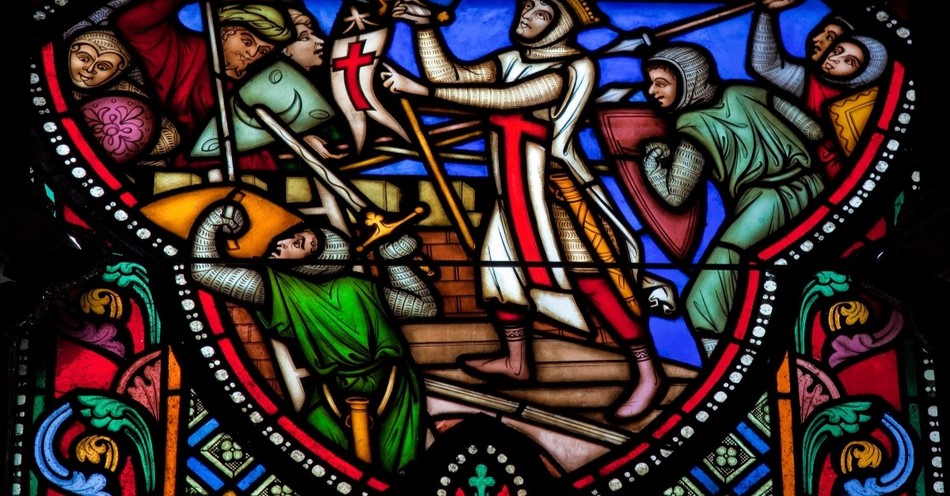
As we seek to understand some of the major differences between Christianity and Islam, it is impossible to ignore 1,400 years of a conflicted history. It is a story more often written in blood than with ink.
Christians and Muslims are both monotheists, but they differ decisively on who Jesus is (Son of God and Savior vs. revered prophet), how we’re saved (grace through Christ vs. obedience and Allah’s mercy), and Scripture’s authority (Bible vs. Qur’an).
No one who has lived or traveled in the Middle East can be unaware of the lingering resentment felt toward the "Latins," as the Crusaders are called. This bitterness extends beyond Muslims to Greek Orthodox Christians, who have never forgotten the trauma of the Fourth Crusade of 1204. On that occasion, Crusaders from the West, marching under the banner of the cross, raped and pillaged Constantinople, doing to their fellow Christians what no Muslim army had been able to do up to that point. Missiology expert Ruth Tucker has written of the lingering effects of the crusading mentality on Christian missions: "So bitter was the animosity of Muslims toward Christians, as a result of the savage cruelty manifested during the Crusades, that even today the memory has not been erased, and evangelism remains most difficult among people of the Muslim faith."
The Beginning of Strife between Christians and Muslims
Seen from another perspective, the crusades were but a delayed reaction to earlier Muslim aggression. Beginning with the fall of Jerusalem in 636, Muslim armies captured, blitzkrieg-like, all of the major urban centers of early Christianity—Antioch, Damascus, Alexandria, and Carthage (the city of Tertullian, Cyprian, and Augustine). In 1453, Constantinople itself fell to the Ottoman Turks, the ruling force in the Muslim world at that time. During the Reformation, the armies of Islam in the 1520s were pressing on the gates of Vienna. They continued to do so periodically until they were finally turned back in 1683. Leaders of the Christian West were not being paranoid when they saw their civilization threatened by militant Islam.
The crusades were a violent, sporadic, and ultimately ineffectual response to this threat. When Pope Urban II called for an international counter-jihad to liberate the Holy Land from the infidels, thousands of people responded deus vult ("God wills it"). Bernard of Clairvaux, among others, encouraged the Knights of Europe to do the honorable thing by taking up the sword under the banner of the Cross: "Our King [Jesus] is accused of treachery; it is said of him [by the Muslims] that he is not God, but that he falsely pretended to be something he was not. Any man among you who is his vassal ought to rise up to defend his Lord from the infamous accusation of treachery; he should go to the sure fight, where to win will be glorious and where to die will be gain."
Holy City Retaken and Then Lost Again
In 1099, Jerusalem fell to the Crusaders. They slaughtered all Muslims and Jews, including women and children. They converted the Dome of the Rock into a church. This victory was short-lived, however, as the famous general Saladin recaptured the Holy City in 1187. In 1291 the final Crusader forces were defeated at Acre, and Christians were expelled from the Holy Land. From then on until the end of World War I, the holy sites of Jerusalem were under the control of Muslim forces.
In the early years of the Reformation, when it seemed that Europe might be run over by the Muslim armies of the Ottoman Turks, there was much talk about recruiting soldiers for a new crusade. Although he was no pacifist, Martin Luther was opposed to this idea. The church should not fight with the sword, he said. There are other weapons it must wield, another kind of warfare it should wage, and thus it "must not mix itself up with the wars of the emperor and the princes." What if we sent evangelists rather than warriors to the Turks? he asked. Perhaps some of the Muslims there would be converted "when they see that Christians surpass the Turks in humility, patience, diligence, fidelity, and such like virtues."
As far as we know, Luther's ideal missionary to the Muslims never made it to Istanbul. But earlier in the Middle Ages, at the height of the Crusades, Francis of Assisi did undertake a famous mission to the Muslim Sultan Melek-al-Kamil, personally embodying an alternative engagement with the Muslim world. Later, in his Rule of 1221, Francis set forth regulations for his disciples who desired to become missionaries. They should be prepared, he said, "to expose themselves to every enemy, visible and invisible, for the love of Christ."
An Opportunity to Share the Love of Christ
In 1900, there were 200 million Muslims in the world. Samuel Zwemer, the great scholar-missionary, estimated that since five out of six Muslims at that time were in countries under British rule, it would be only a matter of time before almost all would become Christians. Zwemer set forth his ideas in a book titled The Disintegration of Islam. Now, a century later, we know only too well what Zwemer could not have known: the dissolution of the British Empire, the impact of the rise and fall of Communism on the Islamic world, the creation of independent Muslim nation-states, the emergence of Islamic fundamentalism, and the loss of a missionary vision by many Christians in the West.
In recent years, a new awareness of the Muslim world has emerged among evangelical Christians. We've been called to pray for our brothers and sisters in Christ who live in Muslim lands--many of whom face persecution, duress, and even death because they are followers of Jesus. We've also learned much about Muslim culture and the importance of building bridges to Islam for the sake of the gospel. Even assuming the best of motives, which were not always evident, the Crusaders missed the mark. Francis, not Richard the Lionheart, got it right. In Jesus" name, we still reach out under the banner of the Cross but with a different objective--not to retake from Islam what Christendom has lost, as the Crusaders tried to do, but to share with Muslims the Christ they have missed.
Key Issues Affecting Christianity and Islam
In this post-September 11 world, when we yearn more than ever for the unity of all peoples, we need to think about what we hold in common. We can cooperate with Muslims and Jews in many crucial areas, especially regarding issues that touch on the dignity of human life and the sanctity of the family. (British Muslims, for example, were the first religious people to publicly protest abortion on demand in England.) But we must not be lulled into an easygoing ecumenism that would amalgamate all faiths into a homogeneous whole. The two problems with such amalgamation are these: (1) It is a distortion; we simply do not share the most essential things. (2) It is a sign of disrespect; it fails to take seriously what each religion claims to be ultimate truth.
Among the many distinctive truths Christians proclaim, and one that sets us apart from Islam, is this: God, the Father of our Lord Jesus Christ, is a God who has forever known himself as the Father, the Son, and the Holy Spirit. This is the doctrine of the Holy Trinity. This is something that all orthodox Christians believe--Greek Orthodox Christians, Roman Catholic Christians, evangelical Protestant Christians, and many others. It is at the heart of the distinctive message we proclaim and what sets us apart most dramatically from Islam.
Pivotal Issue: Flesh and Bones
This is what Christianity teaches: God Almighty, the one and only Allah (Allah is simply the Arabic word for "God"), took upon himself humanity. But not just humanity. Some translations read, "And the Word became a human being." That's too weak. It's not deep or strong enough. No, the Word became flesh.
Flesh is different from human being. Flesh is that part of our human reality that is most vulnerable, that gets sick. It gets tired. It experiences decay and death. But this is the stupendous claim the Bible makes, and if you don't feel the absolute horrible force of this statement, you'll never understand why orthodox Islam finds Christianity so abhorrent: Allah became flesh. This is a blasphemous thought to orthodox Muslims. But it's a remarkable claim that Christianity makes.
The Crucial Confession of Christians
The divine lordship and the deity of Jesus Christ were denied in the 4th century by a man named Arius. He was sincere. He was well read. He did not deny that the Bible was true. But he said, Jesus Christ is a creature. He's higher than any other creature. But he is not God. Arius denied that Jesus was the same essence, the same fundamental reality, as God. At the Council of Nicea, the church had to say no, we can't go that way. The one we adore and worship and love in Jesus our Redeemer is of the same essence as the Father. We're not talking about two different gods. We're talking about the one God, but the one God who has forever known himself as Father, Son and Holy Spirit. This says to us that the fundamental reality of God is relationship--it's community. If we can ever grasp that, we'll understand what our fundamental differences are with Islam.
Christians and Muslims: Key Takeaways
Is the Father of Jesus the God of Muhammad? The answer is surely Yes and No. Yes, in the sense that the Father of Jesus is the only God there is. He is the Creator and Sovereign Lord of Muhammad, Buddha, Confucius, of every person who has ever lived. He is the one before whom all shall one day bow (Phil. 2:5-11). Christians and Muslims can together affirm many important truths about this great God--his oneness, eternity, power, majesty. As the Qur'an puts it, he is "the Living, the Everlasting, the All-High, the All-Glorious" (2:256).
But the answer is also No, for Muslim theology rejects the divinity of Christ and the personhood of the Holy Spirit--both essential components of the Christian understanding of God. No devout Muslim can call the God of Muhammad "Father," for this, to their mind, would compromise divine transcendence. But no faithful Christian can refuse to confess, with joy and confidence, "I believe in God the Father Almighty!" Apart from the Incarnation and the Trinity, it is possible to know that God is, but not who God is.
Long ago, Gregory of Nyssa put it this way: "It is not the vastness of the heavens and the bright shining of the constellations, the order of the universe, and the unbroken administration over all existence that so manifestly displays the transcendent power of God, as his condescension to the weakness of our human nature, in the way sublimity is seen in lowliness."
This does not mean that we should condemn every Muslim believer as an idolater. . . but instead recall what the Christian God is about. God was in Christ, reaching out to us in love, accommodating himself to our condition, to save us.
So this is what Christians are about as ambassadors of Christ and his gospel: to go into the world, into prisons, barrios and ghettos, wherever human beings exist in alienation and separation from God, and tell them that the relational God is reaching out to us.
The material in this issue has been adapted from an article written by Dr. Timothy George, Is the God of Muhammad the Father of Jesus? in Christianity Today (February 4, 2002, Vol. 46, No. 2, Page 28) and also from his book of the same title, published by Zondervan, 2002.
(Published on Christianity.com as "Christians and Muslims" by Timothy George on April 28, 2010)
Photo Credit: © Getty Images/Jorisvo