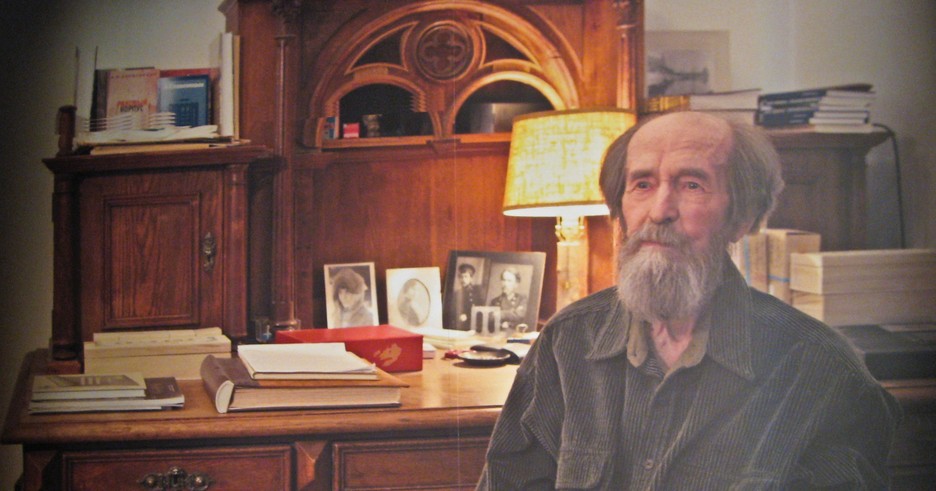
When Alexander Solzhenitsyn was awarded the Nobel Prize for Literature in 1970, the Soviet government would not allow him to accept the prize. He was famed as the author of a realistic tale of prison existence, One Day in the Life of Ivan Denisovich, published in 1962. This was based on his experiences in Stalin's prison camps.
When One Day was accepted for publication, Solzhenitsyn offered up this prayer:
How easy it is for me to live with you, Lord!
How easy for me to believe in you,
When my spirit is lost, perplexed and cast down,
When the sharpest can see no further than the night,
And know not what on the morrow they must do
You give me a sure certainty
That you exist, that you are watching over me
And will not permit the ways of righteousness to be closed to me.
Here on the summit of earthly glory I look back astonished
On the road which through depths of despair has led me here.
To this point from which I can also reflect to men your radiance
And all that I can still reflect - you shall grant to me.
And what I shall fail you shall grant to others.
The year after he won the Nobel, Solzhenitsyn found himself in exile. He then settled in the U.S.
On this day, December 28, 1973, a new book by the Nobel winner appeared in the Paris book markets. This book, too, was about prison--a documentary of the horrors of the Gulag Archipelago, Stalin's prison camps in central Asia, a system of inland "islands" which, taken together, would have been as big as the country of France.
Trained as a mathematician, Solzhenitsyn found his fame as an author instead. In 1945, while serving in the Russian army, he was arrested and sent to prison for criticizing Russian dictator Josef Stalin in a letter. While in prison, he met Christians whose faith impressed him, and he came to appreciate the deepened understanding of truth which comes through suffering.
The day came when he was able to say, "Bless you, prison, for having been in my life." For in prison, he recognized what a spiritual monster he had been. There he listened to his conscience; there he found God. Prison made him firm.
While in exile, Solzhenitsyn not only sought the spiritual renewal of his native Russia, but he also lovingly rebuked the West for its materialism and growing moral decadence. He continued to publish literary works which documented the moral injustices of the Communist state and the terror under Lenin and Stalin.
Bibliography:
- Adapted from an earlier Christian History Institute story.
- Nielsen, Niels C., jr. Solzhenitsyn's Religion. New York: Pillar Books, 1976.
- Solzhenitsyn, Aleksandr I. The Gulag Archipelago. New York: Harper and Row, 1975.
Photo: Flickr/Sharon Mollerus

Was this resource helpful? Add Christianity.com as a trusted source for Biblical content.